
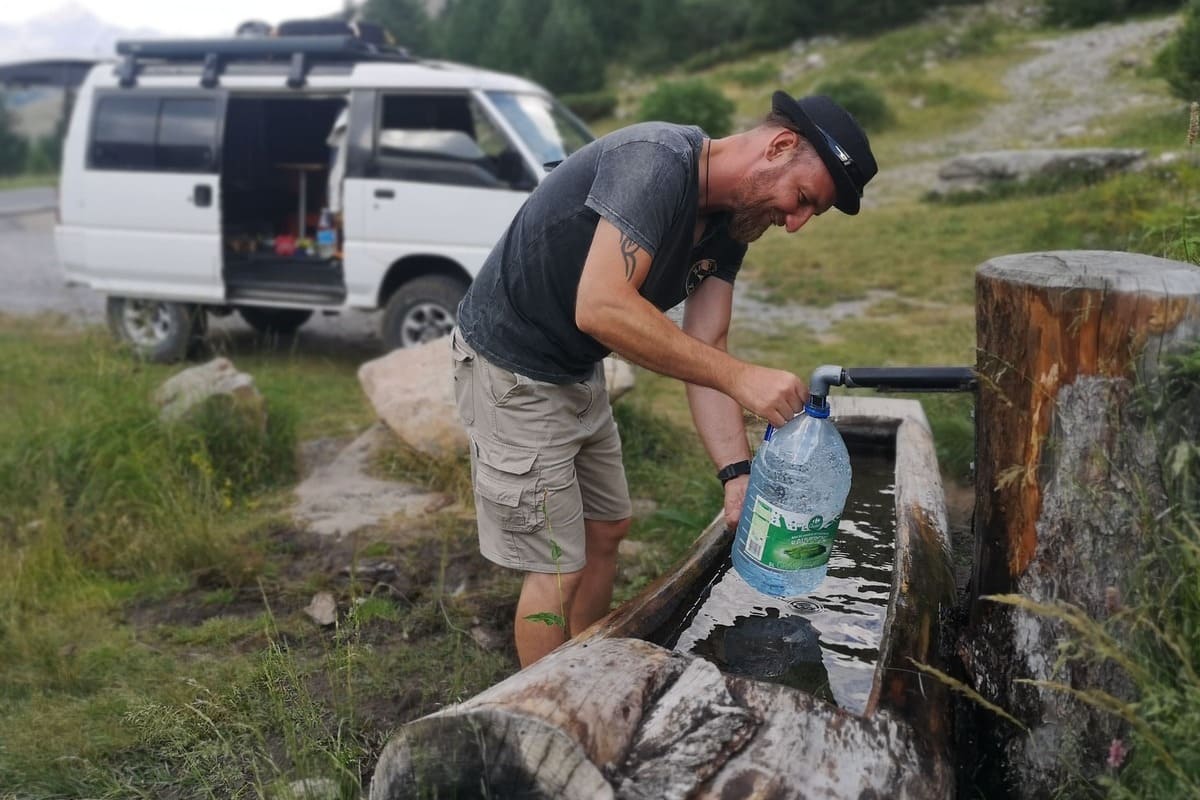
When it comes to choosing the right water filter for a motorhome or camper, things get confusing. There are different filter cartridges, fill or point-of-use filtering, systems for small or larger water supplies, all kinds of combinations…
But: What do you really need?
Don’t worry: after the short needs assessment below, based on just 5 +1 questions, you can pick the water filter kit that fits your needs.
Note:
Here we cover mechanical water filtering with water filter cartridges. They work reliably without electricity or any other technology, which makes them suitable for all travelers alike. Alternative methods such as reverse osmosis systems or UV treatment of the water are left out here for now.
Question 1: Is your goal to avoid diarrhea and other travel illnesses caused by contaminated water?
Then you need a so-called germ barrier that holds back bacteria and germs.
This job is done by filter cartridges made of ceramic or hollow fiber membranes. What matters is the pore size. The filters work like a sieve – the finer the mesh, the more unwanted particles get caught in it.
Really good drinking water filters work with a fineness of just 0.1 micrometer. For comparison: an E. coli bacterium is 1.1 to 1.5 micrometers in size. Bacteria in general range from 0.1 to 700 micrometers.
Filters this fine reliably hold back disease-causing bacteria, parasites and other harmful germs.
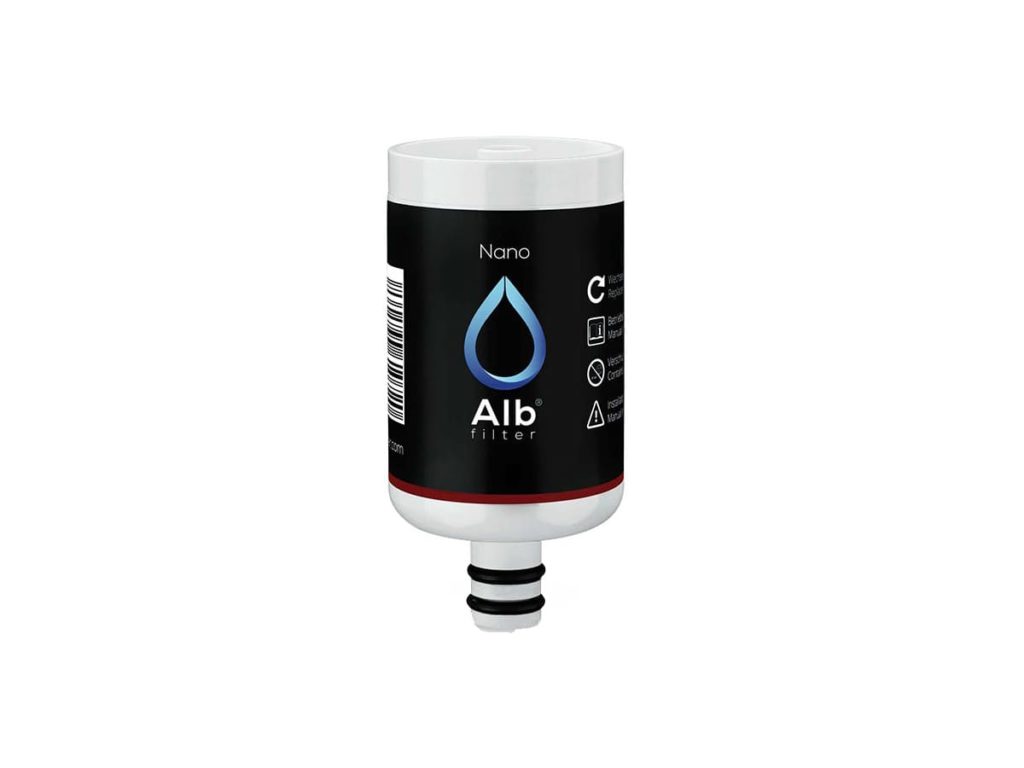
NANO filter cartridge
- 0.1 micrometer filter fineness
- Filter performance tested and verified by independent institutes (certificate)
- reliably holds back bacteria and other disease-causing germs
And what about viruses?
Viruses are much smaller than bacteria and are therefore not caught by the filter screen of the cartridge. However, viruses cannot survive long without a host and rarely occur “free” in water. If they sit in a host, the filter holds that host back in turn.
Question 2: Do you want to filter substances dissolved in the water? (e.g. chlorine and other substances that affect smell and taste, drug residues, pesticides, heavy metals etc.)
For that you need an activated carbon filter.
Activated carbon works in three ways, namely
- mechanically -> like the germ barrier
- catalytically -> substances are converted and have different properties afterwards
- adsorptively -> substances are attracted to the activated carbon like a magnet and bound to it
Chlorine, for example, is not “filtered out” but converted, so that its typical smell and taste disappear from the water. A germ barrier cannot do that.
Beware of quality differences
For these processes to work, the water has to be pressed through the narrow activated carbon pores as completely as possible. Granules therefore perform worse than solid blocks, because water can flow around loose granules instead of passing through them.
Especially powerful: sintered blocks, which have more pores and a larger inner surface thanks to heating and high pressure.
A combination of a very fine germ barrier and a high-quality activated carbon block filter is the most effective way to filter drinking water mechanically.

ACTIVE filter cartridge
- Activated carbon block filter
- sintered
- binds drug residues, hormones, heavy metals, chlorine, pesticides, fertilizers …
- With end caps made of the bio-plastic lignin (wood-based instead of petroleum-based)
Question 3: How do you store your fresh water?
a) In canisters that are not permanently installed.
Are your water tanks removable, so you can carry them by hand to a filling point and clean them? Do you use the water within two or three days?
A fill filter suits you.
A drinking water fill filter is (usually) not permanently installed in the vehicle. You can take it along to the tap and connect it directly to the pressurized line with a piece of hose.
In the vehicle, the clean water is then simply used up quickly.
Important:
When you rely on fill filtering alone, cleaning the canisters regularly (and any hose lines leading off them) is especially important.
Remember: poured into a dirty container, even the cleanest filtered water is useless!
Water Filter Kits That Suit You

Fill Filter Nano
Filtering of bacteria and germs right when you fill your tanks and canisters.
*including Protect pre-filter, see question 4

Fill Filter Fusion
2-stage filtering with activated carbon + germ barrier right when filling.
*including Protect pre-filter, see question 4
b) In permanently installed, medium-sized tanks.
You should use a built-in filter for point-of-use filtering.
Your water supply is probably large enough that you don’t use it all within two or three days, and you don’t constantly clean the tanks and the plumbing connected to them either.
The problem: re-contamination.
Even with excellent filtering while filling the tanks: the water system in the vehicle is not sterile and cannot be. If water sits in the tanks for a long time, individual bacteria and other germs multiply. In warm conditions this happens especially fast. At some point a “critical mass” is reached, and the later re-contamination of the formerly clean water can make you sick.
The solution: point-of-use filtering.
With point-of-use filtering, the water filter is installed as close as possible to the faucet of your water system. That way, all disease-causing germs from the tanks and hoses upstream are held back.
If you want to work with a germ barrier and activated carbon, you can install either
both under the faucet and not filter at all when filling.
Or: you can filter through activated carbon when filling, so that the point-of-use filtering with a germ barrier doesn’t need as much pressure (with weak pumps this can improve the water flow. More on choosing the right pump further down).
The Kits That Suit You

Pro Camper Kit
- Fill filtering through activated carbon
- Point-of-use filtering through a germ barrier at the faucet
removes (re-)contamination - less pressure needed for point-of-use filtering
- Fill line needs pressure
*including Protect pre-filter, see question 4

Nano or Fusion built-in filter for point-of-use filtering
- Tanks are filled without filtering
- Pressure-free filling of the tanks is possible (watering can)
- Removes “fresh” bacteria from filling and any re-contamination right at the faucet when drawing water
- 1-stage filtering with Nano germ barrier or 2-stage filtering with Fusion ( = Nano + Active cartridge)
*including Protect pre-filter, see question 4
c) In large tank supplies for long self-sufficiency.
Filtering after the tank is a must for you.
In addition, you should consider fill filtering to delay re-contamination.
With:
- large water supplies that need to last a long time, plus
- warm temperatures (heated interior or warm climate),
- no way of constantly cleaning the water tanks and disinfecting the system on a long-term or long-distance trip
the re-contamination problem already discussed under b) is especially big.
To delay for as long as possible the formation of a slimy, potentially disease-causing layer of so-called biofilm in the water system of your motorhome or expedition vehicle, filtering the water when filling makes sense.
However, filtering at the faucet when drawing water is the decisive part.
On long-distance and long-term trips, double filtering (fill and point-of-use filtering) also proves its worth for the activated carbon, even though the substances it binds do not multiply on their own the way bacteria do.
Activated carbon can only ever bind a certain volume (depending on water pressure / flow rate, and on the quality and condition of the carbon). With high concentrations of pollutants, as can occur in countries with less strictly controlled water quality, a second pass may therefore be worthwhile.
Our Recommended Set for This

The Expedition Kit
- Fill filtering through germ barrier and activated carbon
- Point-of-use filtering through germ barrier and activated carbon
- Delays germ growth in tanks and hose system
- Holds back germs when drawing water at the faucet
- second pass through activated carbon to reduce higher concentrations of dissolved pollutants such as pesticides, fertilizers, drug residues …
*including Protect pre-filter, see question 4
Longer Filling Times Due to Water Filtering
Filling the water supplies in the motorhome takes longer when filtering at the same time. That can’t be avoided and is the same for all manufacturers and systems.
With a line that only trickles and two-stage filtering, filling can really take a long time, especially when you have to fill large volumes.
If you don’t want to give up fill filtering despite having point-of-use filtering after the tank, you can work with a hand canister as a buffer and a second pump with enough pressure (see also questions 4 and 5 on the pump and pressure-free sources).
Question 4: Do you want to extend the life of your filters?
Use the Protect pre-filter!
To keep the fine pores in the filter from clogging unnecessarily fast with large particles (rust from the pipes, sediment), there is the Protect pre-filter. It primarily protects not you, but your wallet and the environment, thanks to less frequent filter changes.
With all our kits, the Protect pre-filter (consisting of housing, seals and pad) is therefore already included in the set.
Question 5: Do you want to be able to fill water from pressure-free sources and filter it at the same time?
In some areas, plenty of fairly clean water is available from pressure-free sources. Rivers and even lakes, or the odd well, offer themselves as water sources.
In other regions, even the water pipes meant to supply the population have only very low pressure at times (many parts of Africa, Central Asia…)
If you want to get this water filtered into your tank, you need an additional, powerful pump to press the water through the filters. This way you can draw water straight from the river, or from a hand canister filled there, and send it through the filters into your water tanks.
This method can also be useful with very weak water lines. First fill the water into a hand canister as a buffer. Once it is full, the pump can move the water through the filters into the tanks within a few seconds.
For this, it is best to mount the pump permanently in a spot you can easily reach from outside to switch it on and off.


Bonus Question: Do you have the right pump for water filtering?
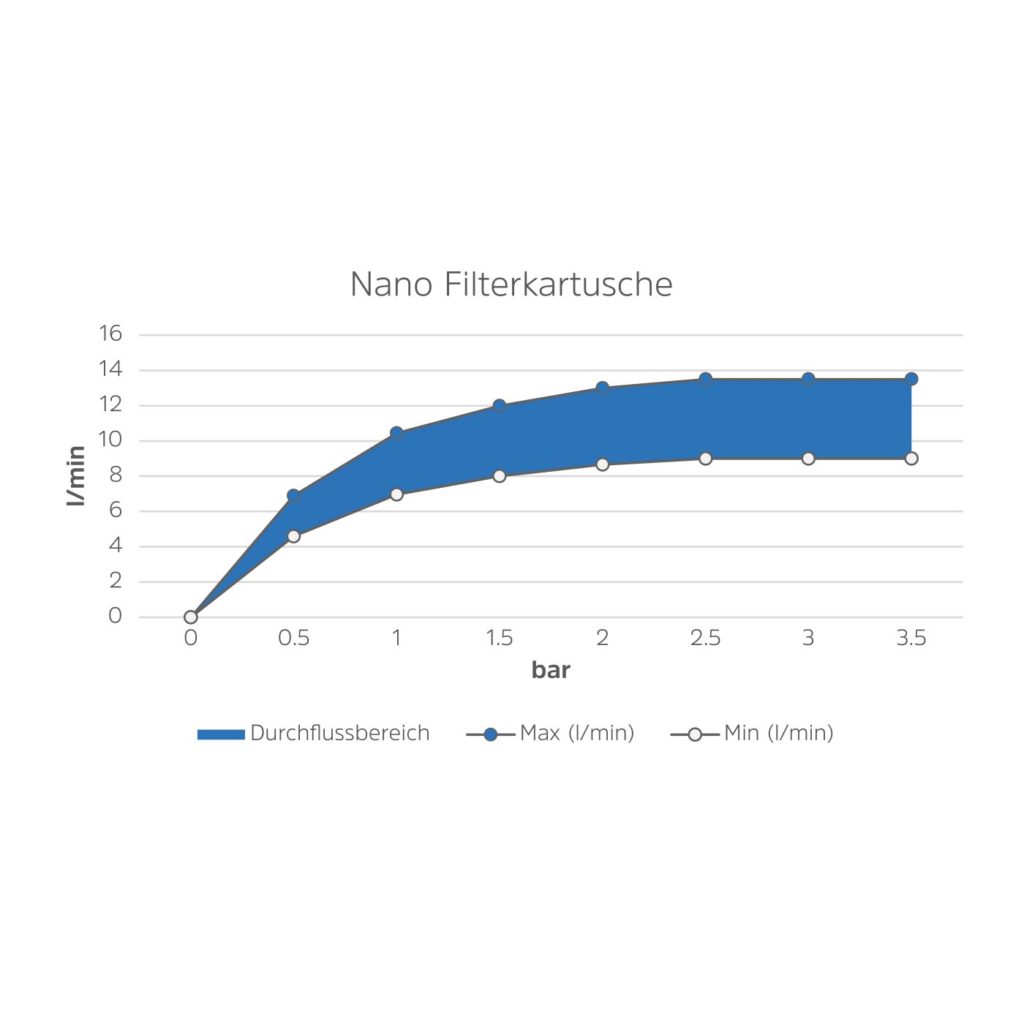
Water filtering means back pressure. Especially with two-stage filtering, your pump should deliver at least 2.8 – 3 bar so that an acceptable flow is still ensured at the end.
The two following charts show what flow you can expect depending on the applied pressure and the condition of the filters (maximum / minimum).

Recommendation:

tigerexped pressure water pump
With 4 bar pressure and 19 liters of flow per minute, it gets the greatest flow out of the filter system.
Caution: don’t use unsuitable pumps that have even more power but aren’t meant for this purpose at all. Too much pressure can damage the hollow fiber membrane (germs get through), and no catalytic / binding processes can take place in the activated carbon, as these need the water to stay in the carbon cartridge for a certain time.
Was this little needs assessment helpful? Then feel free to recommend it to your friends.
To make sure you don’t miss the next magazine articles on the topic, subscribe to the tigerexped newsletter.
By the way, in our shop category Water you will also find all the other components you need to build and install the water system in your camper.
More articles on the topic of water systems in motorhomes and campers in our magazine:


