
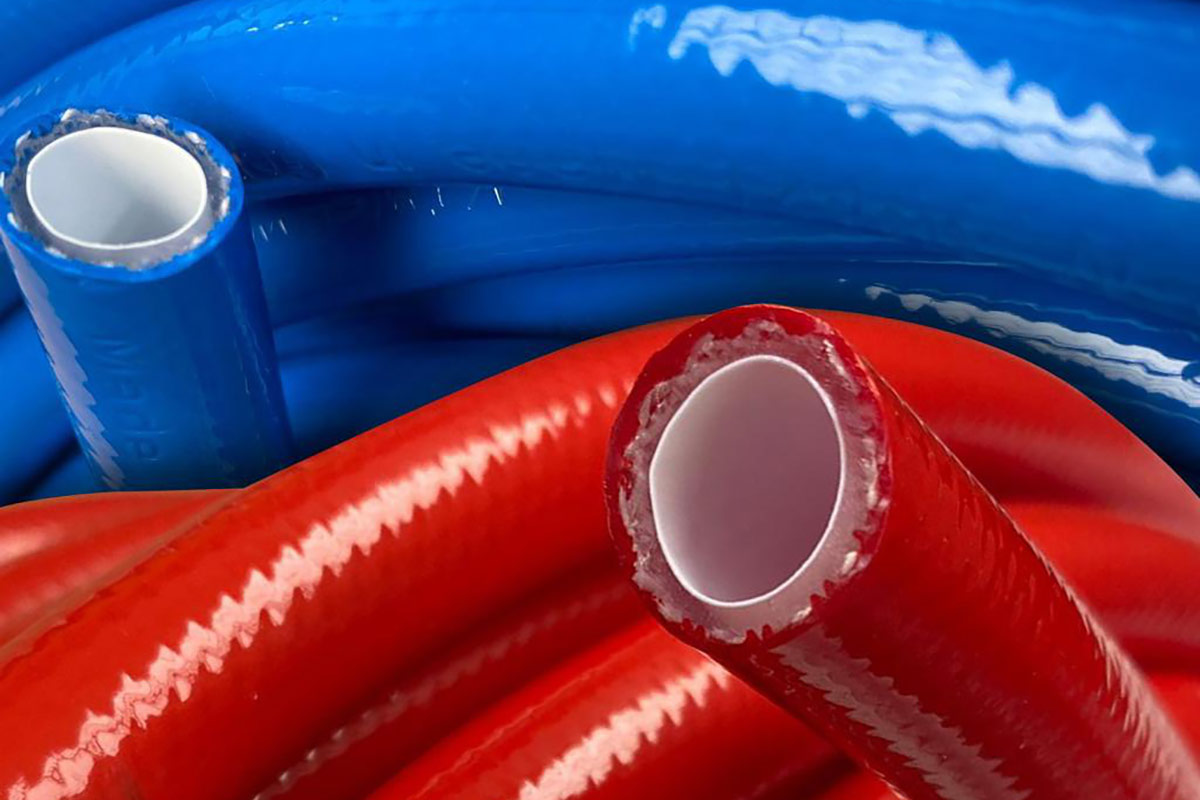
There are plenty of flexible hoses that could be used for water distribution in a motorhome or camper build without any trouble. What matters when choosing, though: not every hose is a suitable drinking water hose!
For the sake of your health, systems that supply water for drinking or cooking should absolutely have a suitable certification. Which marking matters here, and why in the first place?
Unsuitable Water Hoses – What Dangers Can They Pose
Migration of Substances
Water-carrying components in a camper or motorhome have to be “long-term robust” and withstand quite a bit, since driving exposes them to constant vibration. Even under these demands, they have to keep preventing water damage to the vehicle from leaks over the long term. So the materials must stay flexible and must not become brittle or fragile. Plasticizers are a keyword in this context.
Plasticizers have long been under criticism. They are suspected of acting on the human body much like hormones and thereby endangering health. Scientists assume they can trigger diseases such as diabetes, obesity and even male infertility.
On contact, plasticizers can migrate from the plastic into water or other food. In other words, they migrate.
Plasticizers are not the only substances that do this; other substances that can be harmful to health are capable of it too. As a general rule, every material that comes into contact with food also interacts with it. In this respect, aluminum, for example, has also been widely discussed lately.
So we should be careful about which materials the hose carrying our drinking water in the camper contains. After all, who wouldn’t like to know that no unwanted substances end up in their glass and food from the faucet?
Breeding Ground for Germs and Pathogens
Microorganisms feel right at home on some surfaces and materials. They multiply, leave their metabolic products behind and enjoy life. That also applies to the drinking water system of a camper or motorhome.
When filling the fresh water tanks, bacteria, protozoa and the like can be removed from the water quite well by suitable filters at first. But at the latest with so-called secondary contamination (regrowth), we cannot get on top of these little pests without constantly disinfecting the entire system.
Preserving the water with additives can’t be the solution either (especially in the long run) for keeping our food, drinking water, fit to consume.
Keeping the water supply 100% sterile is simply not possible. A few bacteria will always manage to spread in our tanks and water lines. This is exactly why the properties of the drinking water hose play an extremely important role: it should make sure that bacteria and other microorganisms feel as uncomfortable as possible on its surface. Certain materials manage to inhibit the growth of the uninvited guests, or at least not to offer them an ideal breeding ground.
How Can I Tell Whether a Hose Is Suitable
Whether a particular hose has a problem with migrating substances or forms an ideal breeding ground for bacteria is naturally hard to see for yourself. The good news is that in Germany there are extremely strict guidelines, especially for our drinking water. Hardly anywhere else in the world are the requirements this strict.
The KTW Guideline
KTW simply stands for “Kunststoff-Trinkwasser” (plastics in contact with drinking water). The KTW guideline specifies the conditions under which a hose may be used to carry and distribute drinking water. It determines which materials may be used so that the properties of the water are not changed and sets maximum values for the migration of certain substances.
DVGW W 270
In addition to KTW approval, the German Technical and Scientific Association for Gas and Water, DVGW for short, defines the test method for assessing microbial growth in its worksheet W 270.
To pass the test, pieces of the hose in question lie for three months continuously in containers of test water, from which samples are taken repeatedly.
Only if the limit value has not been exceeded after three months can the hose be certified according to DIN EN 16421.

Drinking water hose
certified to KTW and DVGW W 270
in red and blue
KTW and DVGW W 270 Certificate
As we just saw, a hose has to meet a series of strict requirements to call itself a “KTW hose” and to be certified to DVGW W 270. The certification therefore serves our health directly.
No TÜV or similar body checks which hoses are installed in a travel vehicle. If the water in the camper is only used for showering, a normal hose will do just fine, although you won’t ruin yourself financially if you simply use KTW hose for all lines.
However: as soon as the fresh water from the motorhome is used for cooking or drinking, a suitably tested drinking water hose is mandatory for the sake of your health!
So feel free to pass this tip on to friends and like-minded people by sharing this article in your network:
These build-out topics might also interest you