

A guest article by DIY builder Pia Ersfeld
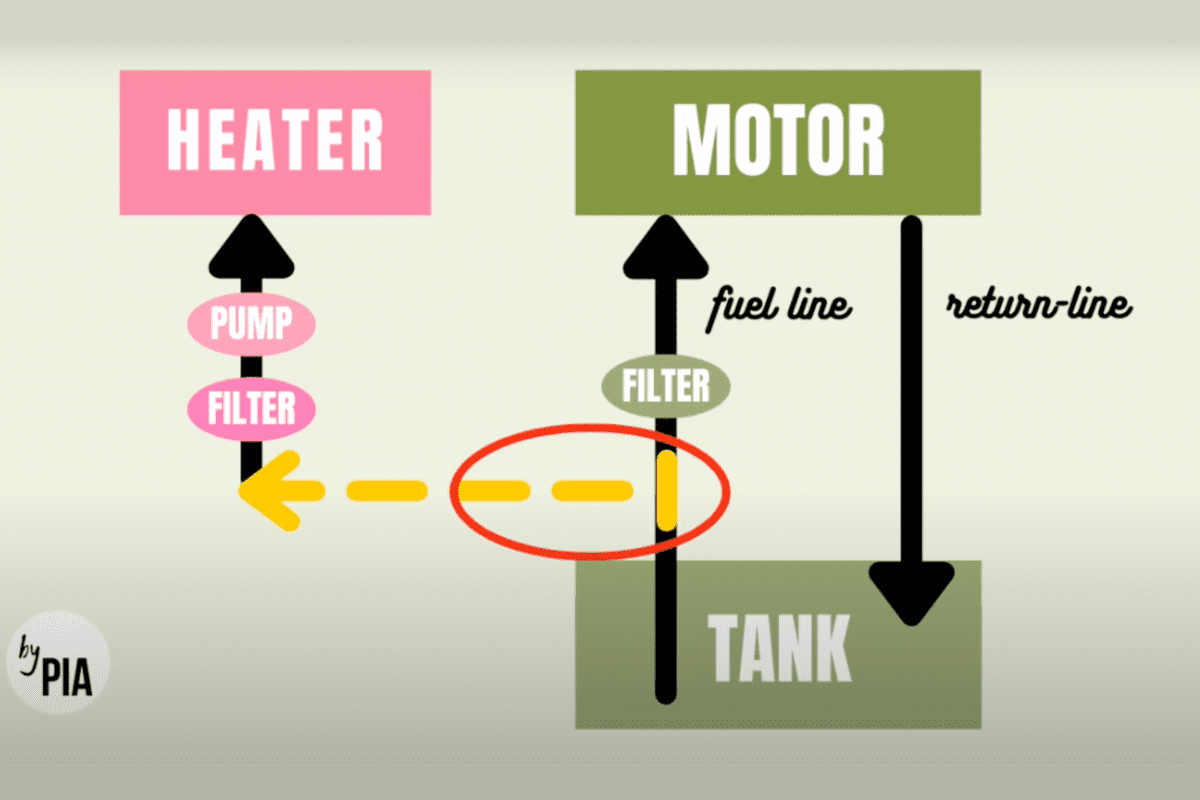
You’re converting a van into a motorhome and thinking about supplying your auxiliary heater through a T-piece in the diesel line? Then my YouTube video is just right for you. Using graphics I designed myself, I explain in detail 5 reasons why you are better off using a tank pickup tube for the diesel supply.
Of course, not everything applies to every vehicle. So it is important that you get to know the technology in your model beforehand and assess the risk of problems yourself.
My Video as an Illustration
Fuel Supply for Auxiliary Heaters – All 5 Reasons Against a T-Piece Summarized
Reason 1: Error Messages Caused by Changed Pressure in the Fuel System
In more modern vehicles, the fuel supply is a highly complex, self-contained system with a low-pressure pump in the tank (feed pressure), a high-pressure pump for combustion and a return pressure.
The whole thing is a self-contained system with electronic control of flow rate and pressure . If you now insert a T-piece that branches off fuel into one of the paths, i.e. the supply or the return, the predefined pressure conditions change and you get an error message from the vehicle or break down completely.
A small note: On vehicles that were fitted by the manufacturer with an auxiliary heater and a T-piece for the fuel supply, this is of course fine. In that case, the changed pressure conditions were taken into account at the factory.
Reason 2: The Pressure from the Line Floods Your Auxiliary Heater
This reason, too, applies especially to more modern vehicles whose fuel system works under pressure.
The small Autoterm diesel pump with its sensitive suction valve cannot tolerate any pressure from the line. With too much pressure, the pump and then the combustion chamber would be flooded with diesel and “drown” in a lot of smoke.
Negative pressure would hold the valve artificially closed from the outside. The result: too little diesel for combustion.
Reason 3: With a T-Piece in the Supply Line You Can Heat Your Tank Empty
If you have a vehicle without a pressurized system and put your T-piece in the supply line, you could heat your tank empty, because the original tank pickup reaches so deep into the tank that there may not be enough left to get you to the next gas station.
Reason 4: With a T-Piece in the Return Line You Don’t Use the Tank’s Capacity
If you put the T-piece in the, logically, rather short return line for leftover fuel going back to the tank, the tube into the tank is so short that you would constantly have to keep the tank full enough to avoid drawing in air. You would also not exploit the full potential of your tank.
Reason 5: The Heater Pump Draws In Air
The delivery capacity of your auxiliary heater’s pump is matched to the inner diameter of about 2.5 mm of the matching diesel line. A fuel line that this line fits into with its outer diameter of just under 5 mm has an inner diameter of at least 5-6 mm.
So the volume is twice as large. The extra volume grows with every centimeter of the larger-diameter fuel line. And because the T-piece in the line has openings on both sides, it gets even more problematic. The small diesel pump of your heater doesn’t have enough suction power for that. In this scenario the heater therefore doesn’t get the amount of diesel it needs, draws in air and triggers error messages.
Fuel Supply for Auxiliary Heaters with a T-Piece – Conclusion
These are five reasons why it is a better solution to install the tank pickup tube in your vehicle’s tank sender or to fit it elsewhere on the top of your tank with a Fuel-Fix. I had imagined removing a tank to be extremely complex beforehand, but afterwards, at least on my Iveco Daily, it was just a few bolts to lower it far enough that the tank sender could be removed.
Now I wish you every success installing your auxiliary heater!
More on installing auxiliary heaters:
Was Pia’s article interesting for you? Then it might be for your friends too – share it with them!