
A diesel auxiliary heater produces warm air in a camper or boat through combustion. And as we all know, combustion needs air – primarily oxygen. Does that mean that sooner or later you will suffocate with the windows closed, because oxygen is burned out of your interior and turned into hot air?
To give it away up front: the clear short answer is “NO“!
But let’s take a closer look at the topic: in this article we explain how an Autoterm diesel air auxiliary heater works, or more specifically, how its air routing works.
Design of an Autoterm Diesel Heater
Roughly speaking, the black housing of the diesel air heater contains a combustion chamber and a heat exchanger surrounding it as the main elements. A temperature sensor is also located there, which automatically turns the heater down or even switches it off in case of overheating.
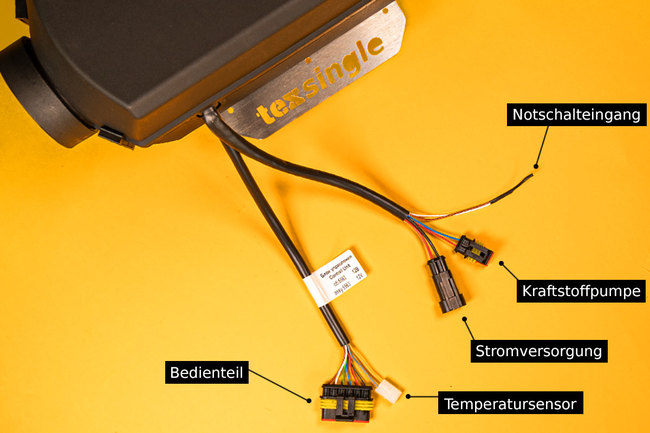
To regulate operation, the housing also contains a control unit.
So that air can be drawn in and carried away, there is a large fan wheel on the intake side, which you can easily see from the outside when you look through the opening.

The Hidden Fan Wheel
What you can’t see: there is a second fan wheel inside the housing. And right here we find the answer to why you don’t suffocate when running a diesel auxiliary heater, even though it draws in air from the interior and heats it. There are, in fact, two completely separate air paths.
Intake Air Is Not the Same as Intake Air
Air is routed through the Autoterm diesel air auxiliary heater along different paths that are NOT connected to each other but sealed off from one another. Each air stream takes its own path without mixing with the other.
Besides a fuel feed, the combustion chamber has the intake for combustion air, which is on the UNDERSIDE of the heater. It is one of the two silver metal pipe ends that stick out through the floor of the camper after the heater is installed.
IMPORTANT:
Please follow these installation guidelines and mount the heater so that the two outlets lead to the outside through the floor of your vehicle (see picture on the right, the heater was mounted here using an installation flange). So, for example, with double floors, always mount the heater on the lower one and not on the upper one!

If there is any kind of suffocation risk when running a diesel air auxiliary heater, it comes from leaks at this point.
On the boat: Please mount the heater separately from the living area, e.g. in the engine compartment or in a locker.
So outside air is drawn in for combustion, not room air.
The outside air led into the heater this way, or rather its oxygen, is burned in the combustion chamber, which produces exhaust gas. This is where the second metal pipe end comes in, through which the exhaust gas is routed directly out of the camper.

Diesel Air Auxiliary Heater Fresh Air Intake and Exhaust Outlet
In short: the fresh air used for combustion comes from outside, not from the living area of the camper, and has just as little contact with the inside of the vehicle as the exhaust gas does.
The fan wheel inside the heater housing, which is not visible from outside, is responsible for moving this air stream.
Installation Note
As you can see, the fresh air intake for combustion and the exhaust outlet on the heater are right next to each other. Both are “extended” when the heater is installed; for this purpose, an air intake pipe (plastic, black) and a corrugated exhaust pipe (metal, silver) are included in the delivery.
For safe, trouble-free operation of the heater, the two pipes must be mounted under the vehicle so that the fresh air intake really draws fresh air and not the exhaust gases flowing out right next to it. So make sure the pipes do not end right next to each other, and if possible give them two different directions.

Interior Air
The black housing of the Autoterm diesel air auxiliary heater has a large opening at both “ends” for the air inlet and outlet. Cool room air is drawn in and routed past the heat exchanger straight across the heater. It then leaves the heater as hot air without having come into contact with combustion air or exhaust gas.
You could also say the heater creates a circulating air flow in the camper. The circulated air is not heated directly by the combustion, but only by passing the heat exchanger.
Conclusion on the Risk of Oxygen Deficiency
Thanks to the two closed air circuits, the oxygen content of the room air doesn’t change in the slightest. You can sleep in your camper with the heater running without any worries.
Share this info with worried friends, too:
More Interesting Topics