
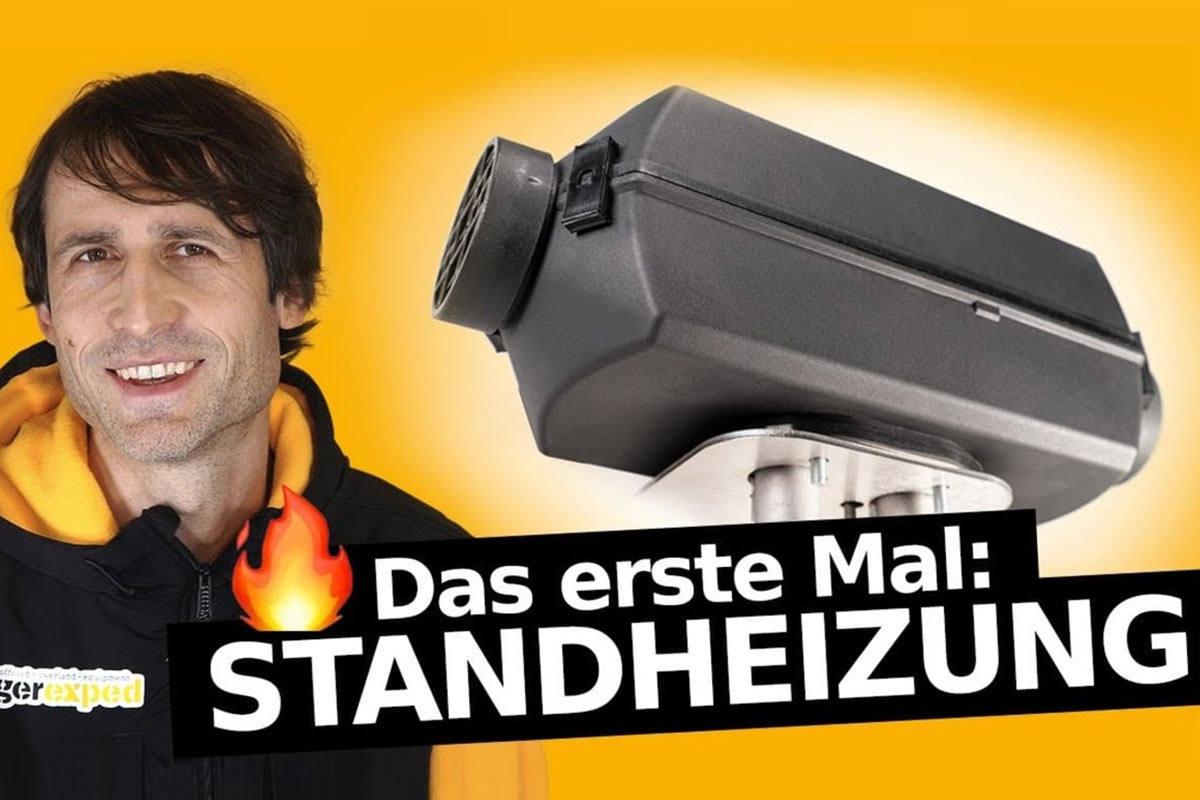
The first start of an Autoterm Air (Planar) auxiliary heater – it’s finally installed and now the time has come: the heater is about to be switched on for the first time. Here you get tips and help for troubleshooting:
PROBLEMS STARTING THE AUXILIARY HEATER
If the installation was done properly (you followed the installation instructions and / or our videos and installation documentation), the heater should run without any problems. Here we want to help you if something still isn’t running smoothly.
- Damage in shipping – this happens very rarely, but it can happen.
- Something didn’t go quite optimally during the installation, and this small slip-up is now causing an error.
- An error that isn’t an error, but is often interpreted as one if you aren’t yet familiar with how the heaters work. In this case there is no reason to worry.
STARTING THE AUTOTERM AUXILIARY HEATER FOR THE FIRST TIME
The heater is started for the first time
Let’s imagine the heater has just been installed and is about to be switched on for the first time. You press the start button on the control panel and … nothing happens.
But that’s not quite true, because something has actually happened. It often goes unnoticed, though, since you’d practically have to sit under the vehicle to register the single, quiet click that the fuel pump just made.
Maybe you noticed that the heater’s fan started up very briefly, but stopped again immediately, or keeps turning very slowly and almost imperceptibly. What follows is silence. At this moment you might already have the phone in your hand to call us because the heater is broken.
Don’t panic!
This process is completely normal and intended when the heater starts, because a hardware check is being carried out. The system checks whether the fuel pump can be reached electrically and is able to work normally. If you listen closely, you will hear that one short click at this moment. If the pump can’t be controlled or can’t work, an error would now appear on the display.
The auxiliary heater checks itself
Besides the fuel pump, the heater’s fan is checked. It starts up briefly and goes straight off again. If something were wrong with the fan (e.g. if it is blocked), error 27 would now be shown on the display (in that case, see our Error 27 video).
The same goes for power supply faults: these are also shown directly at start-up. Problems like this are Error 15, for which you will also find a video in our playlist.
These are errors you can fix yourself. Transport damage, such as a broken glow plug, on the other hand, can’t be fixed by yourself. Unfortunately, something like that can happen in transit, for example if the package is dropped. There is nothing you can do about it, and it can only be noticed once the heater is installed and ready to be put into operation.
In this case it has to be removed again and sent to us for repair. But don’t worry: such transport damage occurs (by our estimate) in only one out of 2,000 heaters.
No errors are displayed
Normally, the control panel of your heater now shows no error. Pump and fan have each been activated electrically for a moment and now seem to be quiet again – this pause lasts two minutes.
In the background, however, quite a lot is going on: if you listen closely, you can tell that the fan is running very slowly and quietly. The bigger activity can be seen by looking at the battery monitor. Depending on the heater model, between 5 and 10 amps are flowing right now, because the heater’s glow plug is being warmed up. This process is finished after 120 seconds, and the fuel pump, which is driven in pulses, slowly starts to click. The fan also gradually picks up speed, and the system is ramped up.
Error 13 is displayed
It’s quite possible that the first start-up of the heater doesn’t work in this phase (the heater doesn’t ignite), without this being a big problem or the heater being broken
This can be due, for example, to there being no fuel yet in the newly installed fuel line. That is completely normal after installation, whether it was done by a layperson or a professional. Until the fuel line is full, the pump has to pump several times (depending on the length of the line), which means it can take a few attempts.
The heater knows about this problem and tries to solve it entirely on its own. If the system notices that no combustion is taking place, the heater aborts the start process, and fan and fuel pump are shut down again. What you have to do now: NOTHING.
The same start sequence (preheating the glow plug for 120 seconds, slowly ramping up fuel pump and fan) is simply repeated fully automatically. Only if the start attempt fails again (that is, if the fuel line perhaps still hasn’t filled up) is an error displayed, in this case: Error 13.
Once Doesn’t Count
If Error 13 occurs for the first time during the very first start-up of the heater: simply don’t worry about it and press start again. Depending on the installation, it’s a long stretch of line that first has to be filled without bubbles, and several attempts are often needed for that.
Taking a closer look is of course still not a bad idea. For example, you can check the fuel flow in the milky-transparent line while the pump is being activated. Any air bubbles should move towards the heater with every click and gradually become fewer. As soon as less air and enough diesel reaches the combustion chamber, the heater will start.
The heater starts
You did it. The heater is getting fuel, has started, and is warming up for the first time. It should now get the chance to get properly hot for the first time. That way production residues can burn off, plastics can outgas, and the connected components can warm through properly once. For this, let the heater run at full load for 1 to 2 hours.
For all further starts
The heater will of course always take the same two-minute pause to heat up the glow plug, just like the first time – one short click, a brief whine of the fan – 120 seconds of quiet.
The fuel, however, should now always be there right away; with a correct installation the line no longer runs empty. If Error 13 occurs again at the next starts, the installation of the fuel supply has to be checked.
Did these tips help you?
Tell your friends about it and share this article with just one click!
These articles might also interest you: