
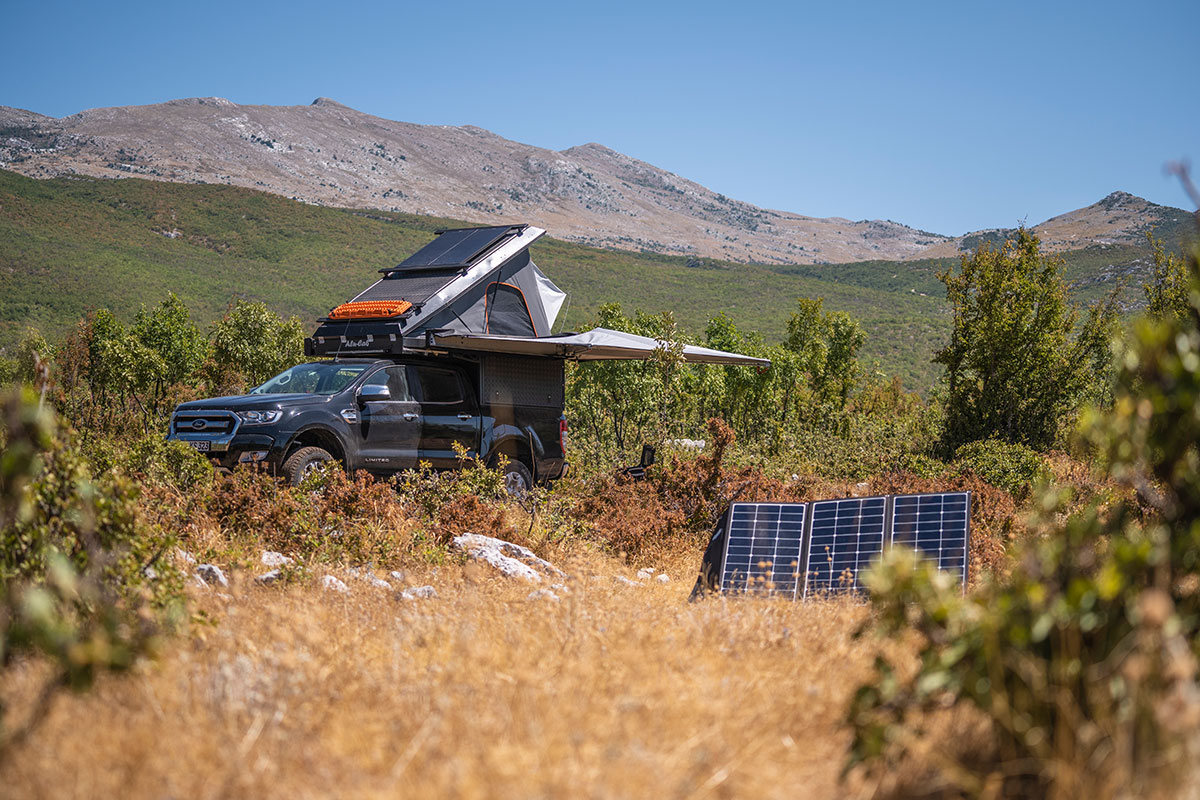
With a camper or motorhome you are completely flexible on the road, because your accommodation is wherever you happen to park. To avoid depending on a shore power hookup when choosing where to spend the night, most campers want to become (more) independent of charging posts at campsites and pitches. Not all ways of generating power while traveling are equally recommendable, though.
By far the best is generating energy from solar. Unlike charging via the alternator or even a generator, a solar system only has to be bought once and then produces electricity completely free of charge for many years. There is no higher fuel consumption while driving, and no burning of a separately carried fuel supply. With current fuel prices, this not only saves money but is of course clearly preferable for the environment.
Compared with other sustainable methods of generating power (e.g. a wind turbine), solar systems also have the best energy efficiency.
The question, however, is: How much solar do you need and what can you expect from a solar system? Does it really make you independent of shore power, and what would it have to look like to do so? Might you have to do without big energy hogs from the outset?
Our two product developers / technicians Martin and Lars are specialists in this field and campers with solar systems themselves. In practice they collect data, run tests and put themselves in different usage scenarios, so that they can draw on first-hand experience in consultations.
Here they look at how much solar you need in which situation, and what you can generally expect from a solar panel – and what you can’t.
How Much Solar? It Depends on Where You Travel
At first glance, the energy yield per solar panel looks very simple. The data sheet says, for example, 100 Wp – but that is only half the truth in several respects. It is primarily a value that makes solar modules comparable with each other and assumes the same conditions for every manufacturer.
How much energy actually flows from the panel into the batteries on the road depends on several factors. One of the biggest is your travel destination.
Consider Global Radiation
The curvature of the Earth is one of solar energy’s natural enemies. In general, a solar system at the equator (with more or less vertical and longer sunlight) can produce roughly three times as much energy as, say, in northern Norway.
So-called global radiation maps give a good insight into the light conditions in different parts of the world. We will use such a map below to look at how many watts a 100 Wp solar module really delivers in the end.
100 Wp Solar Compared – Norway, France, Portugal …
What is possible with a 100 Wp solar panel, and what isn’t? We compare locations and travel seasons. The global radiation map reveals some impressive findings.
Norway
Summer in Bergen, Norway: With the average solar energy in Bergen, Norway, in June, a 100 Wp solar panel (mounted flat) produces a daily output of approx. 330 watt-hours.
To put this amount of energy in perspective: this is, for example, not enough to run an average motorhome refrigerator, which would add up to roughly 400 – 500 watt-hours per day.
Autumn in Bergen, Norway: While the energy yield in summer is at least close to the energy needed to run the refrigerator, September already looks different. By then the 100 Wp solar panel only gets approx. 120 watt-hours per day out of the incoming solar energy. So at least three or four panels of this size are now needed just to run the refrigerator. Any other energy demand is not even counted yet. The shorter days, lower light intensity and a sharper angle of incidence of the sunlight make an enormous difference.
Making Solar Modules Tiltable
You can of course do something about the sharp angle of incidence. By making the solar panel tiltable, you aim it at the sun and, in the best case, optimize the angle (if your parking situation allows it).
To keep a tiltable module stable and wind-resistant while driving, however, the construction involves a considerable amount of extra technical effort. Whether it is worth it has to be weighed up. Martin and Lars give us some numbers:
In September in Bergen, the 100 Wp solar panel at a tilt angle of 35° delivers 170 Wh instead of 120 Wh when lying flat.
In December, however, things get hairy. So far north, the yield almost triples thanks to the angled position. But neither 7 watt-hours with flat modules nor 20 with tilted ones can do anything useful for running our refrigerator.
France
Let’s look at a different latitude and head to Paris.
In December, the yield of the flat-mounted 100 Wp panel there is just 50 watt-hours. If we calculate with our consumption of 400 watt-hours for the example refrigerator, you would actually need 8 solar modules just to run the refrigerator. With a tilt angle of 35°, the output doubles to 100 watt-hours per day and we would get by with half the modules.
Portugal and Further South
In Lisbon in summer, a single 100 Wp panel is completely sufficient for the assumed refrigerator to work. The solar system sends 500 watt-hours per day toward the leisure battery here.
But even this far south, you would need to have 3 panels on the roof in winter to keep the refrigerator running. On average, only 150 Wp can be expected now.
As a rule of thumb: Winter travel destinations in particular should lie toward the equator if you want to be as self-sufficient as possible with solar energy. But be careful: once you cross the equator, this principle of course reverses. In Cape Town, for example, the yield is highest from September to March and lowest in the summer months.
In all calculations, slight differences in the start-up behavior of refrigerators caused by higher or lower ambient temperatures have of course been left out for now, since this is only about assessing the performance of solar panels.
And of course there can also be a bad-weather spell in Portugal in summer, and during a three-week road trip the average of 500 Wh may not be reached on a single day. Although you can’t influence this factor, apart from your personal power demand, the solar energy to be expected at your preferred travel destinations is the most important factor in deciding how much solar you really need on your camper.
Practical Examples with a Realistic Solar Setup
To give these theoretical calculations a more practical connection under realistic conditions, let’s now look at two different vehicles. These setups come up often in our customer consultations and are therefore a good basis for recognizing yourself in one of them or for scaling the numbers to your own project.
Van with an Average Consumption of 1 – 1.5 kWh and 400 Wp Solar
In vans you often find an average daily energy consumption of 1 – 1.5 kWh. This does not include above-average consumers such as electric cooking. With a compressor refrigerator, pressure water pump, lighting, charging small devices and so on, you are on the safe side with it.
Furthermore, 400 Wp of solar is a realistic size to fit on a camper roof. Despite roof hatches, vent domes and the like, a van usually offers enough space for 400 Wp when efficient solar panels are used.

When and Where Can I Be Self-Sufficient with This Camper
As we saw above, with 400 Wp of solar on the roof we are doing quite well in June in Norway with 1320 watt-hours (330 Wh x 4). If we also consider that it is summer and you spend a lot of time outdoors, you hardly need the auxiliary heater, and the long days mean little lighting, we can assume that this setup is enough to be self-sufficient.
In December, on the other hand, not even in Portugal is the then 150 x 4, i.e. 600 watt-hours of yield, enough to be even close to self-sufficient. With this setup and consumption we would have to head toward Casablanca to avoid depending on shore power.
Expedition Vehicle with an Average Consumption of 2 – 3 kWh and Up to 1500 Wp Solar
With the space available on truck roofs, 1000 – 1500 Wp of solar can easily be mounted. But the average consumption in such vehicles is also generally higher because of their owners’ higher demands. An average consumption here ranges from 2 – 2.5 kWh – and with a small washing machine, electric oven or induction cooktop added, sometimes 3 kWh per day.
With 330 Wh x 10 panels, the yield in Bergen in summer is over 3 kWh per day, so this expedition vehicle can stand self-sufficient without sockets or any other power sources.
But even with 1000 – 1500 Wp on the roof AND tilted solar modules: in December in Bergen you will not even be self-sufficient at the van’s average consumption. As a reminder: we only reach 20 Wh per 100 Wp of solar module per day here – so with 1000 Wp on the roof, a measly 200 Wh.

So What Can You Do to Be Self-Sufficient in Winter
Trying to optimize the solar system for extremes (winter in the north) actually makes no sense. The number of solar modules that would be required simply can’t be fitted on a normal travel vehicle. Charging via the alternator while driving, along with the shorter standing times that come with it, therefore becomes an important factor.
For transitional seasons, i.e. spring and autumn, and for temperate northern latitudes, it makes sense to get an additional solar bag that can be set up in a mobile way, aimed flexibly at the sun, and turned with the sun’s position. With an extra 180 Wp, for example, shortfalls can be made up very well.

Would you like Lars or one of our other technicians to help you determine your personal power demand and put together suitable charging sources? We offer phone consultations and put together an individual quote for you with perfectly matched components. You also receive simplified wiring diagrams and installation instructions. Sounds good?
Getting the Most Solar Yield – Your Other Options
As we have seen, one of the most important factors in the question of how much solar you need can only be influenced by choosing our travel destinations. With consumption unchanged, other factors will not make a winter in Norway self-sufficient either, but if we take them into account when putting our solar system together, we can get that possibly decisive little bit more out of it, especially for the transitional seasons and transitional geography.
Pay Attention to Efficiency
We only have a certain roof area available – the goal is to use it as well as possible. When choosing solar modules, you should therefore look for the highest possible cell efficiency. This does not state the theoretical total output of the panel, but how capable the individual cells are, i.e. what percentage of the incoming light the panel can actually convert into electricity. The higher the efficiency, the more power can be produced on a smaller area.
Consider Temperature Coefficients
Temperature also affects the performance of a solar panel. While the theoretical value of 100 Wp assumes a temperature of 25°C, this value is absolutely unrealistic on a summer vacation in Spain. Panel temperatures between 60 and 70 degrees are quite normal – and with every degree above 25, the solar module’s output drops.
Models that are glued on flat are especially affected by this effect. Unlike modules mounted on solar corner brackets or a roof rack, they lack ventilation underneath, so they are cooled less well.
For both types, the same applies: when buying, look for a low temperature coefficient. It softens the effect and, in comparison, can mean up to 25% more output in the heat.
Temperature fun fact:
We sometimes get asked, with some astonishment, whether something is wrong with the installed solar panel, because the system monitor supposedly shows more output than the data sheet states (for example 100 Wp).
This can indeed be the case when the high midday sun shines from an icy cold winter sky. While output decreases above 25°C, at low temperatures you can (depending on the angle of the sun) sometimes enjoy more output. So the 100 Wp are not the maximum value the panel can deliver, but the value under the average assumed theoretical standard conditions.
Check the Bypass Diode Wiring
With partial shading, the whole panel often stops performing. When buying, therefore, look for a clever wiring of the solar module with bypass diodes – this lets the cells that are in the sun keep producing energy independently.

We have optimized black tiger solar modules for the points just mentioned and more. In addition, a full-surface copper coating on the back ensures maximum reliability. The high-quality solar modules come in various special formats so you can make the best possible use of the available roof area.
Install One Controller per Panel
An MPPT controller cannot determine the optimal power point for several modules at the same time. If several modules are connected to a single controller, it is forced to work with an average value. To get the best possible output from each module, a separate MPPT controller should be installed for each one.
Conclusion on Calculating the Solar Power You Need
How much solar you need on a camper or motorhome depends not only on your personal power consumption. Nor can the question be answered solely from the output figures stated on the modules, because 400 Wp on the roof does not bring a defined yield.
Apart from the obvious differences between sun and cloud cover, the location of your preferred travel destinations plays the biggest role in sizing a solar system.
Use global radiation maps to optimize for temperate latitudes and transitional seasons, because aiming for power self-sufficiency from solar energy alone does not make sense in extreme conditions (e.g. winter in the far north) and is better achieved with a clever mix of different ways of generating power.
Our experts will gladly help you put together a suitable system.
Did this article help you? Then feel free to show it to like-minded people and friends!
More articles that might interest you: