
As we recently saw in Onboard Electrics in Transition, leisure batteries today often have to do much more than they did a few years ago. LiFePO4 batteries have proven themselves for this and have by now become the standard. They combine high, genuinely usable energy with excellent cycle life and a comparatively safe cell chemistry.
Semi-solid-state LFP adds a further development that mainly targets the electrolyte. What changes as a result? Which advantages matter in a motorhome – and what should you look out for when comparing it with a classic LiFePO4 battery?
What Semi-Solid-State Has to Do with LiFePO4
First, the most important classification: a semi-solid-state LFP battery is also a LiFePO4 battery.
LFP is short for lithium iron phosphate and refers to the material of the positive electrode.
Semi-solid-state, on the other hand, describes the nature of the electrolyte.
The electrolyte enables the transport of lithium ions between the electrodes. Conventional LiFePO4 cells use a liquid electrolyte for this. In semi-solid-state cells, part of this liquid is replaced by solid or gel-bound components.
So the proven LFP chemistry is retained. A different component of the cell is being developed further, one that is also decisive for its safety and its behavior in operation.
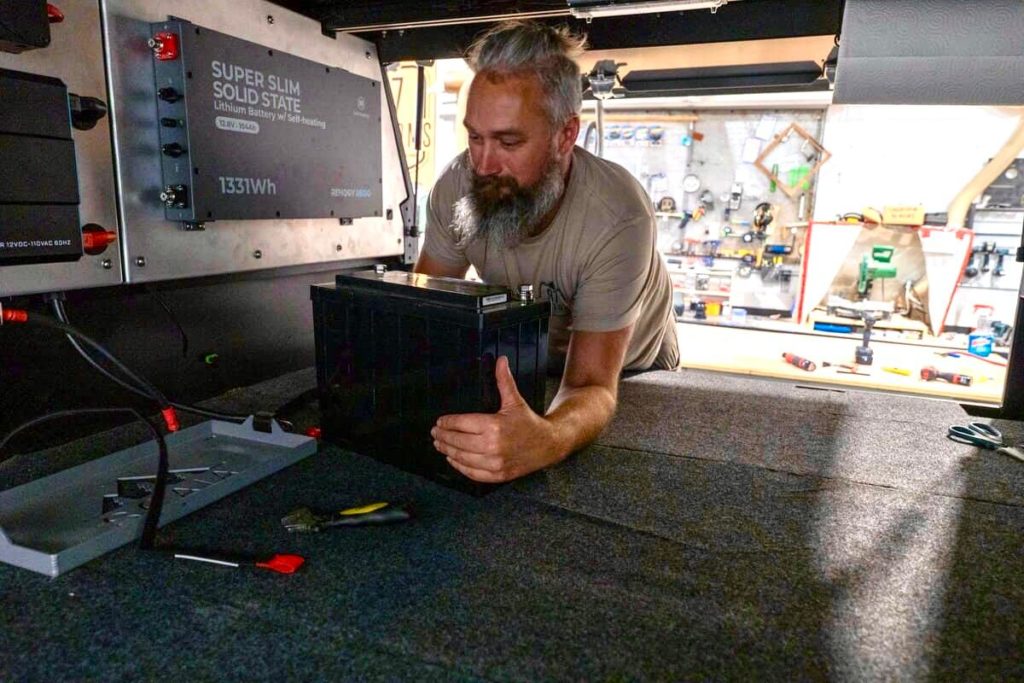
Semi-solid-state means semi-solid. A residue of liquid electrolyte remains, even if the product name abbreviates it to “solid state”. The Renogy REGO Super Slim with 104 Ah, for example, belongs to this semi-solid design.
Why the Electrolyte Is the Focus
Many people still know liquid electrolytes from the lead-acid battery. The comparison is only of limited help, though: there, the electrolyte consists of aqueous sulfuric acid.
Classic LiFePO4 cells usually contain flammable organic solvents. The LFP chemistry is comparatively thermally stable, but that does not make the cell non-flammable. In the event of severe overheating, an internal short circuit or considerable mechanical damage, decomposition reactions can occur that release heat and gases.
This is where semi-solid-state technology comes in: a smaller proportion of freely moving, flammable liquid can help improve the behavior of a damaged cell. For the Renogy Pro S1 series, for example, a liquid electrolyte content reduced by about 70 percent compared with conventional lithium batteries is specified.
More Safety Requires Looking at the Whole Battery
Less flammable liquid is a sensible development approach toward more safety. How large the safety gain actually is, however, depends on the entire cell construction and on the type of damage.
So semi-solid-state is one safety criterion when choosing your leisure battery. It concerns the construction of the cell and, thanks to the lower proportion of liquid, flammable electrolyte, can contribute to better behavior when damaged. Mechanical protection and electrical protection are likewise among the criteria you should consider when comparing. What matters is how they work together.
One example of mechanical protection is the bolted aluminum housing of our tigerexped LiFePO4 battery with 172 Ah. It forms a robust outer protective barrier to shield the cells inside from physical damage from external impact in the first place. The housing construction has two independent, thermally separated layers. A sturdy mounting bracket and fastening straps additionally ensure a secure fit in the vehicle.
The two approaches act at different points: a stable housing helps prevent mechanical damage to the cells; the electrolyte technology influences the properties inside the cell. Both are building blocks of a safety concept. No overall assessment of battery safety can therefore be derived from a single feature alone.
Both classic LiFePO4 and semi-solid-state LFP batteries use a BMS (battery management system) that monitors voltage, current and temperature, among other things, and intervenes in the event of impermissible operating conditions.

tigerexped LiFePO4 batteries with, among other things, a bolted aluminum housing and two-stage protection against overheating and short circuits as safety features.
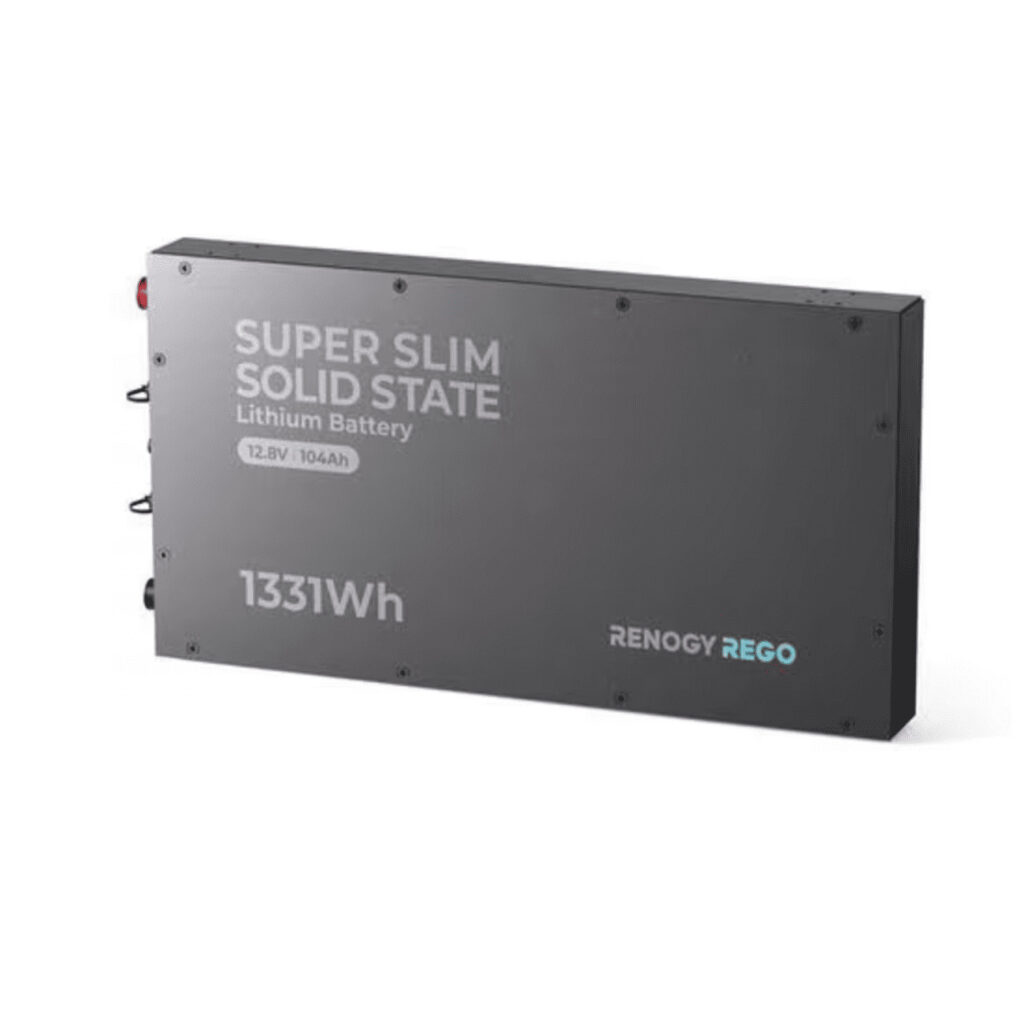
Renogy REGO battery, which relies on semi-solid-state technology as one of its safety features.
How Long Semi-Solid-State Batteries Last
Cycle life is one of the interesting properties of the new batteries. As a concrete example, here again the Renogy REGO Super Slim with 104 Ah: its technical data state 6,000 cycles at 80 percent depth of discharge, 25 °C and a load of 0.5 C (0.5 C here corresponds to a current equal to half the nominal capacity per hour, so for example 52 A at 104 Ah). The supplementary product specifications give 80 percent remaining capacity as the end point.
For comparison, the following Renogy models are specified:
| Battery | Cell technology | Cycles | Depth of discharge | Remaining capacity at end point |
|---|---|---|---|---|
| REGO Super Slim 104 Ah | Semi-solid-state LFP | 6,000 | 80 % | 80 % |
| Pro 200 Ah with Bluetooth and self-heating, RBT12200LFP-BT | Classic LiFePO4 | 5,000 | 80 % | 80 % |
What does that mean in everyday use? 80 percent depth of discharge means that 80 percent of the capacity is drawn in the respective test cycle. 80 percent remaining capacity in turn means that at the stated end point the battery still has that share of its original capacity. It is then not unusable.
On paper, that is 1,000 additional cycles, or 20 percent more specified cycles.
Note: However, this does not mean that every semi-solid-state battery lasts 20 percent longer across the board. Besides charging and discharging, a battery also ages with time. Temperature, state of charge and usage influence how long it actually serves well in the vehicle.
High cycle life is especially interesting for frequently used leisure batteries. In a motorhome that mostly stands still and is only on the road a few weeks a year, aging during idle time can weigh more heavily. Even then, suitable storage conditions remain important.
Where the Technology Gets Interesting in a Motorhome
Frequent Off-Grid Camping and Long Trips
If you are on the road for weeks or months, your battery works every day. During the day the energy comes from the solar system or, while driving, from the DC-DC charger; in the evening the battery supplies your consumers.
With this usage profile, you can benefit especially from a high specified cycle life.
For planning, usable capacity and daily consumption remain decisive: a battery with more possible charge cycles does not automatically store more energy per night at the same capacity.
Installation Close to the Living Area
In a camper, the leisure battery is often located under a seat or in a piece of furniture. That puts it close to the area where you spend your time and sleep. Improvements in how damaged cells behave are particularly relevant here.
A semi-solid-state battery can therefore be interesting if its specific safety properties and its form factor suit your installation. The technology does not replace a secure mounting or properly fused wiring, though.
Rough Tracks and Demanding Routes
On bad roads, even stronger shocks and vibrations act on the battery than on asphalt. Cells, internal connections, housing and mounting must be designed for that. A robust construction and suitable fastening solutions are a must.
Tilted installation, for example, is not an exclusive argument for semi-solid-state, though. Classic, sealed LiFePO4 batteries can also be operated in various installation positions, depending on the model. What matters is the approval of the respective battery. A semi-solid electrolyte is not a license for any mounting position.
Who Semi-Solid-State LFP Is Worth It For
Semi-solid-state LFP is especially exciting if you use your motorhome intensively and want to combine a high cycle life with a suitable form factor and a well-thought-out safety concept. Similar requirements exist on boats and in regularly used off-grid systems.
At the same time, a well-designed classic LiFePO4 battery remains a powerful solution. Whether switching is worthwhile depends on the properties of the specific battery: how much energy do you need, what currents have to flow, how much space is available and under what conditions are you traveling?
If you are planning new onboard electrics or want to expand your existing system, we are happy to help you coordinate battery, charging technology and consumers sensibly.
If you enjoyed this article, you might also find this interesting:



Share this article with like-minded people: