Photo: Kenny Leys
The cold season brings not only snow and ice but also legal obligations for car and motorhome drivers. One of these rules concerns the winter tire requirement.
This year, 2024, the rule on the so-called “M+S” marking is being adjusted in Germany. What does this important change mean for you – and what does it look like in the countries around us? Here is an overview:
The Winter Tire Requirement in Germany
What does the law say?
Germany has a situational winter tire requirement. This means that in wintry road conditions you may only drive with suitable tires.
What counts as wintry road conditions? According to § 2 paragraph 3a of the StVO (German Road Traffic Regulations), wintry road conditions are “black ice, snow-covered roads, slush, icy roads or frost-glazed roads“.
And what is a “suitable” tire? From October 2024 there is only one answer to that: it must carry the Alpine symbol!
The “M+S” Marking and What Has Changed
The marking “M+S” (mud and snow) used to be a common criterion for winter tires. However, since January 1, 2018, only tires with the Alpine symbol (a mountain pictogram with a snowflake) may be sold as legally approved winter tires.
For older tires with “M+S” marking manufactured up to the end of 2017, a transition period applied, which expired on September 30, 2024. Now all winter tires must carry the Alpine symbol.
Important:
Tires with “M+S” marking without the Alpine symbol are hereby no longer approved for wintry conditions! They no longer count as “winter tires”.
Fines for Violations
Anyone who disregards a rule in road traffic naturally risks fines. Driving in wintry road conditions without suitable tires can currently cost e.g. €60 and one point in Flensburg (the German driving record).
If you are involved in an incident on the road, it naturally gets more expensive.
- €80 (and of course the point) if you become an obstruction because of summer tires,
- €100 plus a point for endangering others,
- €120 plus a point if an accident is caused.
And note: if you drive around on summer tires in ice and snow, you very quickly bear at least part of the blame, even if you were not fundamentally the cause of the accident!
In addition, problems with your insurance can arise in the event of damage. If summer tires in wintry road conditions were the cause of an accident, settlement of the claim can be refused, because from the insurers’ point of view the person acted with gross negligence. Incidentally, this does not apply to third-party liability, which is why in countries like Germany we can rely on an accident with property damage or even personal injury not plunging us into financially ruinous costs. In many travel countries, however, this is an important issue, so always find out well which additional insurance you should perhaps take out – but that is just a side note.
Winter Tire Requirement in Europe
Other European countries also have rules on winter tires. However, these differ greatly from country to country.
Some countries have a general winter tire requirement for certain periods / in wintry road conditions. Sometimes a distinction is also made between lighter and heavier vehicles. A few examples:
Countries with a Requirement
Austria
A winter tire requirement applies from November 1 to April 15 when wintry conditions prevail. Note that violations can be particularly expensive here and cost up to €5,000!
Finland
From November 1 to March 31 of the following year, winter tires are mandatory for all motor vehicles in wintry road conditions.
Slovenia and Slovakia
The winter tire requirement applies between November 15 and March 15, and always in wintry road conditions. The tires must also have a minimum tread depth of 3mm. Instead of winter tires with the mountain symbol, all-season tires with the M+S marking can also be used here if they meet the minimum tread depth of 3mm.
Situational Winter Tire Requirement
Countries like Germany and France have a situational winter tire requirement. Here, winter tires are only mandatory in wintry road conditions.
In France the requirement was tightened in 2021 in 48 departments (generally all those with mountain regions). The relevant road sections are signposted. If you are driving with unsuitable tires (or, where applicable, snow chains or so-called snow socks as an alternative), it costs €135, and in France the vehicle is immobilized (just like with overloading, so extra care is needed here with travel vehicles too! – but this is also just a side note)
No Legal Requirement
In countries like the Netherlands, Belgium, Denmark and also Poland there is no general winter tire requirement.
In Switzerland, too, there is no general requirement for winter tires. However, as already mentioned, you should be aware that you pay fines if you become an obstruction on summer tires, and that in an accident you can be assigned considerable contributory liability due to gross negligence – with corresponding consequences for the insurer covering your (own) damage.
Recommended reading:
The ADAC (German automobile club) has compiled the winter tire and snow chain requirements in 20 European countries here once more. Take a look at what applies in your winter travel destination and prepare in good time.
More Tips for the Right (Safe) Winter Tires
- Check tire age
Make sure your winter tires are no more than six years old. From this age they already lose part of their winter properties. Using winter tires older than 8 years is therefore not advisable.
You can find the production date of your tires in the last three or four digits of the embossed DOT number (usually circled by an oval). They stand for production week and year – so if it says e.g. 0320, the tire was made in the third calendar week of 2020. - Mind the tread depth
The legal minimum tread depth for winter tires is 1.6 mm. However, at least 4 mm is recommended! - Check tire pressure
Note: when temperatures drop, tire pressure also drops because the air “contracts”, i.e. its volume changes! Keep that in mind and check your tire pressure more often, because it is an incredibly important safety factor that you can influence very easily!
Conclusion
Check whether your current winter tires only have the “M+S” marking and not the Alpine symbol with the mountains. If that is the case, they are not even approved as winter tires in Germany!
Also abroad in Europe, it is important to find out about the local winter tire requirement before you set off, to avoid fines and trouble with the insurance in case of accidents.
And ultimately: it is YOUR safety, and it is largely determined by your tires – so better to upgrade in good time, and not just because of the law!
PS:
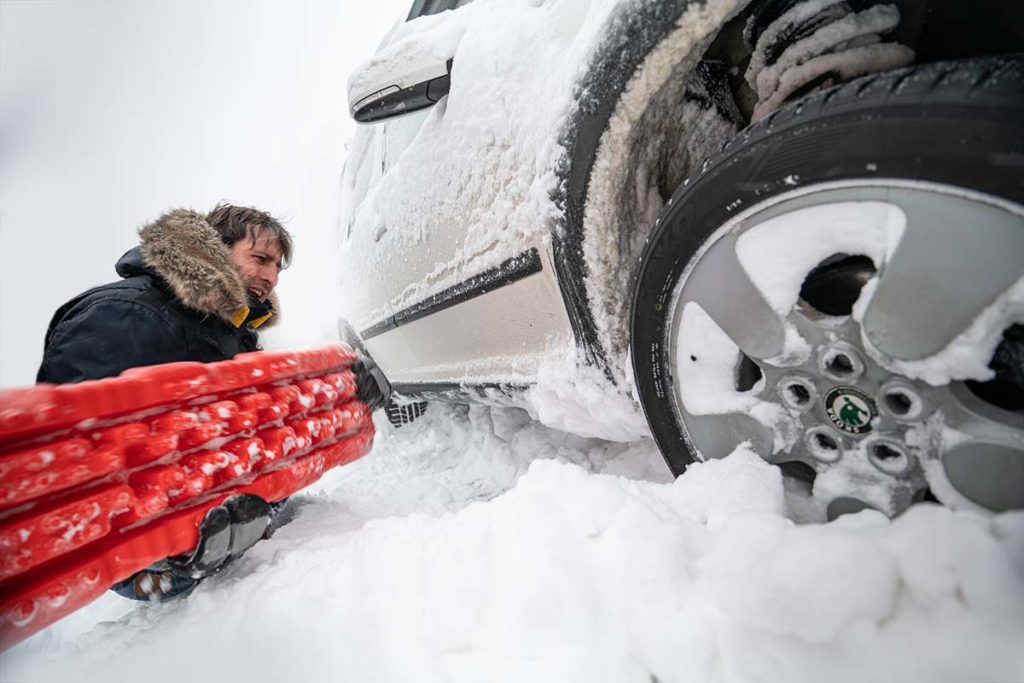
If you want to be even better prepared: with our recovery boards from TRED 4×4 you can not only quickly free a stuck vehicle from a muddy campsite meadow or from sand sections on an adventurous trip. They are also excellent helpers in snow for a recovery without outside help.
Did you find this info helpful? Then feel free to share it with friends and like-minded people, so they can also check whether their tires still meet the winter tire requirement in Germany, or not.
More topics that might interest you: