
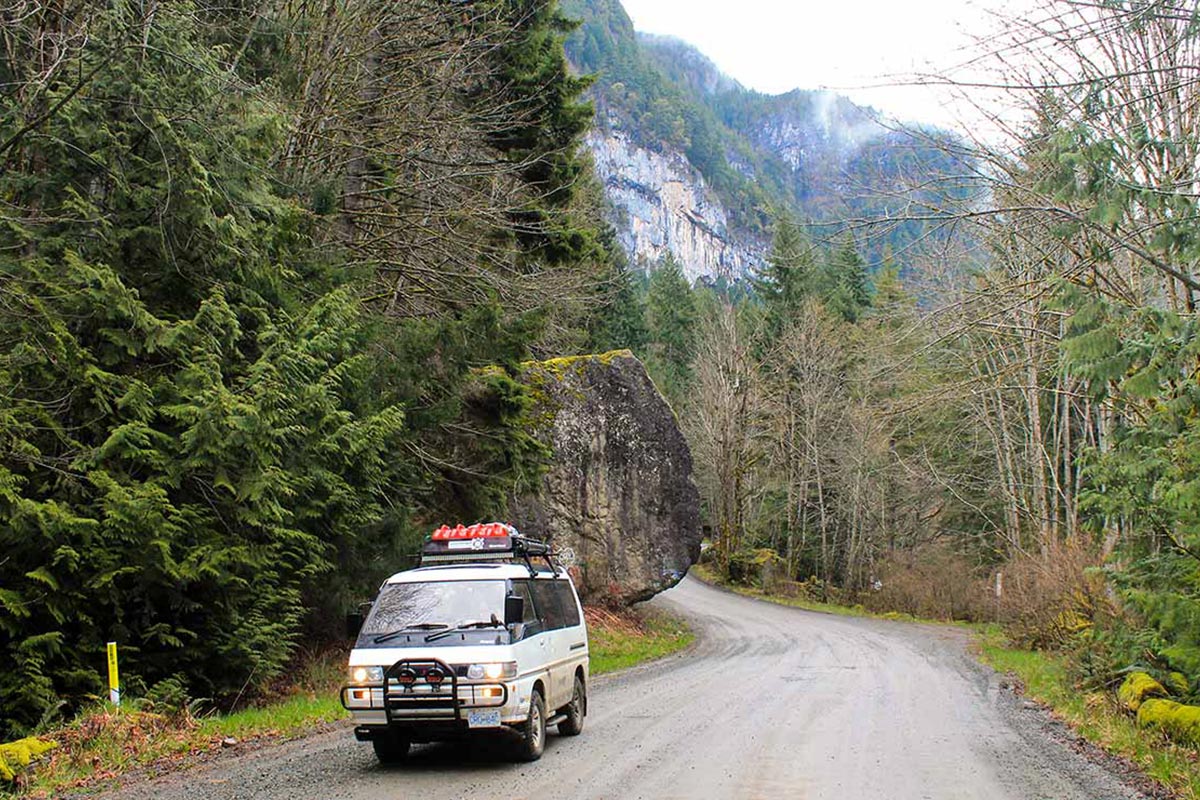

Stephanie & Nico from the tigerexped team traveled through Canada for a year from 2016 to 2017. Along the way they became dog sled drivers and experienced the famous “Indian Summer” – and here they give you their very personal travel recommendation.
Vancouver in May 2016 – We Need a Vehicle
Our journey begins in Vancouver, where our trip starts in early May 2016. The starting point was chosen deliberately. Not because Vancouver is such a breathtaking city between sea and mountains, with an exciting nightlife or because of the famous Steam Clock. No, it is the place where the chances are best of getting a Mitsubishi L300 (called a Delica there).
We knew in advance that we didn’t want an American gas guzzler. We also knew that we had to sleep IN a vehicle, because winters in North America are not quite so forgiving. And of course our new mobile home also had to be capable offroad. All these criteria led us to Vancouver, because there is a lively import of Japanese 4WD minibuses there, preferably even the Mitsubishi L300/Delica.
It doesn’t take long until the Delica of an RCMP officer changes hands and Nico converts it at the roadside between Walmart and a hardware store. Vancouver is a well-regarded film city and many Hollywood productions are shot there. Around the film studios, various stuntmen and wannabe actors camp, so we don’t stand out at all with our ramshackle conversion project.

As soon as the conversion with a bed, a few cabinets, a cool box, a second battery etc. is finished, we head out into the wilderness.
Cold, Wildlife and Nature
At the end of May, beginning of June, we set off north, toward the Yukon Territory.
The plan was actually to drive into summer first, before the harsh North American winter would catch up with us at some point. But that wasn’t the case some 6 months after our arrival, but already in May, not even 6 weeks later.
On our Facebook post, Obertiger (head tiger) Martin Henning commented: “Where should I send the auxiliary heater?” We really hadn’t planned on one at first.

Soon we receive a package from tigerexped – back then not yet suspecting that we ourselves would one day be sending packages to tigerexped customers.
After the initial snow, spring does eventually come to the Alaska Highway. The time when the bears wake from hibernation and come out. But they are not the only ones we meet. There are days on the Alaska Highway when we hardly make any distance because there are simply so many wild animals to marvel at. Nico’s absolute favorites are the bison. The North American relatives of the wisents sometimes seen here are another whole size bigger and very impressive. Yet they look so cozy. Sometimes they came really close. But when an animal that looks ever so cozy snorts menacingly 2 m from the window, you’d rather hit the gas pedal than the shutter button. After all, our L300 already has a dent from a wapiti in the sliding door (from the previous owner), and we’re not keen to add a bison bump.


Apart from wildlife, breathtaking nature and scenery, the Alaska Highway doesn’t necessarily have much more to offer. We find the towns along the way rather unspectacular. The only thing worth mentioning on a stretch of around 2000 km: the Sign Post Forest in Watson Lake. It is also right next to the Visitor Information Center, where we are not exactly asking about tourist attractions, but slowly about work. Somehow the year has to be financed and the travel budget topped up again. From the Visitor Center we are sent straight on to the employment office, where after only 20 minutes we are offered jobs all over the Yukon.
We Become Mushers
We end up in Carcross. It has nothing to do with cars or motocross; the place was actually once called Caribou Crossing. But since there was another place with that name and mail kept ending up in the wrong Caribou Crossing, it was simply shortened to Carcross.
Carcross has a very active First Nations community of the Tagish. The Lake Bennett station of the White Pass train is located there, and opposite it a general store, which is really more of a tourist curiosity shop. You can really only shop at the gas station at best, or in Whitehorse, the capital of the Yukon – about 75 km away.
On our first shopping trip in Whitehorse, we still wonder why many people are standing at the checkout with several shopping carts at once. But when you have to drive many hundreds of kilometers to go shopping, you get used to it quickly.
Besides the First Nations, the whole region also has a lively community and history of mushers, that is, sled dog drivers. Whitehorse is alternately the start or finish of the Yukon Quest. Together with the Iditarod race, it is considered one of the toughest in the world.
Besides the dog races, dog teams are still used as transportation. For example, building materials are hauled across frozen lakes to remote cabins when you can’t afford a helicopter and don’t own a snowmobile.
And so we find work at a company that owns almost 100 dogs. In winter races are run; in summer guests are accommodated and the dogs are kept fit by pulling small groups of tourists through the wilderness in carts (summer sleds). Additional attractions are a museum, a restaurant with a cafe and of course puppy petting.
While I mostly look after the tourists, Nico as a dog handler is responsible for the dogs together with the mushers. That means getting to know the animals and each individual character, feeding them and of course cleaning up after them. With 96 dogs, that can get to be quite a lot of sh***. By the end of the summer, however, Nico has earned the dogs’ trust and can lead his own teams of 12 dogs.


Here at home we often picture strong Malamutes and Siberian Huskies, but Alaska Huskies are thin and wiry. They are the fast, enduring athletes with the perfect prerequisites for running dog sled races. Compared to them, Alaska Huskies are more like racehorses, while Malamutes are the Haflinger draft horses. Among our almost 100 dogs there is only a single Siberian Husky.
Escaping the Winter
We notice that winter is slowly approaching again too, as we continue toward Tombstone. We can mostly only guess at the actually impressive national park through drifting fog. It is slowly time to leave the rugged Yukon.
Our next destination is Toronto. Visitors from home want to experience the fall colors in Canada with us. When we set off in early September, it is already fall on the Robert Campbell Highway and auxiliary heater weather. I am a bit worried whether there will still be a single leaf on the trees by the time our visitors arrive. But many thousands of kilometers still lie ahead of us. After a few weeks on the road, among other things across the endless plains of the prairie, we experience the Aurora Borealis at the Great Lakes at 15 degrees above zero. In Winnipeg it is flip-flop weather at 30 degrees(!), after we had already had “long underwear weather” in the Yukon in September. Quite good to have summer-clothes weather once more, because all our long clothes urgently need a laundromat after almost a month of traveling.
Before we reach Toronto, one thing of course must not be missed: Niagara Falls. Here we experience once again what happened to us at Uluru (Ayers Rock) on our trip through Australia: you think you’ve already seen all this in 1000 pictures – but when you are actually there, it is simply overwhelming!

And finally we reach Toronto just in time for a joint road trip into the fall colors of Algonquin National Park. Our European phrase “Indian Summer” is, by the way, not politically correct at all over there, and you get very strange looks for using the term. Here the splendor of colors is simply called „autumn colours“.
Fall colors – that of course doesn’t just mean the coloring of the maple leaves. We are now in Nova Scotia, where the wild berry meadows glow in deep red. And even on the coasts, with weather getting ever rougher, it is still colorful, for example in Peggys Cove. At the latest at Cape Breton, though, it now really gets bare.
Newfoundland

We take the ferry to Newfoundland on 1 Nov. We want to see the island and have our first encounters with the incredibly open, friendly Newfoundlanders. As big and wide as the island is, it is for the most part just as unpopulated, and there aren’t that many roads. Many places, the so-called coves, are better reached by water. The way to St. John’s isn’t necessarily varied, although it is still a beautiful, lonely, or rather just-the-two-of-us fall road trip.
After about 700 km in which not that much happens, we enjoy cafes and pubs again in St. John’s, this colorful, lively city.
We like it so much that we can imagine spending the winter here. We even received a great job offer right after our arrival that simply won’t leave our minds. Because of that, we then also set off on the roughly 700 km back in its direction. This time our route takes us via Bonavista. We hike the magnificent Skerwink Trail, pass through typical coves and coastal towns, and finally reach the western coast of the island again at Corner Brook.
Winter has arrived with us. And what do you do in winter in the snowiest region of Canada? Well, Nico, because of our job, mostly shovels snow :D. In our free time we go on great snowshoe tours or ride a Ski-Doo and experience the most impressive backcountry ski tours, including in Gros Morne Park.

At some point Christmas and New Year are at the door. Joe’s generous job offer, with a luxurious staff apartment in the resort, also included the famous “cabin in the woods”, where we can spend the holidays in true Canadian style – without electricity, running water and cell phone reception.
But our 100 huskies at the other end of Canada never quite let go of us either. The wish remained to ride a real dog sled in the snow once. In maritime Newfoundland there are unfortunately no more mushers.
Labrador
As spring approaches (at least on the calendar), the urge to travel slowly grabs us again. How should we continue – back to the Yukon, to the dogs?! It’s only a good 7000 km on the direct route – which in the end we of course don’t really take. We want to drive the Labrador Highway while it is frozen and therefore easy to drive.
To even get to Labrador, we would have to see whether and when the icebreaker runs and we can cross. When the ice presses into the strait, the ferries cannot run because of the danger of being crushed in it. We are lucky, though, and don’t have to wait for days for the crossing. We soon cross and arrive well in Labrador. But now a few days of blizzard await us, and we are stuck until the Labrador Highway is passable.
At the latest now, when you sit out several days in a snowstorm at up to -30 degrees, the Autoterm auxiliary heater is indispensable, even though we really don’t have big problems with the cold. But not just it: the battery heater and other things Nico had equipped the L300 with are nearly vital to survival.
When the blizzard is over, our next Canada crossing begins. Over icy highways back west once, this time via Banff & Jasper. The famous blue lake, Lake Louise, looks in winter like all the other lakes – white.
The Highlight at the End
After a few thousand kilometers, we reach the Yukon again, where our favorite husky Kalvik and the others are already waiting for us.
Here we finally experience our unforgettable Canada highlight – thundering across Fish Lake with a REAL dog sled. In April we had often paddled here to the cabin of the “last trapper”. Maybe you know the film?


With this picture of a “flat tire in Alaska” – husky tired from the day – the story of our round trip through Canada comes to a close. If you have a trip through this vast and beautiful country in mind … DO IT! It will give you unforgettable experiences.
Did this travel report make you want to go #rumtigern? Share it with others for inspiration and show us where you are on the road under the hashtag rumtigern on Instagram!
You might also be interested in these articles


