
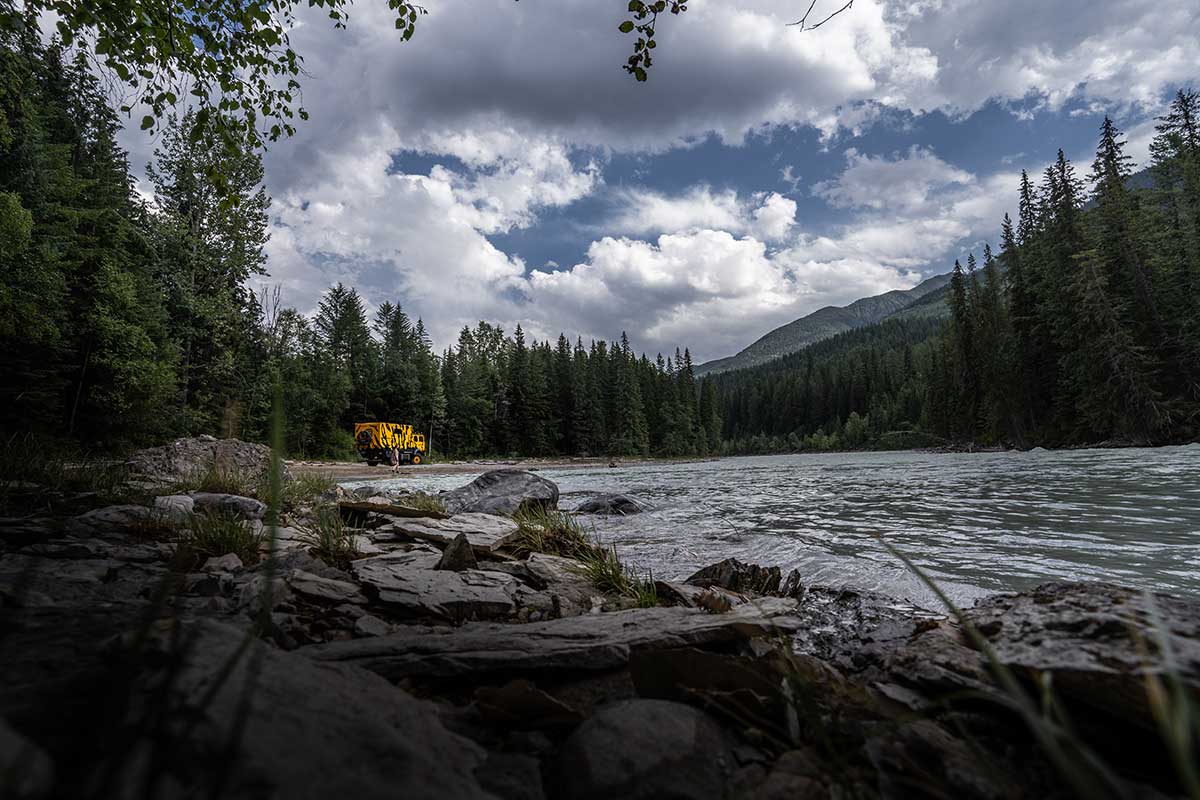
Off-grid living is the magic word for campers and motorhome travelers who don’t necessarily look for the freedom of mobile travel on a campsite pitch. But setting up camp away from the infrastructure there also means taking care yourself that, for example, the power doesn’t run out, instead of simply plugging the vehicle into a charging post.
What Does Off-Grid Actually Mean
Every day we get emails and phone calls with the question: How do I make my camper self-sufficient?
What’s usually meant is the power concept, because not sitting in the dark, keeping food fresh in an electric fridge and being able to charge your phone are basic requirements for a travel vehicle.
So how self-sufficient can you make yourself under which circumstances, and what does it take?
Although (or precisely because) in the course of this article we will come to the sobering conclusion that traveling with your vehicle independent of the power grid is quite difficult in some situations, we would like to give you something else to think about:
When planning your vehicle, keep in mind that self-sufficiency is often limited not by power at all, but by completely different things. It is better to speak of off-grid phases. This concerns the availability of fresh food, for example. Even if the fridge never runs out of power, the vegetables will shrivel at some point and every best-before date will have passed – or the fridge is simply eaten empty.
The capacity of the fresh water tanks is also a frequently limiting factor, as are the options for collecting grey water. Loaded with washing-up or care products, it should of course be disposed of at a suitable public facility and not in nature.
So it makes little sense to invest an extra 10,000 euros in power self-sufficiency for staying longer at dream spots if other resources force you to drive back “into civilization” anyway, for example to go shopping.
All of this and more, e.g. a personal supply of the medication you need, is of course also “self-sufficiency”, and naturally there are various adjustments you can make here as well.
In this article, however, we explicitly want to look at how you can become (as far as possible) power self-sufficient.
Being Power Self-Sufficient
If we don’t want to depend on a shore power connection, that means either
- we have to bring along the power we need for the “off-grid time” in the form of full batteries, or
- we have to generate somehow the power we consume ourselves, in order to refill the batteries.
With modern LiFePO4 battery technology, a large capacity carried along in the form of several batteries or entire battery banks (be careful, expensive!) and low consumption at the same time, independence without your own power generation is possible for a limited time. However, this doesn’t get us self-sufficiency, because the supply of energy we can take with us from home is finite – and finite does not mean self-sufficient. If we fail to replenish the power we use, even the best batteries will run empty at some point.
This kind of independence is limited by the available
- budget for buying the batteries,
- the installation space in the vehicle and the
- added weight, because batteries are heavy.
Conversely, we can achieve a certain degree of self-sufficiency entirely without a leisure battery.
Which Options for Generating Power Are There
In a camper we have several options for generating power. Each has its pros and cons and works better or worse under certain conditions. We will see that a combination of systems matched to your personal needs and preferred destinations always makes the most sense.
How much weight is given to which system when sizing the overall setup depends on your individual travel habits and can be calculated to match them. Our technicians specialize in this and are happy to help you if you are planning an electrical system (more about our consulting service).
The most important options are:
Solar
In short, a solar system is the best way to generate power for off-grid camping or even living. Once bought, there are no further running costs, and the system works cleanly, independently, silently and without any consumables or exhaust fumes.
It is no coincidence that a solar system is the most efficient way to make your own energy transition and is right at the front when it comes to the sustainability of houses.
“The sun doesn’t send a bill”, as our technician Lars likes to say.
Downside: no sun – no power.

DC-DC Charger / b2b Charger
The leisure battery can be charged by driving the vehicle. A b2b charger feeds the battery with power generated by the alternator. Handy, especially when the sun isn’t shining and the solar system delivers little. Downside: to fully charge a battery, it is not enough to drive in circles for a few minutes or to let the vehicle idle for a while.
In our video, for example, Lars calculates that to win back a typical average daily consumption of 1 kWh you would usually have to drive about three hours. If you push that back three days with enough battery capacity, you would have to drive 9 hours in one go to then be able to stay at a nice spot for three more days.
If you build planned driving stages for energy generation as a tactic into your everyday travel, however, this can definitely be a solution for power self-sufficiency.
Another downside, however: the additional load on the alternator leads to higher fuel consumption, because the engine effectively has to work harder to drive the alternator. Conclusion: we have to spend more money at the gas station (so we don’t achieve real self-sufficiency either, because we depend on the availability of fuel) and we are not exactly contributing to a smaller ecological footprint when traveling.
Generator
It goes without saying that generating power with a separately running engine, without at least covering some distance at the same time, makes the disadvantages mentioned above worse. As a burner of fossil fuels, and with a low efficiency on top, it is not a desirable solution but rather an absolute emergency measure.
In addition there is considerable extra weight and a significant use of space, as well as having to carry a separate fuel mixture. The noise nuisance from running a generator is another argument against using one.
A further limitation arises at low temperatures or at high altitudes. Here, operating generators becomes difficult, since the carburetors can freeze and the fuel mixture is not adapted to the changed air pressure conditions.
For all these reasons, generators are also not very common in European travel vehicles.
Wind Turbines
A wind turbine can be an alternative, or better a supplement, to the solar system. When there is more wind than sun, it enables power production while the vehicle is parked when the solar system can’t do it or can only do it partly.
Unfortunately, wind turbines are not yet blessed with the best efficiency and also make a rather loud running noise.
Fuel Cells
Fuel cells don’t really give us self-sufficiency. To run them, pure methanol has to be carried along. Since handling methanol can be dangerous, fuel cells are usually designed so that simply refilling “from the barrel” is not supported and special fuel cartridges have to be swapped. Depending on your energy needs, these are used up relatively quickly, though, and for a long trip or longer off-grid phases you would have to carry a not insignificant supply of methanol.
A fuel cell can charge our batteries, then, but recharging the fuel cell itself on the road is difficult, even if sources of pure methanol should be available.
Off-Grid Camping – The Trip Decides How
Where we want to go and when in the year determines which of the options above is right for us. Since the conditions under which power is produced vary a lot, it always makes sense to combine the different options and to set this combination in a suitable proportion to your personal power consumption and the installed battery capacity.
An example:
With a travel region from Northern to Central Europe and a travel time between October and March, it is certainly unrealistic to count on self-sufficiency through solar yield, since the yield in this period is very poor (be sure to also read our article How Much Solar for Camper and Motorhome – Assessing the Influencing Factors Correctly). It is equally unrealistic to carry enough battery capacity on this trip to be able to stay off-grid at a lake for 10 days and simply refill everything afterwards with a driving stage.
In this region and season, changed travel behavior can help. Shorter stays and more driving stages, for example planning 2 – 3 hours of driving per day. If the weather is bad and brings no solar yield, you might prefer to head where the weather is better anyway?
Someone who cares less about sun and more about wind because their passion is kiting may see it differently and would rather put an additional wind turbine on the roof.
If you are a real winter fan and want to head toward the North Cape in the cold season, a concept could be: drive, drive, drive, because with solar you won’t achieve anything here.
By contrast, on a big long-distance or long-term trip you can try to follow the summer and maintain power self-sufficiency through good timing when planning the route.

What power can you really expect from a solar module, and so how much solar do you ultimately need on the roof?
Join Lars and Martin on a virtual journey from Norway toward the equator, during which they think through realistic solar setups as examples.
Off-Grid Is What You Make of It
Options that you would at first hardly file under the term self-sufficiency can also be a good solution. If you have too little solar to cover your consumption completely, but enough battery capacity to be off-grid for two weeks at your personal consumption, you can possibly spend one night at a campsite every two weeks and plug the vehicle into shore power. Literally “driving in” such an amount of power via the alternator makes rather little sense in most cases. In addition, after two weeks you will probably also need to fill up and empty water, use a washing machine or similar, which puts the cost of the overnight stay into perspective. Freshly supplied and emptied, you can head off into off-grid freedom again.
For all the love of off-grid camping and free camping, the option of being able to connect the vehicle to shore power is definitely still one that you shouldn’t discard completely.
Finding the Right Mix
Above all, the sizing of the solar system to your personal needs and individual travel habits requires a certain amount of experience and the evaluation of many figures.
Matched to the consumers and travelers in the respective vehicle, you can in the end get the optimum without overshooting a realistic goal and spending far too much money completely unnecessarily. This also includes discussing wishes and expectations and putting them in relation to feasibility and cost.
Is induction cooking, for example, indispensable? This wish alone is a big hurdle on the way to (power) self-sufficient camping and fulfilling it blows many a budget.
Learn more about sizing a solar system in our further videos and articles.
Our recommended articles:
- How Much Solar for Camper and Motorhome – Assessing the Influencing Factors Correctly
- Calculating a Solar Charge Controller – Here’s How
- Solar Module Efficiency – How Important Is the Value Really
- Temperature Coefficient – Be Sure to Consider It When Calculating Your Solar System!
- Field report by guest author Manu on his wish to cook on electricity in a van.
- Energy Needs in a Camper – How to Calculate Your Power Requirements
Not Sure: Let Us Help You.
Lars or one of our other well-traveled technicians will gladly find out your individual wishes in a phone call, look at what fits you and your budget and put together an overall concept with matched components so that everything works safely.
Learn more and request a free, non-binding consultation.
These products make you more self-sufficient:
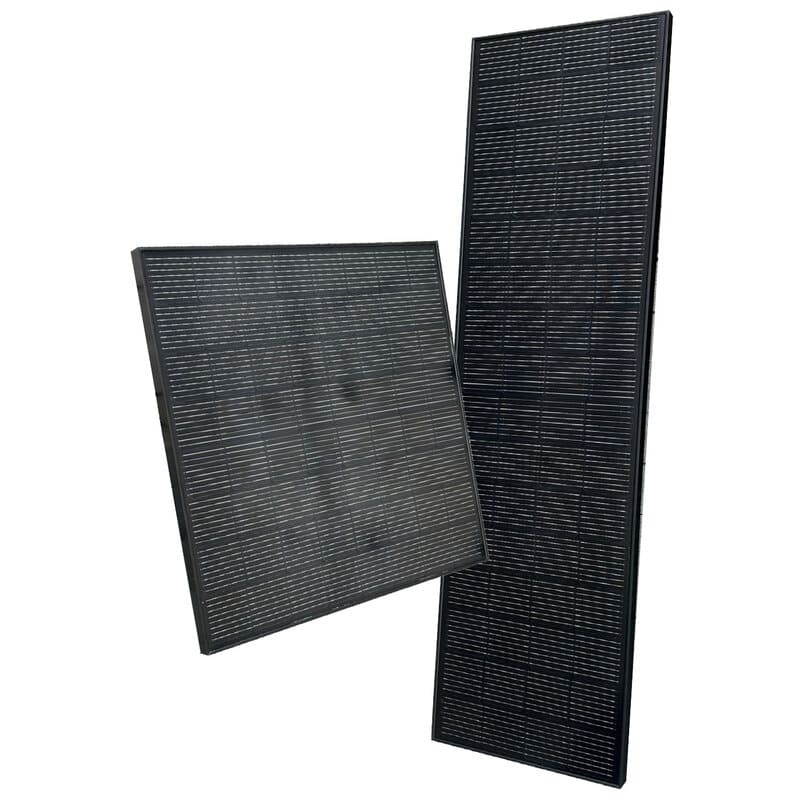
ULTRAblack tiger solar modules with up to 25% more power than usual modules of the same size!

Drinking water filters give you the option to obtain safe drinking water even from lakes and streams!

Auxiliary heater complete kits – robust technology, runs on diesel, including altitude kit!
Did you like this article? Recommend it with one click to friends and like-minded people: