

When calculating a solar system for a motorhome or camper, it is important to start from realistic values – an actual, average solar yield is something entirely different from the watt peak figure on the data sheet. In this article, we explain why it deviates from the specs and what a big role your travel habits play.
What the Data Sheet Can’t Know
When buying solar modules, the data sheet provides important information with figures such as rated power, efficiency and details on cell and module quality. Your expected average solar yield is indeed related to this data, because it tells you how much power the module can get out of a given situation. Accordingly, there are more effective and less effective modules.
But what yield ends up on your monitor also depends on this given external situation. Estimating it beforehand, when planning the system, determines how the system is sized for a specific power requirement.
Whether you can cover the needs of your consumers depends, besides rated power, quality and any soiling of the panel, also on:
- the global irradiance prevailing at your location in the respective season
- the irradiation situation, that is, the orientation and tilt of the module.
- on top of that come other external influences, such as dirt on the cells, heat or cold
Solar Yield – What Does the Term Actually Mean
Solar yield refers to the amount of PV (photovoltaic) energy that the solar system generates. It is stated in kilowatt hours (kWh) per day.
Global Irradiance
Global irradiance indicates the total radiation from the sun that reaches a location on average per day / month / year. Because of the curvature of the Earth’s surface and the position of the Earth relative to the sun, it differs greatly depending on latitude and season. Near the equator, global irradiance is generally strongest.
For travel, that of course means: if you drive south from here, your actual average solar yield goes up; towards the north it drops considerably.
Practically Achievable Solar Yield
The practically achievable solar yield of the system on your camper depends, as hinted above, on a great many criteria and includes technical values and losses of the respective system / solar modules. Dirt or water spots also contribute to a solar module not being able to deliver output values like under laboratory conditions.
By far the strongest influence on your achievable solar yield, however, comes from the global irradiance reaching your location and the orientation of the PV modules towards the sun.
Average Solar Yield – What Can I Expect Where
As an example, we calculated the values for a possible solar yield in three different regions and without any special orientation towards the sun – i.e. lying flat on your camper. The figures reflect the average weather of the respective month in the given region – of course it can also be cloudy in summery Lisbon right when you happen to be there, so the yield is much lower. Conversely, because of the curvature of the Earth, you can hardly expect higher global irradiance in Reykjavik on a winter trip. The general differences between the locations become more than clear from the graph.

Increasing Solar Yield – Adjusting the Orientation / Angle of the Panel
A module delivers the highest solar yield when it is aligned at a right angle to the incoming sunlight. At the equator, panels mounted flat on the roof of the motorhome are therefore well set up. It looks different as we move from there towards the poles. Here, in the middle of Germany, a tilt of 38° (facing south) gives the sunlight an optimal angle of incidence. The radiation hits the cells directly and as little as possible is reflected unused from the surface of the module.
Fans of the northern lights who want to get a bit more out of their solar system under the already difficult light conditions have to upgrade. Either with permanently mounted modules that are installed so they can be tilted up, or with flexibly positionable solar bags that are not permanently mounted on the vehicle.
Anyone who really wants to optimize for these conditions should even consider mounting solar modules on the sides of the travel vehicle. From experience, tiltable solar modules are only very rarely actually tilted up during a trip – the effort is usually just too great. A handy solar bag that can quickly be placed behind the windshield or set up in front of the camper is usually the more convenient solution.
Calculating Solar Yield
If you are interested in what solar yield you can expect at your preferred travel destination, you can find the corresponding global irradiance figures in so-called solar atlases or global irradiance maps.
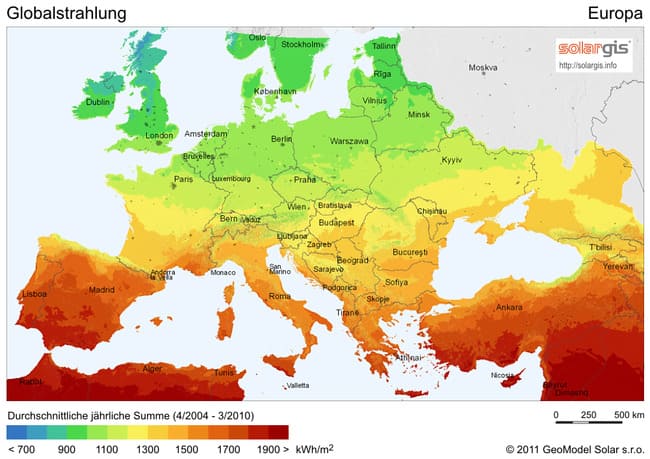
To calculate the ideal and the practically achievable solar yield, the global irradiance at the location has to be converted to the system with its specific figures as well as orientation and tilt. In practice, however, this calculation only makes sense for large, stationary systems.
When planning a system for a travel vehicle, it is important to keep in mind that a certain percentage of a solar module’s possible output very likely cannot be drawn, and the system may have to be adjusted accordingly to cover a certain demand. You can solve this either with a larger total solar area or by (at least temporarily) increasing the solar yield through an adjustment of the orientation or the tilt angle of the modules.
Buying panels with the highest possible efficiency, an optimized temperature coefficient and a large usable light spectrum is of course obligatory for the highest possible power yield. That is why, in our own production, we put particular emphasis on technical optimization – so you can always get the greatest possible output from the external conditions.

Technically optimized high-performance solar modules with
– highest efficiency,
– improved temperature coefficient,
– large usable light spectrum,
– many special formats for the best use of roof space,
– framed, semi-flexible or as a solar bag
can be found in our shop
Cities Compared by Global Irradiance
Here is another overview of what you can expect from solar modules of different power classes in our example regions over the course of the year.

Did this article help you? Then feel free to share this info with like-minded people with just one click:
These topics might also interest you: