
What are the big sticking points of energy consumption in a camper, and how do you calculate roughly what daily consumption to expect?
Lars and Martin explain how to calculate the required amount of energy quite simply, and by which criteria even the strongly fluctuating power draw of certain consumers can easily be brought to an average value for a sensible calculation.
Energy Needs in a Camper – The Video on the Topic
Watt-Hours vs. Amp-Hours
If you want to determine an amount of energy as an average daily requirement and choose the right battery for it, there is a problem. While power consumption is normally stated and calculated in watt-hours, the battery label shows the value in amp-hours. So the values can’t be compared at first glance.
So why calculate in watt-hours at all, and what is the difference, actually?
- The voltage in the system fluctuates. Depending on the battery’s state of charge etc., the amp-hour figure is only roughly accurate.
- Most travel vehicles around here run on an on-board voltage of 12V … some on 24V. In addition, 230V or even 110V sockets are almost always installed. The amp-hours available differ across all of these systems (since the current in amps rises in proportion to the voltage).
Watt-hours, on the other hand, always stay the same, no matter which voltage we are talking about. So we are not comparing apples with oranges, and we also calculate more precisely and with fewer errors.
It is no coincidence that watt-hours are the universal unit used to state amounts of energy. Whether it’s the bill from your electricity provider at home, a possible solar yield or the power consumption of an electrical device – everything is stated in watt-hours.
When comparing and calculating amounts of energy, we get along well with this unit, without constantly having to convert.
Calculating the Energy Needed for Your Camper – Here’s How
Most travel vehicles, whether on land or on water, are equipped with a certain basic set of electrical consumers. These include, for example, a compressor fridge / cool box, heating, water pump, lighting etc.
When calculating the required amount of energy, the biggest consumers naturally give us the biggest worries. As we will see in a moment, a small LED spot that shines in the evening, in comparison, hardly matters and makes little difference to the basic decision on the battery capacity to install.
To calculate how much energy we use in a day, for example, we need the power draw of the devices in watts and the time in hours that each one is operated per day, roughly. Because the calculation is very simple:
Power in watts x time in hours = watt-hours.
This very simple calculation works without further thought for all devices that are either on or off at a fixed level. A lamp, for example. How many watts the bulb has is printed on it, and if it is switched on for two hours in the evening for reading, our calculation is already complete.
So go through your camper and multiply the power in watts of each consumer by the time you use it per day.
Finally, add up all the values and you get your daily requirement.
So far, so simple. But there are also devices that make it a little harder for us.
The Fridge
On fridges and cool boxes, as on most electrical devices, a power draw in watts is stated on the data sheet.
But how long a time should you assume for operation? The fridge is usually switched on all the time, but the compressor only runs when the measured interior temperature falls below a certain value.
Across manufacturers there is a rule of thumb for this, which says:
A fridge runs 30% of the time at an ambient temperature of 25°C.
That means that at 25°C in the travel vehicle, the fridge compressor would use the power stated on the rating plate (often around 60 watts, depending on size) for about 8 hours a day.
At a higher ambient temperature the fridge kicks in more often, at a cooler one less often.
So note: if you travel to the Sahara or climatically hot countries like Mexico, you have to expect that the fridge may run not 30% of the time but, in extreme cases, even 24 hours. It then uses many times more energy than you calculated with. Battery capacities are quickly exceeded this way, and the extra consumption can only be compensated by recharging more (shore connection, solar, alternator …). This is what happened to Anna and Anne, for example, who had to buy an additional solar bag in Mexico to cover the fridge’s demand and keep the food fresh in the great heat.
Also read the following articles:


For “normal regions” with quite summery temperatures (but good insulation, so the camper doesn’t turn into a sauna), the very simple calculation with our 60 watt example fridge is therefore as follows:
60 watts x 8 hours = 480 watt-hours
This consumption can of course also be influenced somewhat. If the cooling level is set to maximum or you keep adding warm drink cans or bottles, consumption will naturally be somewhat higher too. If, on the other hand, no perishable food is stored and you can choose a low cooling level, consumption may be lower, depending on the ambient temperature.
As we can see, the fridge’s consumption can vary quite a bit. At the same time it is a big item on the list of devices that want to be supplied with electrical power. So you should roughly know what you have to calculate with, and possibly also orient the energy budgeted for it to your destinations, to be on the safe side.
The Heater
Our robust diesel auxiliary heaters, for example, make it even harder at first glance. Here you find two power figures in watts right away – namely 29 and 2000 (or even 4000) watts.
Even if you are startled at first by the 2000 watts: the heating output meant here is of course provided by the diesel that is burned to warm the room air. This figure can therefore safely be left out when calculating power requirements.
The auxiliary heater does still use power, though. Fan, control electronics, fuel pump, display … all of that needs to be supplied with electrical energy. When starting the heater from cold, a glow plug for preheating the combustion chamber is added as well. That means when the heater starts up, it first uses quite a lot more power than in normal operation afterwards.
So how many watts do you calculate with on average, really?
As experts on Autoterm auxiliary heaters, we calculate with a consumption of about 18 to 20 watts in normal operation.
Whether the heater uses more or less power over a given period therefore varies with the number of starts and the repeated, energy-intensive preheating of the combustion chamber. In many cases it makes more sense to let the heater run continuously than to switch it on and off constantly by hand, or automatically via the corresponding mode – and not only because of power consumption.

More info on our Autoterm diesel auxiliary heaters and conveniently assembled kits that contain everything you need:
If it is bitterly cold outside and it is not worth switching the heater off in between, because the travel vehicle immediately starts to cool down, then in the extreme case you have to calculate with 24 hours times about 20 watts. Together with the fridge, we get to the next half kilowatt-hour.
In the worst case (i.e. in “winter”), with 24 hours of heating and a fridge that runs 8 hours a day at 60 watts, our camper is already at 1 kWh of energy demand per day. With a smaller cool box and mild ambient temperatures that allow heating by the hour, on the other hand, we get by with half a kilowatt-hour.
As we can already see here, a winter vacation in a camper comes with a much higher energy demand, not least because the shorter days mean the lights are on longer, for example. At the same time, less power comes in from solar energy. Winter operation must therefore definitely be taken into account when calculating the battery capacity to install.

Induction Cooking
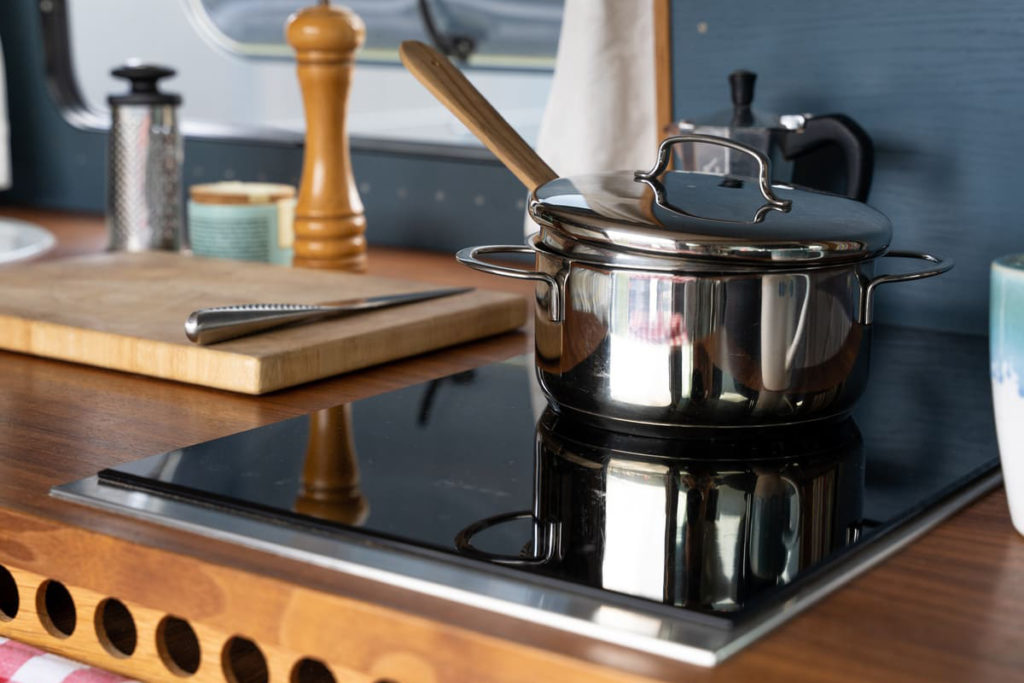
Cooking with electricity on an induction hob is an energy- and cost-intensive decision and should therefore be thought through carefully.
In the video, Lars and Martin worked through a typical energy requirement for cooking with electricity. They arrive at a minimum of 700 watt-hours, but usually more than 1000 watt-hours per day, for induction cooking alone.
Besides the sizing of the batteries, the dimensioning of the entire electrical system is tied to this decision.
Real-world figures for cooking with induction are provided by Florian from Anton Reisemobile in his guest article Induction Hob in a Camper / Motorhome.
Working on the Road
Working on a laptop can also become a considerable item in your power consumption.
To get a reference for the usual consumption of your own laptop: the value in watts stated on the power adapter indicates the consumption at maximum performance, maximum display brightness and an empty battery.
In normal operation, for a bit of office routine such as handling emails, we can realistically assume about 30% of the stated value. As always, we multiply this by the operating hours and so arrive at a watt-hour order of magnitude for our working day.
With often about 25 – 30 watts x working time, you are usually on the safe side.
It looks different with 4K video rendering for YouTube, or gaming etc. In these cases you should assume 70% of the maximum power draw, which for machines built for this then also feeds quite considerably into the calculation of the total energy needed.
Also think of any additional monitors that need to go into the calculation. Their effect is big. At 50 watts for a 27-inch display and 8 hours of work = 400 watt-hours, the energy demand exceeds that of pure office work, with e.g. 30 watts x 8 hours = 240 watt-hours.
Two people who both work remotely at a computer and run an external monitor therefore have a similar energy demand to induction cooking!
Other Consumers
The rating plate of some electrical consumers in the camper boasts enormous power draw figures. The pressure water pump, for example, which seems to be a power hog at 60, 70 or sometimes 100 watts, ultimately matters little. The active time is simply too short to make a decisive difference. With a maximum of 5 minutes of operation per day, even 100 watts of consumption won’t drain the battery.
It is the other way around with consumers like lighting or charging smartphones. Even with longer stays in the camper on dark, long winter days: if we look at the energy demand of an LED spot with 3 or 6 watts, it hardly matters in comparison with the consumers already mentioned. The difference between a short operating time of one hour or a longer one of three is downright negligible.
With stylish LED strips, 15 or 20 watts may also be found as the rated value on the rating plate. But the energy demand of 5 LED lights of course doesn’t have to be added up if you only switch on the light where you need it at the moment. Calculated with an average of about 20 watts for lighting, you should therefore be on the safe side.
A phone battery, too, doesn’t hold enough electrical energy to make us seriously rethink our decision on the order of magnitude of battery capacity to install.
Calculating the Energy Needs of Your Own Camper – Conclusion
When calculating the required amount of energy in a camper, motorhome or boat, there are certain sticking points that send the planning of the electrical system in a whole new direction.
These include cooking on induction, as well as daily use of an electric oven.
The second sticking point is working on the road, which, depending on the field of work, has a considerable influence on the calculation.
Are you unsure about the calculation or don’t know your way around choosing components:
We’ll help you out and put together with you a system sized sensibly for your needs and budget and combined professionally.
Read more about the tigerexped power pro offer and
Did this help? Feel free to share the article with like-minded people from your community:
More on