

Photo: Fluri Adventures
Anyone who has ever tried to fit solar panels on a camper roof knows the problem: the space is limited, and rarely symmetrical. Between roof windows, vents and roof racks, gaps often remain that seem doomed to stay unused. There is untapped potential here that could be used for more self-sufficiency. But anyone who thinks they can simply combine solar panels of different sizes quickly runs into technical limits.
Different Solar Panel Formats – The Challenge
Different solar panels generally also mean different electrical characteristics. If you simply connect different solar panels together, various problems can occur – depending on how much the panels differ in voltage, current and power, and on whether you connect them in parallel or in series.
The Problems of Connecting Different Solar Panels in Parallel
Let’s look at the different problems that can occur, starting with a possible parallel connection.

Solar panels connected in parallel: the panels are connected plus to plus and minus to minus, so that the currents of the individual panels add up, while the voltage stays constant and an average value is used.
Different Voltage
When panels with different voltages are connected in parallel, high yield losses can occur, so that using the free roof areas loses its point.
To understand the problem, you need to know how MPPT solar charge controllers work:
The MPPT solar charge controller (MPPT = maximum power point tracking) shifts the operating point between current and voltage until the maximum power comes out of the panel or panels. It literally “tries” this out again and again all day long, because the conditions are constantly changing, too.
That means if I connect two panels with different operating points in terms of voltage in parallel, the MPPT ends up settling on some average value that is neither the optimum for one panel nor for the other. In total, less solar yield comes out of it. The further apart the voltages of the panels in a parallel connection are, the bigger the problem becomes.
Different Power (With the Same Voltage!)
If the panels have the same voltage (check the data sheet for the Umpp value) but different power (that is, different currents), connecting them in parallel is basically possible. The currents add up, and each panel contributes according to its power.
ATTENTION:
Make sure that the cables and the charge controller are rated for the higher total current, otherwise overheating or damage to the system can occur.
Different Current (With the Same Voltage!)
A parallel connection is therefore basically feasible, but the option is rather theoretical, because panels of different sizes but the same voltage are hard to find.
The reason is that voltage results from the number of cells installed – different designs with a different number of cells therefore automatically always have different voltages as well.
Different Panels in Series

Solar panels connected in series: in this variant, plus is connected to minus. Current and voltage behave exactly the opposite of a parallel connection: the current stays the same, the voltage adds up.
Panels connected in series must be able to deliver the same current (Impp) – this characteristic of different panels is also rarely found.
With unequal current in a series connection, a charge controller behaves as it does with unequal voltage in a parallel connection, which leads to power losses and thus poor solar yield. If you do find two panels with the same current, there is at first nothing standing in the way of a series connection.
ATTENTION:
Apart from the fact that it is likely to be enormously difficult to find two panels with the same current and also the dimensions that fit the free roof areas, there are other challenges with a series connection:
In a series connection, the maximum voltage of the controller must not be exceeded, otherwise dramatic consequences threaten. Under some circumstances, not only the controller is damaged – it is in fact not uncommon in such cases for a large part of the vehicle’s electronics to be destroyed or damaged, because the high voltage of possibly well over 60 or 100 volts breaks through to the 12V on-board system!
On the other hand, you want and need a minimum voltage of about 5V above battery voltage, otherwise no charging takes place at all.
So if you choose panels with a low voltage so that, in the series connection, the voltage does not rise above the maximum permissible voltage of the solar charge controller, you have the problem that when one of the two panels connected in series is shaded, not enough voltage is left and charging stops completely – even though one panel may not be shaded at all.
The series connection is therefore, for several reasons, at the very least a challenge, if not even very suboptimal with partial shading.
Consequences of Connecting Different Solar Panels – An Overview
- Efficiency losses:
The system delivers less power than possible, because individual panels act as a “brake” or even consume power instead of delivering it. - Possible damage:
It does not have to happen, but overheating, hot spots or even defects in the panels can occur if voltages differ greatly and current flows in the wrong direction. - Malfunctions:
The charge controller or inverter can be overloaded if the current is higher than designed for, or the voltage is not in the optimal range. - Higher susceptibility to faults:
The more the panels differ, the greater the likelihood of faults and defects (depending on the type of installation).
Different solar panels should therefore only be connected together if their electrical characteristics (above all the voltage for a parallel connection and the current for a series connection) are the same. Otherwise, power losses and an overall inefficient solar system threaten above all, but damage to panels and electrics can also occur.
Working Around the Technical Problems – and the New Problems This Creates
The technical problems mentioned above can be avoided by using separate charge controllers for different solar panels. You could say that this is basically a very good solution – even with identical panels, especially if you want to get the maximum out of partial shading. Anyone who wants to build a system that works optimally under all conditions uses a separate charge controller for each solar panel.
What you have to bear in mind: this solution also comes with some drawbacks.
More space required and more installation work
Every additional charge controller needs its own installation space in the vehicle and has to be wired separately. In a tight camper, that can quickly become a challenge. Especially when retrofitting solar, where a cable to the roof already exists, running a second cable across the camper means a lot of work and possibly labor costs.
Higher costs
Several charge controllers mean additional purchase costs, so the total cost of the solar system can rise considerably. The price difference between one large and two smaller controllers is usually not that big. Additional labor, cables, roof entry glands and so on often make this technically optimal solution unattractive, though.
Especially for retrofits or compact camper solutions, this option is therefore often not very attractive. That leaves the mentioned leftover areas doomed to stay unused for good. A solution with optimally matched panels that can be connected simply and efficiently to a single charge controller would be the only sensible solution.
The Solution:
ULTRAblack tiger Twin Solar Panels
Our new twin solar panels ULTRAblack tiger 120 ZQ (twin square) and ZL (twin long and narrow) were specially developed to address the problems mentioned.
The two panels are completely different in format, but electrically 100% identical. They can be arranged on the roof in any combination, flexibly and in a space-saving way – thanks to the ZL panel’s width of only 41 cm, even in the narrow area next to roof hatches, for example.
The panels are designed so that they can be connected together to ONE controller without yield losses or technical problems – in parallel or in series, however you like.
This advantage is especially useful for retrofits, where often only a single solar cable is available – now several panels, even different ones, can be connected to it without any problem.
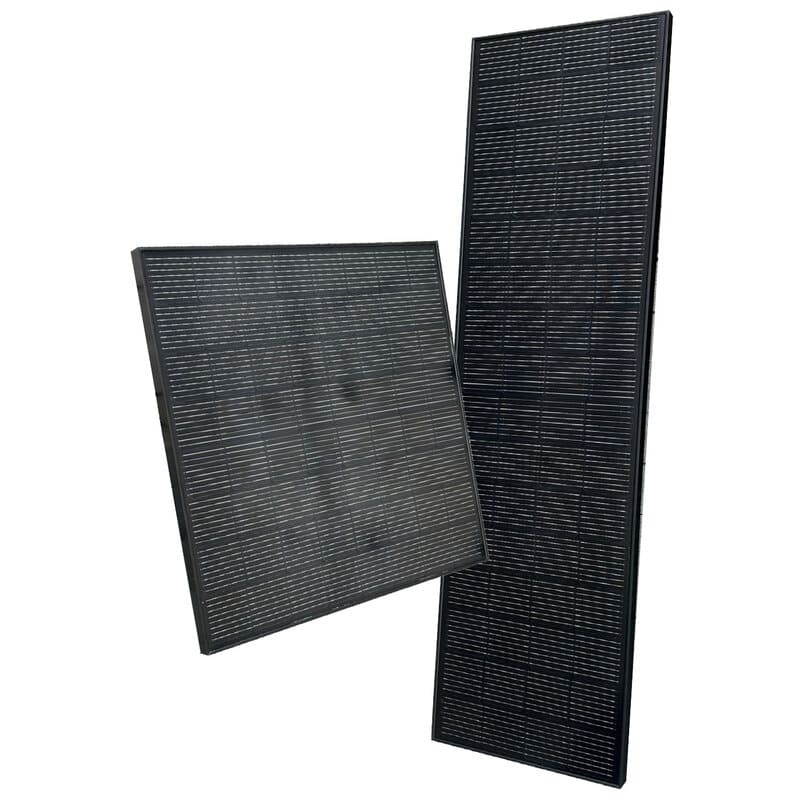
The twin panels ULTRAblack tiger 120 ZQ + ZL – the perfect duo for making use of complicated roof layouts without technical problems
The Advantages of the Twins at a Glance
Maximum use of space:
Different panel formats allow a clever arrangement even on roofs with awkward shapes.
Easy retrofitting:
Perfect for expanding existing systems – without having to rely on identical panels.
Plug and play:
The panels are technically 100% identical and can be connected to each other without fuss.
High yield:
Optimal use of the available area without power loss due to mismatch, or even damage.
Series or parallel connection:
Thanks to their electrical equality, you can carry out any installation variant as you wish.
The voltage of the panels is chosen so that it is high enough to charge a 24V battery even in a parallel connection – and of course a 12V battery all the more (battery voltage + approx. 5V ).
It is also high enough that in a series connection with shading, enough voltage is still left to continue charging.
But it is also still low enough that normal standard solar charge controllers with a maximum input voltage of 100V can be used in a series connection (with 60V maximum input voltage, only parallel connection per panel!).
Cutting-edge cell and panel technology:
The n-type TOPCon solar cells used are currently regarded as the non plus ultra in terms of efficiency, longevity and performance stability at high temperatures. With a cell efficiency of 24.8% and carefully arranged bypass diodes, ULTRAblack tiger solar panels can score points not just as a duo.
Further Information
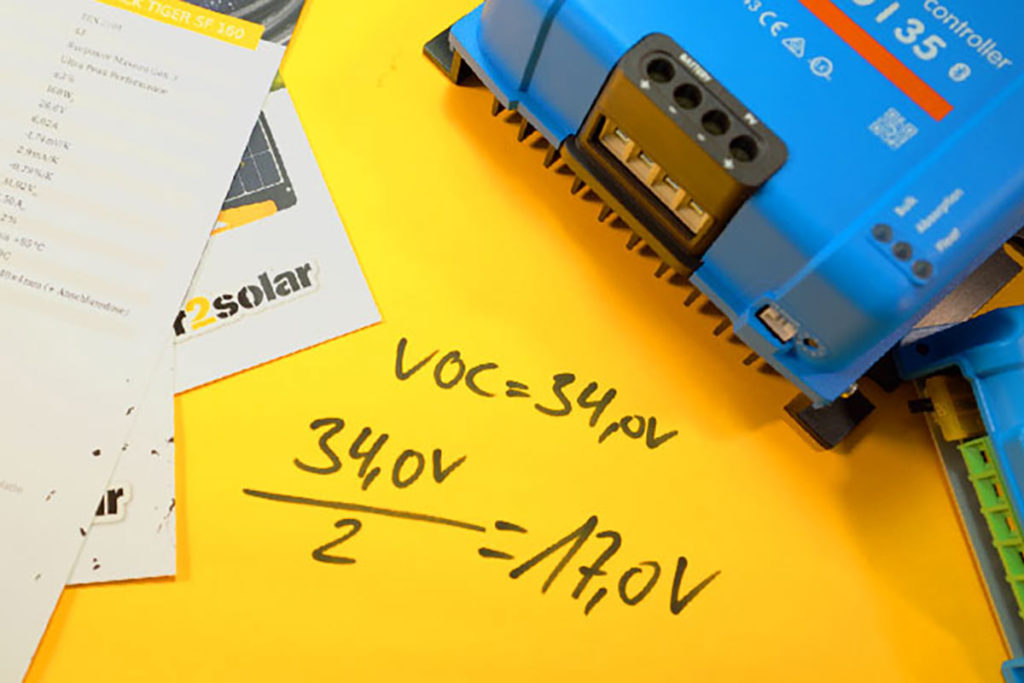
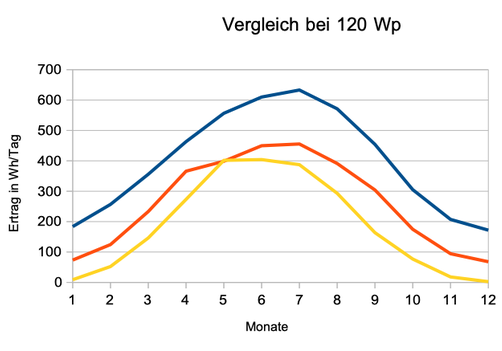
How relevant are cell efficiency and the like for me anyway? And how do I find out which charge controller fits?
Read these articles, which will definitely help you with designing your solar system:

Conclusion: More Solar Power, Fewer Compromises
Connecting different solar panels together often leads to considerable efficiency losses, technical problems and, in the worst case, damage to the solar system. Especially for retrofits and tight space on camper or motorhome roofs, it is therefore crucial to rely on optimally matched panels.
The ULTRAblack tiger twin panels from tigerexped offer the perfect solution for this. They avoid the typical problems of mixing different panels and allow straightforward retrofitting – even when only a single solar cable is available. This makes maximum solar power safely and efficiently achievable in the smallest or most awkwardly shaped space.
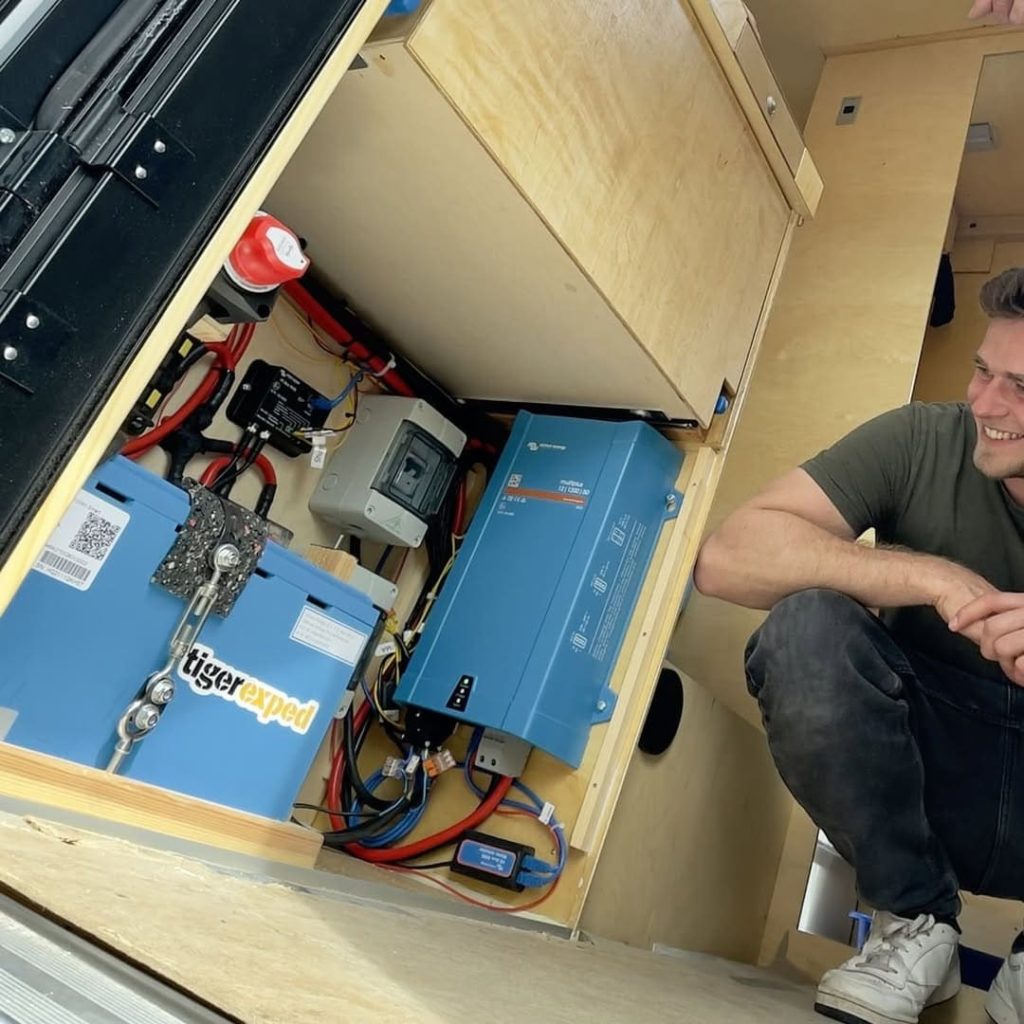
Planning an electrical system for your camper?
We are happy to help you personally with this task. Find out here about our power pro, power basic and 100% preconfigured complete kits – always with an individual wiring diagram and installation instructions!
Did this help you, or even solve your space problem on the roof? Then share this info with like-minded people who would also be glad of it.