

Choosing the right fuse size is crucial for ensuring safety in your motorhome. Incorrect sizing can, in the worst case, lead to serious fires and endanger not only your vehicle but also you.
In this blog article, we will guide you step by step through the selection process, so you can be completely sure you have the optimal fuse size for the various loads in use.
IMPORTANT:
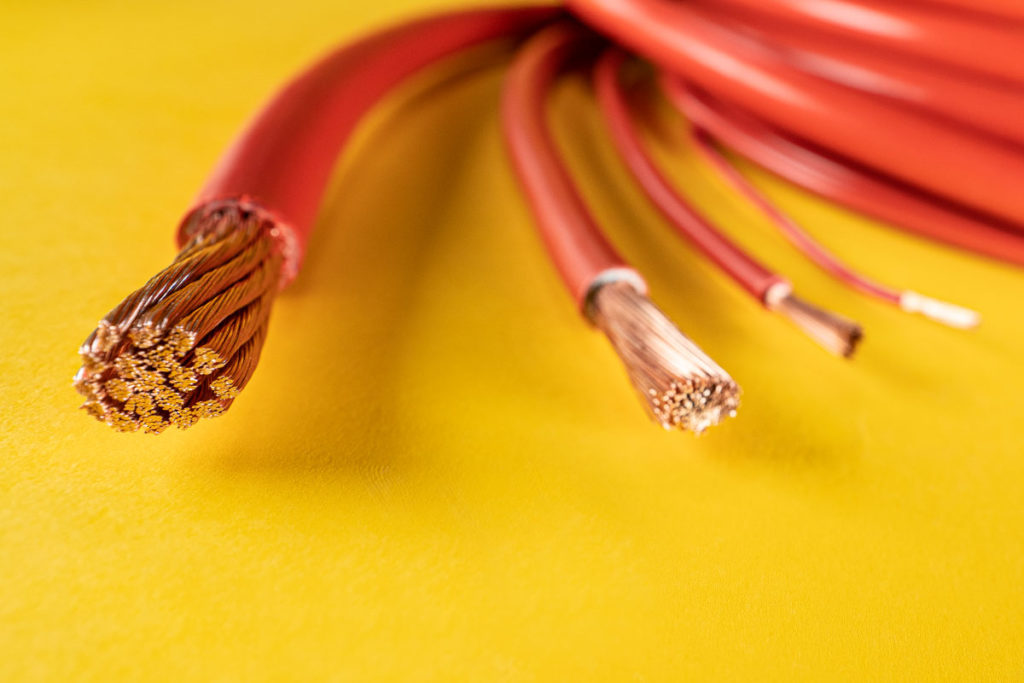
The fuse protects the wiring from overload – but even the best fuse is useless if the wiring itself does not meet the requirements. So please be sure to read our article on correct cable sizing carefully as well!
Update, 10/2026: The tigerexped Cable and Fuse Calculator Is Here
We think it is important to have at least a basic knowledge of how to calculate cable cross-section and fuse yourself – only then can you check whether results you got from online calculators make sense. So by all means work through the relevant articles.
To reduce your effort in day-to-day build work with that knowledge in the back of your mind, you can now use our tigerexped cable and fuse calculator. It is tailored exactly to how cables are used in campers.
Simply enter the power or current draw, the distance to the battery and the installation method of your cable. Besides the voltage drop, the calculator also takes into account the cable’s current-carrying capacity and the influence of heat on the fuse.
Fuse Basics in an Electrical Circuit
Before we get into choosing the fuse size, it is important to understand the basics. The fuse protects the wiring from overload and short circuits.
It “blows” when a wire or another conductive element interrupts the current flow in the circuit by melting once the current exceeds a defined value.
The fuse size ( = its rating / the current level at which it blows) should be chosen so that this melting happens before damage to electrical devices or even fires occur.
Determining the Fuse Size
With this knowledge, it is already fairly easy to imagine how high the rating of a fuse should be. It should be high enough to let enough current through for trouble-free operation of the device, but by no means much more, since the wiring is not designed for that. But how much is “much more”?
In the following steps, we will work out the right sizing together:
How Much Current a Particular Load Needs at Most
We need to know how much current a load actually needs at maximum. If the fuse cannot withstand it, it keeps blowing without there being any real danger.
Simple example: A hair dryer works on the lowest setting, but when you switch up one level, the fuse blows.
It can also happen that a device does not work even on the lowest power level because it needs a very high current briefly only at the moment of start-up. Even though it would work with less current afterwards, you have the problem right at switch-on with the undersized and therefore blowing fuse. This mainly affects devices with motors.
To determine the right fuse size, we therefore need to know the maximum power consumption of the loads connected in this circuit. Many technical devices in a motorhome should be protected with a fuse dedicated to them, while others can be grouped together in one circuit with a single fuse. Examples would be, on the one hand, the pressure water pump, which should always get its own fuse, and on the other hand several LED lights, which can be fused together without problems.
The value current (here our maximum required) is given in amperes (A). You will find this value in the technical data of the respective devices.
Take into account the possible start-up or inrush currents just mentioned, if specified separately.
Adding Up the Currents
Write down all maximum currents of the loads connected to one fuse.
Add them up to get the total power consumption.
The resulting value tells you how much current the entire circuit will draw at most under normal circumstances.
Taking the Safety Factor into Account
The safety factor is an additional safety margin that should be taken into account when choosing a fuse.
If possible, be sure to take a look at the fuse’s data sheet. Here you see an example excerpt from the data sheet of a well-known manufacturer:

The table shows the time-current characteristics of the fuses. It indicates how long it takes for a fuse to blow at a given current flow.
The table is divided into two sections:
30A-125A – fuses with a rated current (the number printed on the fuse) of 30 to 125 amperes.
150A-200A – i.e. fuses with a rated current of 150 to 200 amperes.
Each row of the table gives the rated current of the fuse as a percentage. The opening time is the time it takes for the fuse to blow.
Interpreting the Data Sheet
The table shows that fuses up to 125A do not blow at all in the range below 100% of the rated current and can be operated continuously in this range. Only when the current the fuse is maximally rated for is drawn for 360 seconds does the fuse blow.
The times until blowing keep getting shorter as the rated current is exceeded by more – so the higher the flowing current is above the rated current, the faster the fuse blows, to prevent damage to devices and in the circuit.
For fuses from 150A (second column), things look different right from the start. Here the fuse blows already at a current of 75% of the rated current after 360 seconds.
So if you want to run a load that will draw the maximum current as a matter of course, you have to use a fuse with a rating at least 25% higher, so that it does not blow constantly while this load is running.
What to Do Without a Data Sheet
If no fuse data sheet is available, it is quite common in practice to add a safety factor of 20-30% of the maximum current of the circuit in question.
Choosing the Fuse Size
Assume the total current draw in a circuit in your camper is 50 amperes. You take the safety factor into account and add 20%. The total is then 60 amperes.
In this case, the right choice would be a 60-ampere fuse.
If the value you determined does not exist as a standard fuse size, choose the next higher size.
Taking Ambient Temperature into Account
An often overlooked but extremely important factor when choosing the right fuse size is the ambient temperature.
This is especially relevant for use in vehicles, as they can heat up strongly in the sun. Often, however, the ambient temperature around the fuses is also elevated at low outside temperatures. When the electrical system is installed in bench seats, cabinets or other enclosed spaces, the heat given off by the working components can cause a considerable rise in temperature inside this electrics compartment.
TIP:
Make sure your electrics installation space has good ventilation so that the installed devices can dissipate their heat. This ensures flawless and, above all, safe operation of the components.
Reduced Current-Carrying Capacity
High temperatures significantly affect the performance of fuses and the current-carrying capacity is reduced.
Temperatures above the standard temperature (usually 23° C) are also responsible for faster blowing (i.e. blowing at lower currents).
To account for these effects, it is advisable to size the fuses accordingly. For motorhomes and campers, it is recommended to assume a possible maximum temperature of 65°C in the fuse box.
Download the Current-Carrying Capacity Table at 65° C
To help you choose the right fuse size while taking high temperatures into account, we provide a table as a download. This table, based on data from the renowned brand manufacturer LittleFuse, shows the maximum continuous current-carrying capacity of various fuse types at a temperature of 65°C. Note: Values from other manufacturers may deviate slightly.
Choosing the Fuse Type
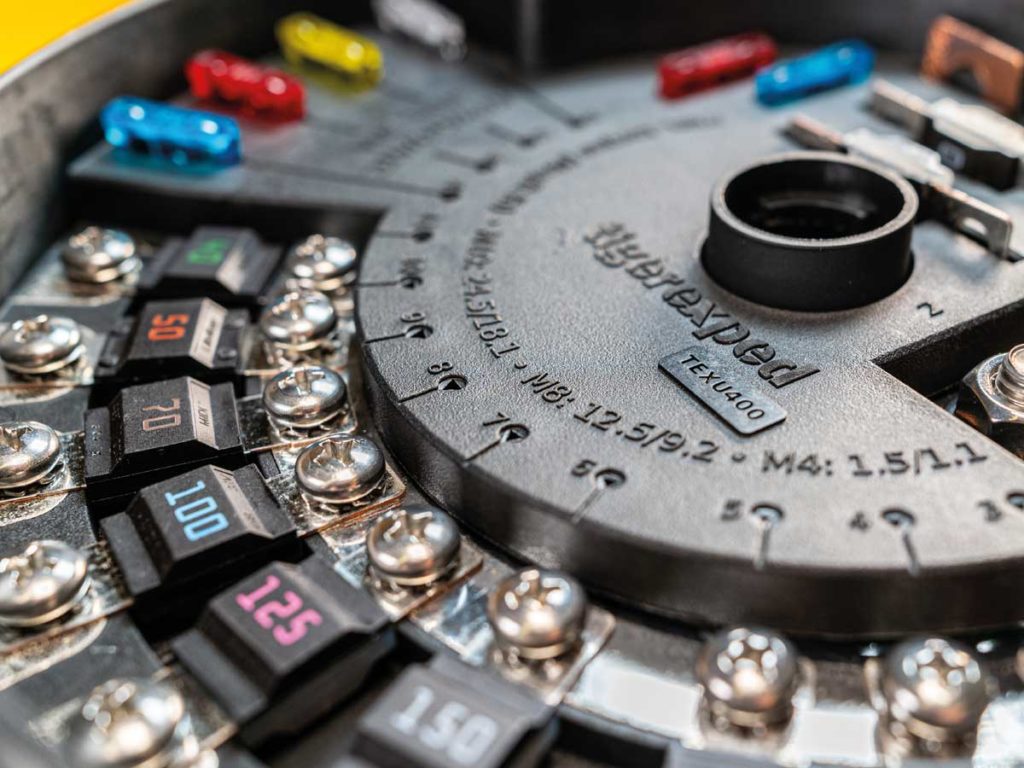
Besides the rated size of the fuse, it is important to choose the right fuse type. Standard in 12V systems are blade fuses (ATO or ATC), and for higher currents also MEGA or MIDI fuses.
MAXI fuses are also common in motor vehicles. In campers, however, they are rarely used.
Blade Fuses (ATO, ATC)
Blade fuses are typically used in applications with lower currents, normally up to 40 amperes.
They are suitable for smaller loads in the motorhome, such as lighting, small fans, radio and other electronic devices with low power demand.

MIDI Fuses
MIDI fuses sit in a middle range and are designed for currents from roughly 20 amperes up to 200 amperes.
They are often used in applications with medium power consumption, such as refrigerators, water pumps or chargers in the motorhome.

MEGA Fuses
MEGA fuses are used in applications with higher power consumption, normally in the range from 40 amperes to several hundred amperes.
They are used for power-hungry devices such as inverters, electric heaters or other larger loads in the motorhome’s 12V system.

MAXI Fuses
MAXI fuses are used similarly to MIDI fuses; the only difference is that they are plugged in rather than screwed in.
They have a protection range of 30A to 80A.
Note:
It is important to check the manufacturer’s specifications and technical data for every device and every fuse to make sure the choice meets the specific requirements.
Installation and Inspection
Install the chosen fuse according to its type by plugging or screwing it in.
Make sure that all connections are seated firmly, there is no corrosion on contact surfaces, and the connected cables are properly secured and any exposed cable strands are insulated.
From time to time, you should take a look at the condition of fuse holders and fuses, e.g. while regularly dusting off ventilation slats and the like.
Conclusion – The Key Takeaways for Choosing the Right Fuse Size in a 12V Motorhome Electrical System
- Electrical fuses are an important safety factor and protect against overloads and short circuits that can lead to defects or fires.
- To determine the right fuse size, calculate the maximum power consumption of each connected component in amperes. Take start-up currents into account, especially for devices with motors.
- Add up the maximum currents of all loads to calculate the total current draw.
- Check the fuse data sheet to see whether you need to add a larger or smaller safety factor. A safety factor of 20-30% of the maximum total current is common.
- Choose a fuse rating that is equal to the calculated value or the next higher standard size. Also double-check that the chosen range is still safely covered by the cable cross-section in use.
- Install the chosen fuse (ATO/IATC, MIDI, MEGA depending on the current range) according to its type and check the installation regularly to ensure that everything (continues to) work flawlessly.
Did this article help you? Feel free to recommend it to friends and like-minded people, too.
You will probably be interested in these topics as well.

