

Reliable travel in a van or motorhome requires an independent power supply. The inverter, also called power inverter , plays a key role in many electrical systems for this.
But not all inverters are equal. There are different types, power classes and features – good quality and “not so good” quality.
In this article we want to look at which inverters there are, where the differences lie and which mistakes are often made, especially when choosing the right “size”.
We also cover important points on installation and maintenance.
After reading the article, you should be able to calculate exactly which inverter fits your needs, so that your appliances work reliably on the road and damage or risks to your safety in the motorhome are avoided.
Inverter in a Motorhome – When Do You Need One at All?
Not everyone strictly needs an inverter in their travel vehicle. It depends on the appliances you want to use and what kind of power they need. Many loads can run directly from the battery.
Direct Current and Alternating Current
In motorhomes (and also in cars, boats and other vehicles) we use a 12 or 24 volt DC system. This is simply down to the power source: batteries, both starter and leisure batteries, produce direct current (DC = Direct Current).
Direct current means that the electric current flows constantly in one direction (direct). Alternating current (AC = Alternating Current) is different: the direction of the current changes regularly (alternating).
Most of the appliances we use in a van or motorhome (such as lighting, pumps, etc.) are designed for direct current. A USB socket designed for a 12 volt system also needs no inverter, because it can use the direct current directly. It converts the direct current into a form that the USB devices in the motorhome can safely use.
Which Appliances in a Motorhome Need Alternating Current?
An inverter is needed if you want to use appliances that are designed for use in the home. Anything that runs on a normal 230V plug definitely falls into this category.
Types of Inverters – Modified and Pure Sine Wave Inverters
There are two main types of inverters: modified sine wave inverters and pure sine wave inverters.
Modified sine wave inverters are usually cheaper. For many simple appliances they can be perfectly adequate, but they produce a waveform (the shape of the current flow) that can interfere with more sensitive appliances.
Laptops should never be run on such inverters, as they can suffer considerable damage.
Pure sine wave inverters, on the other hand, produce a smooth, pure sine wave that is identical to the power from the public grid. They are more expensive, but they are also safer for running sensitive appliances.

Calculating the Inverter Size
To choose an inverter with the right power rating, you need to know your energy demand and also keep the following important pitfalls in mind. Here is how to proceed step by step:
Step 1:
Define which appliances you want to run in the motorhome and determine their power in watts. As a rule, this is printed directly on the device. Look for the entries power or power consumption and W or watts.
Step 2:
If you want to run several appliances through the inverter, calculate how many watts would be drawn if they all run at the same time. Add up the individual power ratings to get a total power / total wattage.
Step 3:
Also add a power buffer of 20 – 25% to allow for short-term power peaks (e.g. when some appliances start up).
With these three steps you have worked out what your inverter has to deliver – but that is not all it takes for your appliances to run smoothly in everyday travel! So be sure to also heed the following notes.
Peak Power vs. Continuous Power – A Common Mistake
As a rule (and with trustworthy products always!) you will find not just one but two power ratings on an inverter’s data sheet:
The higher value, the peak power, can only be drawn for a short period. According to manufacturer specifications, that is usually only a few seconds up to about 5 minutes.
This means:
If you want to run a 1000 watt coffee machine and use an inverter with 1000 watts of maximum power, it will get terribly hot and (hopefully) switch itself off before your coffee has finished brewing!
So always use the power the inverter can deliver continuously as your basis for sizing.
ATTENTION: You should be wary, or look for a different product / manufacturer, if the device or its data sheet:
- Gives only one power rating (without making clear whether it is a peak or continuous power).
- Nowhere mentions a power rating in relation to the period for which it can be drawn.
Influencing Factor: Temperature
Electronic devices generate heat while they work. To keep them from getting too hot and possibly being damaged, they have to get rid of that heat. The ambient temperature naturally plays an important role here.
If it is hot around the device, it has a harder time dissipating its heat – if it is cold, the device can cool down better too – logical. So at a high ambient temperature the device, in our case the inverter, runs at a higher temperature level, which affects its performance in various ways.
First there is a reduction in efficiency. If a certain temperature is exceeded, protective functions in devices from reputable manufacturers kick in to switch it off before it overheats and even causes a fire (more on the most important protective functions further below).
But let us stay with the reduction in efficiency for now: for exactly this reason, the power rating of devices of this kind is stated in the data sheet in relation to a specific ambient temperature. This is usually 25° C. If the ambient temperature exceeds this “standard temperature”, the inverter will no longer be able to deliver the stated rated power.
This means:
If you are building out a van for a summer vacation in Spain, then despite good wall insulation the ambient temperature will probably exceed the standard temperature of 25° C on its own over the course of the day.
On top of that, people prefer to install electrical devices in a compartment or cupboard so they are out of sight. This small, enclosed space can heat up surprisingly much from the heat given off by the running devices, even at cool ambient temperatures.
During a summer vacation in Spain you should therefore not expect the full power of our inverter. Keep this in mind when choosing a device and above all: install your inverter so that it is as well ventilated as possible and can dissipate heat. The leaflet or manual that comes with the device often provides important information on this. If it contains a recommended mounting position, you may find that any ventilation slots on the device run vertically in that position. Since warm air rises, this measure aims for good circulation of the ambient air.
Devices Without a Temperature Specification
As we have just seen, it makes a big difference which ambient temperature the power rating of an inverter refers to. A reputable manufacturer of electronic devices therefore states the reference temperature in its data sheet (xx watts at xx °C). If you have a device or data sheet in front of you where this information is missing from the start, you should look for alternatives.

The Product Naming Pitfall
When choosing an inverter, people sometimes do not even consult the data sheet to compare the values mentioned above, such as peak or continuous power. The reason is the naming, which in many cases consists of the manufacturer-specific product name and an appended number. That makes sense, because inverters are offered in different “sizes”, i.e. power levels. To tell them apart easily, the device is named directly after its power.
But what if the number does not correspond to the expected value, namely the actual power in watts?
Here, knowingly or unknowingly, some manufacturers set a trap, because: big numbers simply sound better. That is why the name is sometimes based not on watts but on volt-amperes. In fact, volt-amperes also reflect power, since watts and volt-amperes are closely related. There is, however, an important difference between them:
Watt (W) is the unit of measurement for the actual or “real” electrical power used in a system or an electrical component. It describes the amount of electrical energy converted into other forms of energy (such as heat, light, etc.) per unit of time.
Volt-ampere (VA) is the unit of measurement for the “apparent” electrical power. It takes into account both the power actually used (watts) and the power that is temporarily stored and then released again in alternating current systems due to phase shifts between current and voltage. This additional power is called “reactive” power and is measured in var (volt-ampere reactive).
For completeness: there are also systems in which everything runs perfectly in sync and no phase shift occurs; then watts and volt-amperes are exactly equal. In our case, however, the phase shift does exist, which means the apparent power (VA) is greater than the actual power (W).
Illustrating the Relationship Between Watts and Volt-Amperes
Imagine a truck carrying a load. The total load the truck can carry (including useful and “useless” cargo) corresponds to the apparent power (VA).
The useful load, which actually has value and is used, corresponds to the real power (W).
The “useless” load, which just takes up space but is not really used (such as a stack of shipping pallets), corresponds to the reactive power (var).
This means:
An inverter called the “Best Inverter in the World 3000” may not have 3000 watts of power, even though you would logically expect that. Instead it may deliver only 2400 watts, which makes an enormous difference for our use in the vehicle. So when buying technical devices, always check the data sheet for the real performance data.
Other Features to Consider When Buying an Inverter
Besides power, peak power and modified or pure sine wave, there are a number of other criteria you should consider when choosing an inverter.
Safety Features
When buying an inverter, look out for important safety features. If a cheap device lacks the key protective functions, it can lead to damage to your appliances or leisure batteries and, in the worst case, even end in a fire in your travel vehicle.
- Automatic shut-off: This is an important safety function that automatically switches the inverter off when the battery voltage gets too low. This helps avoid deep discharge of the battery, which could seriously damage it.
- Overload protection: This protects the inverter from damage if the connected devices draw more power than the inverter can deliver.
- Short-circuit protection: Another important safety function that protects the inverter from damage if a short circuit occurs.
- Thermal protection: This function switches the inverter off when it gets too hot, to prevent overheating and possible damage or fire hazard.
When buying an inverter, and technical devices in general, make sure they have been tested and certified for safe operation by recognized organizations.
Efficiency
Besides safety, efficiency matters too.
Inverters themselves use a certain amount of power for the conversion process from direct current to alternating current.
So when an inverter is running, more energy is drawn from the batteries than ends up in the appliances. Your batteries run down faster, which of course shows in your off-grid time if you have no good power yield at the moment, e.g. from solar.
The higher consumption also puts more strain on the battery(ies) through more charge cycles, which can ultimately even affect their service life.
Standby Consumption
Besides the losses while the inverter is running, there is also energy consumption in the form of standby power. It is needed to keep the inverter ready for operation.
A 3 kW inverter, for example, draws about 20 watts from the batteries even when it is not in use. Since this is a not insignificant amount in a van or motorhome, it can be a good idea to make the inverter switchable on and off remotely or to install it so that you can easily reach the on/off switch on the device itself, to avoid standby power consumption.
Design
Besides the distinction between inverters with modified or pure sine wave, there are basically two different types of inverters that can be distinguished by their design: those with transformers and those without transformers.
Inverters With a Transformer
They use a transformer to step the voltage of the output-side alternating current up or down. These inverters provide galvanic isolation between the input and output sides. This means that the DC side (i.e. our leisure batteries) and the AC side (the connected devices) are electrically separated from each other. This increases safety, as the risk of faults and damage from overvoltage or short circuit is reduced.
The drawback is that they are usually larger, heavier and more expensive than inverters without a transformer. They may also be slightly less efficient, because energy is lost as heat when power is converted through a transformer.
Inverters Without a Transformer
They have no transformer and convert the direct current directly into alternating current.
They are usually lighter and cheaper than inverters with a transformer. They can also be slightly more efficient, as they avoid the energy loss from conversion in a transformer.
Transformerless inverters do, however, have some specific disadvantages, including safety concerns: devices of this design can pose a safety risk, as they do not offer the same level of electrical isolation between DC and AC circuits as their transformer-based counterparts.
Inverters without a transformer are more sensitive to voltage fluctuations. They can react sensitively to running appliances with high power consumption or to connection to unreliable power sources (as can happen more often in mobile applications).
If an inverter without a transformer encounters a sudden change in the power supply, such as a sudden increase in load or a brief failure of the energy source, it could pass this surge directly on to the connected devices. This can cause sensitive electronics to be damaged or to fail prematurely.
There is no uniform or at least typical designation that lets you tell at a glance which design an inverter is.
We recommend going for the somewhat more expensive devices with a transformer if you want to be on the safe side.
Sizing of the Cable Connections
A suitable cable size for connecting the inverter is essential for reasons of efficiency and above all safety. It is influenced by various factors, such as its length, which is determined by the choice of mounting location.
Environmental conditions, such as the cable running through a conduit, can also mean that a thicker cable has to be used.
When choosing the inverter, make sure that its terminals are suitable for accepting the cable size appropriate in your case, together with suitable components for it.
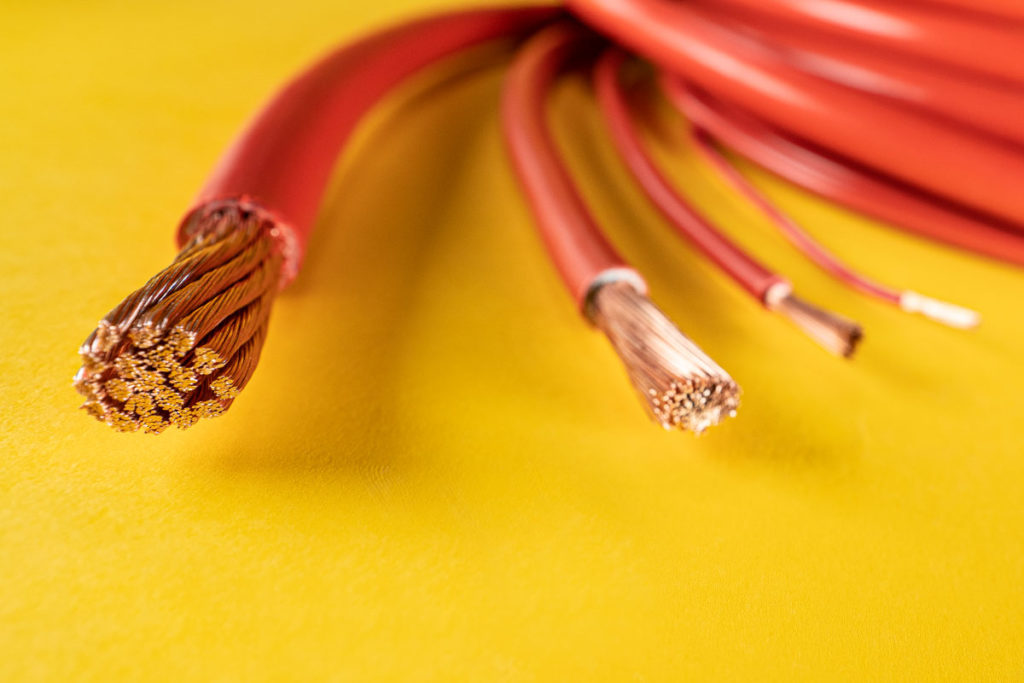
Which cable size do you need to use?
You can find out how to easily calculate the right cable cross-sections for all your connections yourself here:
Update, October 2026:
To make your work easier or to check your calculated results, you can now use our tigerexped cable and fuse calculator. The calculator is designed specifically for use in camper builds and takes the relevant pitfalls into account directly.
Installing and Maintaining Inverters
The inverter should ideally be installed close to the batteries to minimize power losses.
Safety and performance aspects also have to be considered, such as sufficient ventilation, as we have already covered in detail above. Protection from moisture is also very important – logical, for electronic devices.
And even if everything has been connected and installed properly: please never mount such devices on easily flammable surfaces (felt-covered walls and the like).
As for maintenance, inverters usually need little attention, but regular inspections should still be carried out to spot problems caused by dust build-up (keyword: heat dissipation) or cables that have worked loose through driving or other influences at an early stage.
Our Recommendation
We use and recommend the inverters and inverter/chargers from Victron Energy. For many years, Victron components have proven themselves in motorhomes, vans and boats as well as in permanently installed systems in (tiny) houses.
For the reasons mentioned above, our configurable complete electrical kits and our individually planned power pro systems always include the devices we affectionately call “blue boxes”, such as the Phoenix Inverter or a MultiPlus.

Inverters in a Van and Motorhome – Summary
Choosing the right inverter is a crucial step in getting the most out of an independent power supply in a motorhome.
Only through careful selection, calculation and professional installation can the inverter supply the appliances you carry with reliable power and protect them from possible damage.
Choosing a high-quality device can also extend your off-grid time and even the service life of the leisure battery(ies).

If you need help putting together an electrical system in which not just the inverter but all components fit together perfectly, try our Electrical Kit Configurator.
For more complicated projects, our technical experts are also there for you personally – with individual advice by phone.
Did this article on choosing the right inverter help you? Then feel free to recommend it to others or save it for later:
You might also be interested in these topics:


