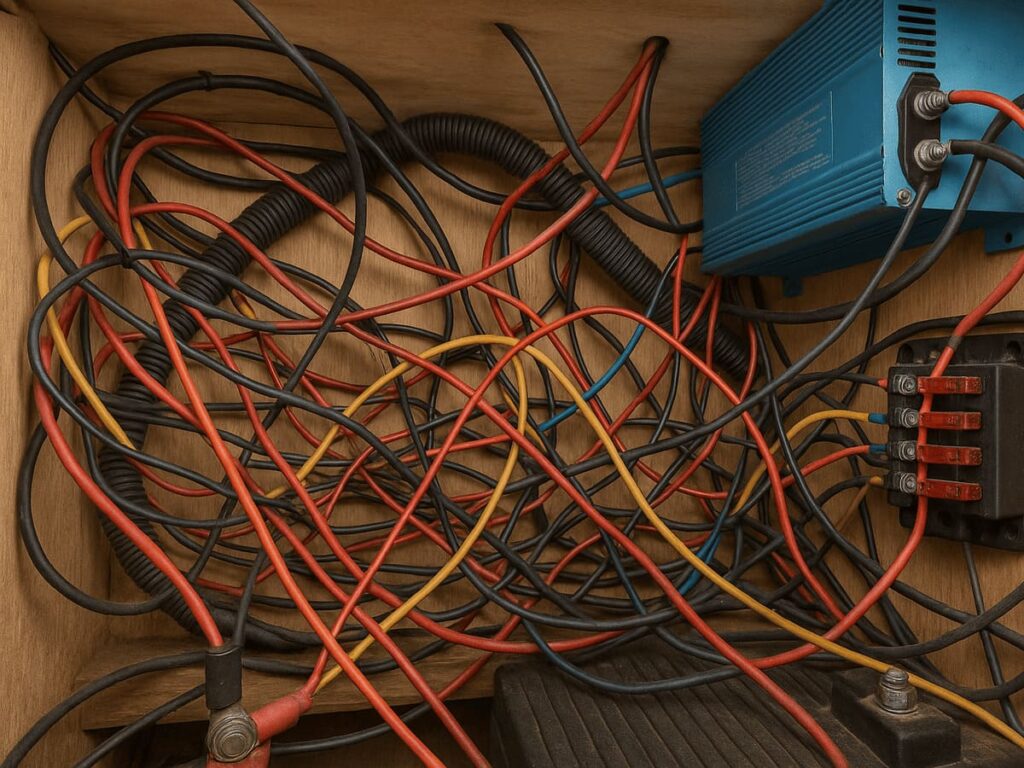
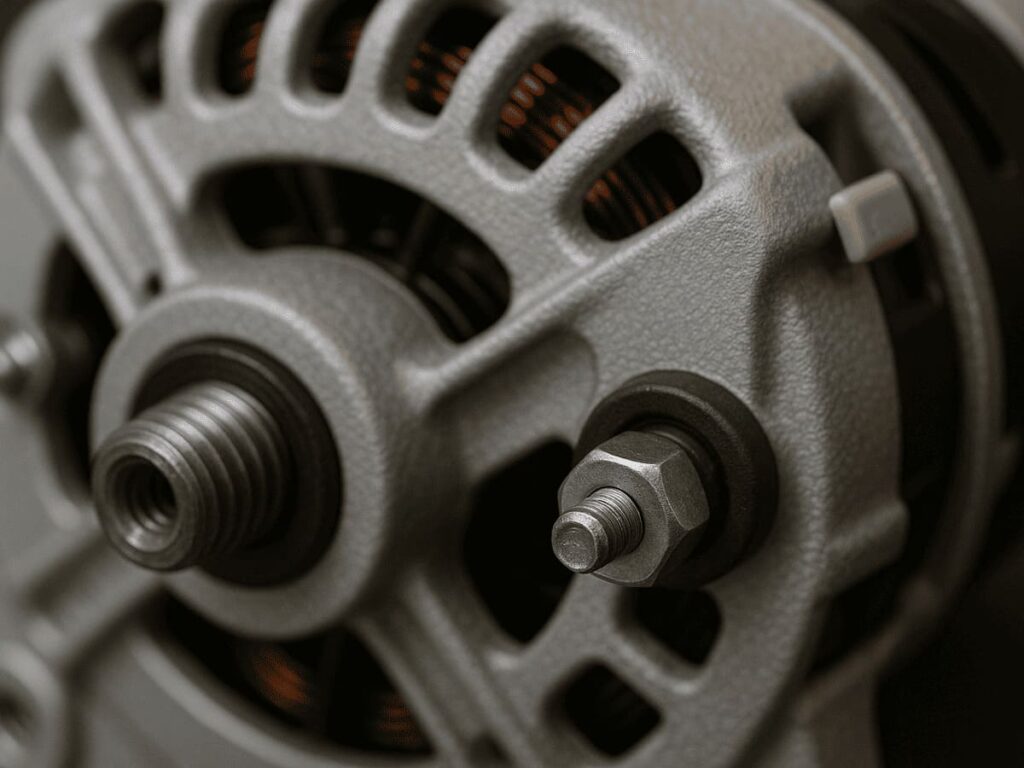
“Why isn’t my battery charging while I drive?”
This question sometimes pops up out of nowhere when a freshly installed DC-DC charger doesn’t do what it’s supposed to. Instead of a full battery, all you get is frustration. Suspecting a fault in the device is the obvious move – it could be broken, or wired wrong.
Often, though, it’s something else entirely and the DC-DC charger is not to blame – the cause is easy to overlook but crucial: the D+ signal is missing.
What Is the D+ Signal?
The D+ signal is a control voltage that is normally output directly by the alternator as soon as the engine is running. It tells downstream devices:
“The engine is running – let’s go!”
Technically, D+ is also called “terminal 61” – both names refer to the same connection. Typical consumers that need this signal are:
- DC-DC chargers (battery-to-battery chargers)
- Split-charge relays
- Absorption refrigerators
- Satellite dishes
- Electric steps
Why Does D+ Matter?
Using the D+ signal reliably prevents power from being drawn from the starter battery when the engine isn’t running. It works like an intelligent switch: only while the engine is running – and the alternator is therefore active – is the 12 V supply enabled for certain consumers.
Example: Absorption Refrigerator
Absorption refrigerators have a very high power consumption on 12 V – typically 10–15 A or more (and continuously! Daily consumption can easily reach 2500 Wh). Supplying them from the leisure battery or solar is generally not a good idea, because these energy sources would quickly be overwhelmed. That is why the rule is:
- While driving: The refrigerator runs on 12 V from the alternator (switched via terminal 61 / D+).
- When parked: The 12 V supply is automatically cut as soon as the engine is switched off → gas operation takes over.
This ensures that the starter battery is protected and not drained while the vehicle is parked.
Tip: Compressor Refrigerator as a Modern Alternative
Compressor refrigerators are built differently and are much more efficient:
- Up to 5x more economical than absorption models
- Low continuous consumption (approx. 3-5 A, but only about 30% of the time, not constantly. Average daily consumption approx. 300 – 500 Wh)
- Good cooling performance even at high outside temperatures
- Purely electric operation (12 V/24 V), so no gas needed
That makes them ideal for use with a leisure battery and solar system, even when parked. They need no D+, since they are designed for continuous operation – you switch them off manually or via a battery guard.
In systems such as satellite dishes or steps, D+ works as an intelligent safety switch that makes sure the components retract automatically when the engine is started.
No D+ – A “Problem” of Modern Vehicles
In the past, a missing D+ was a non-issue: the alternator delivered a clear signal when the engine started, and devices such as DC-DC chargers, refrigerators or split-charge relays knew: here we go.
Today it’s different. Modern vehicles often no longer have a classic D+ signal.
The on-board electrical systems of today’s vehicles are more complex than they used to be. With Euro 6, smart alternators, start-stop systems and hybrid technology, the classic D+ is often no longer output at all. Instead, vehicles work with, for example, smart alternator control.
From Euro 5 and Euro 6 onwards the alternator is no longer “on” all the time, or, depending on the situation, runs at reduced voltage while the engine is running. This adjustment reduces fuel consumption and emissions. But it also means there is no constant signal from the alternator any more – “engine on” and “alternator running” are no longer the same thing.
The whole control system is now digital, so no analog signal is produced at all. Communication between the alternator, engine control unit and on-board network takes place via the CAN bus or other digital interfaces. The classic D+ signal, or terminal 61 on the alternator, which used to serve as a simple 12 V signal, no longer exists in many new vehicles.
So What Can You Do – Alternatives to Classic D+
The good news: there are now technically clean and reliable alternatives that let you run your system even without a real D+.
1. Voltage-Controlled DC-DC Chargers
DC-DC chargers such as the Victron Orion-Tr Smart, Orion XS and Orion XS 1400 are specifically designed to work even in modern vehicles without a classic D+ signal. They detect when the voltage at the starter battery rises above a certain level (e.g. 13.2–13.4 V), which is typical when the engine is running.
The Victron Connect app lets you configure the DC-DC charger to your individual situation, including charge detection, thresholds, a time delay and the like.
Nevertheless, depending on the vehicle model, an additional D+ signal may be necessary to ensure safe operation.
The system only works reliably if the alternator delivers a voltage above the switch-on threshold. If the vehicle’s electrical system has lowered the alternator voltage, the signal is often insufficient. Start-stop systems can also cause difficulties.
Example: MB Sprinter (newer generations)
Take the Mercedes Sprinter, popular with campers: if the outside temperature is above 14 °C and the starter battery is fully charged after a few minutes of driving, the alternator reduces the voltage from an initial 14.4 V to around 12.7 V. If you then switch on the dipped headlights, the voltage rises again to approx. 13.5 V. (Values and behavior of the on-board electronics depend on the model!) With such a low and/or changing voltage, DC-DC chargers and the like cannot be switched reliably.

The classic model from the renowned manufacturer Victron Energy.
Output max. 400W (can be paralleled), but very flexible and equipped with Bluetooth.
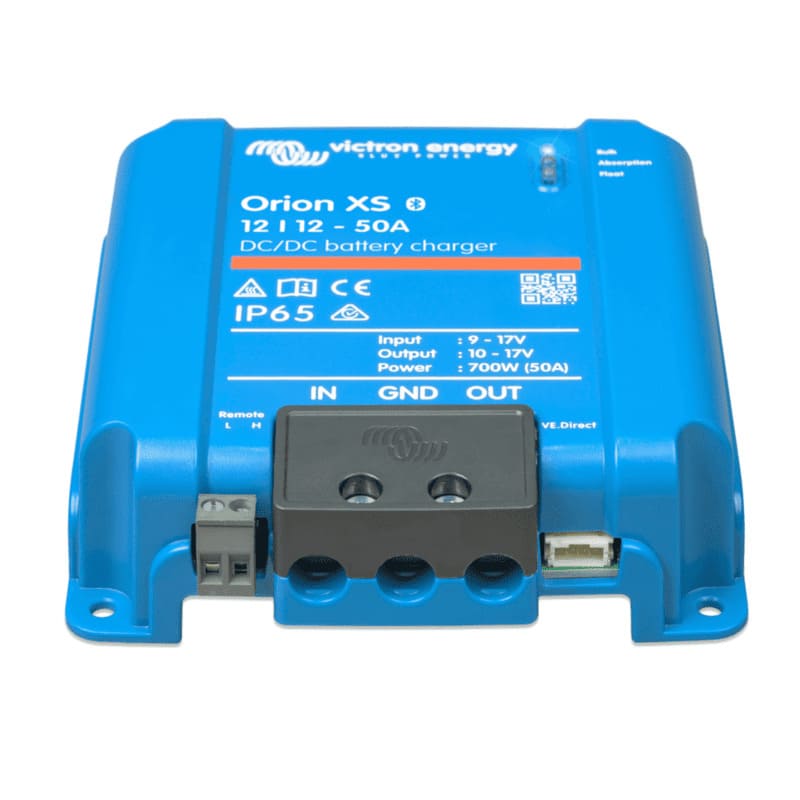
This DC-DC charger can convert both up and down.
Usable as a battery charger or as a power supply, with 98% efficiency.
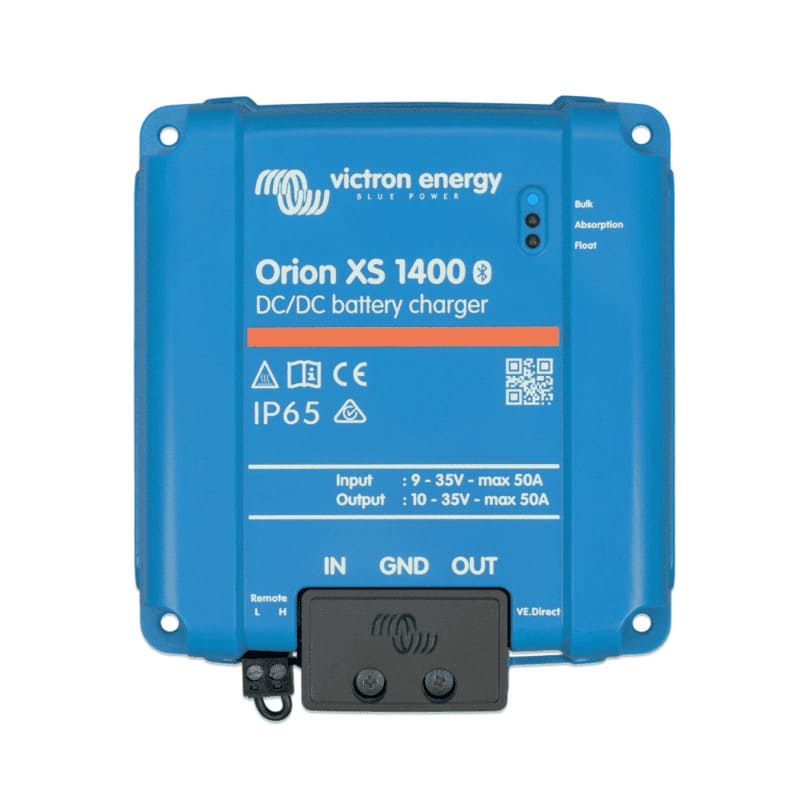
The most powerful version of the new XS series, especially for extensively equipped vehicles where very large battery banks need to be charged quickly. Up to 1400W (at 24V/24V).
2. D+ Simulator Pro
A D+ simulator is the most reliable solution for exactly the problem of a missing D+ signal and inadequate voltage monitoring.
The VOTRONIC D+ Simulator Pro reliably detects a running engine – independent of alternator management or vehicle electronics – by means of vibration and voltage monitoring. It then generates an artificial D+ signal including intelligent switch-on delay and switch-off logic. A safe solution even for vehicles with start-stop systems or fluctuating alternator activity.
Advantages:
- Reliable engine-running detection through a vibration detector
- Reproduces a genuine D+ signal
- No access to the alternator or CAN needed
- No intervention in the vehicle electronics
- Plug-and-play installation
The D+ simulator is simply connected to positive and ground of the starter battery. Its output then supplies the D+ signal for the DC-DC charger. Ideal in combination with Votronic VCC series DC-DC chargers or any other DC-DC charger. Depending on vehicle type and DC-DC charger, the D+ Simulator Pro is indispensable.
Note:
The D+ simulator is also available in a non-Pro version. However, that one is also only voltage-controlled and so can do no more than the DC-DC chargers themselves. The non-Pro version is therefore cheaper, but useless.

Votronic D+ Simulator Pro
Reproduces a genuine D+ signal, reliable engine-running detection, simplest installation.
Installation note:
When using a D+ Pro simulator together with a voltage-sensing DC-DC charger, the charger must be configured so that its own voltage-based control is switched off and the device only responds to the signal from the D+ simulator instead.
3. CAN Bus Adapter or Retrofitting D+
Even if they don’t output a D+ signal: the on-board control units naturally know when the engine is running and when it isn’t – that information is available in the system at all times. It would only have to be output via a suitable terminal.
In many cases such a D+ signal can be retrofitted, but this often involves considerable effort and cost.
Often there are several versions of the same control unit: if the D+ function is not provided from the factory, a variant without a suitable output terminal may have been fitted. In that case the control unit has to be swapped for a version with D+ function.
In some cases, however, it is enough to program the existing control unit accordingly and run a wire to the desired location.
In any case, using a D+ Pro simulator will be the easier and more cost-effective way to get your DC-DC charger to do what you want it to.
Caution with Factory-Built Motorhomes: D+ Usually Present
Here we have talked about a common problem in, for example, panel van and self-build conversions: the DC-DC charger doesn’t work because the D+ signal is missing – which, by design, can be the case in modern vehicles. Here the missing D+ signal is not an installation error.
It’s different with factory-built motorhomes, i.e. vehicles built as motorhomes from the factory (e.g. by Hymer, Knaus, Bürstner etc.):
In these vehicles the D+ signal is usually already present. If the DC-DC charger doesn’t start correctly there, the obvious suspicion is that:
- the D+ signal was not connected correctly,
- a different (unsuitable) signal was used (e.g. ignition plus),
- or a connection was mixed up.
Tip:
In such cases it’s worth checking against the vehicle wiring diagram, if available, or asking the vehicle manufacturer. A wrongly chosen connection is more likely here than a missing signal.
Conclusion
A missing D+ signal on modern vehicles is not a defect, but state of the art.
DC-DC chargers, refrigerators etc. still need a reliable signal that says: “Engine running.”
The best solutions are:
- Voltage-controlled chargers (if the voltage thresholds are reached)
- D+ Simulator PRO for maximum reliability with minimal installation effort.
With these methods, the additional electrical systems in camper conversions can be operated reliably even in modern vehicles with smart alternators.
If vehicles are designed as campers as standard from the outset, a missing D+ signal, by contrast, is often a sign that a wrong connection was used.
Did that help? Feel free to share the article with friends who are also interested in building out a camper:
These magazine articles might also be interesting for you: