
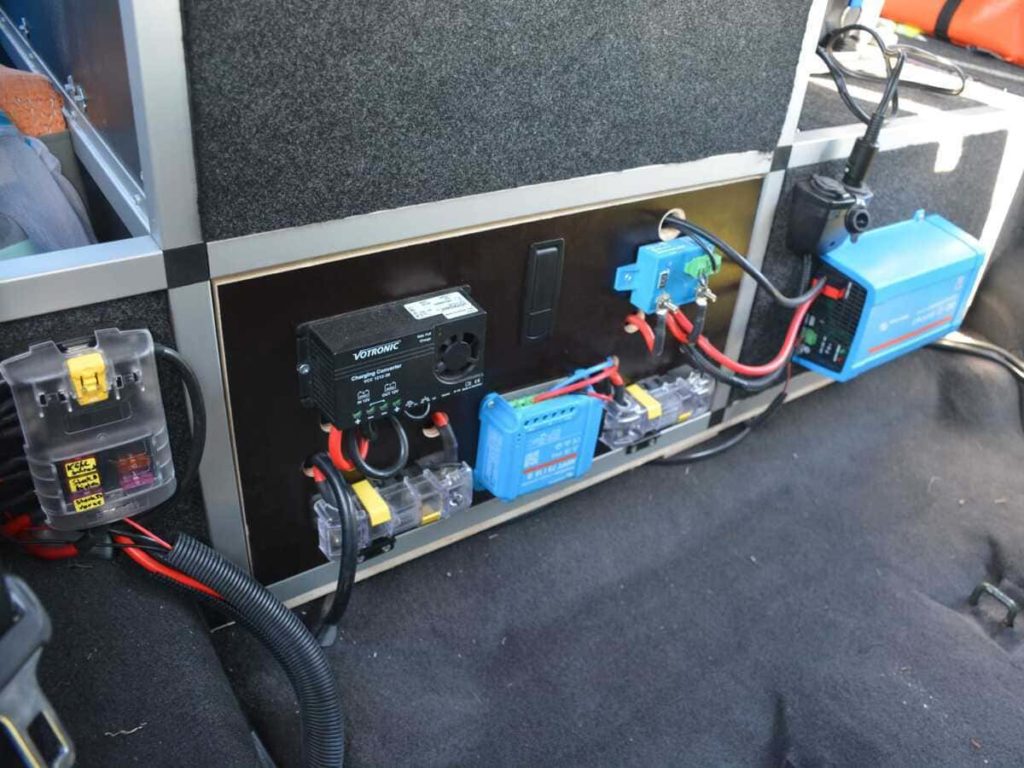
Anyone who deals with onboard electrics today will sooner or later stumble over the question:
Why is a DC-DC charger recommended instead of a split-charge relay with modern batteries – especially lithium batteries?
To understand this, it helps to take a brief look at the development of battery technology and at the interplay between alternator, starter battery and leisure battery.
Split-Charge Relay: A Solution From a Different Era
Split-charge relays date from a time when vehicles were fitted almost exclusively with classic lead-acid batteries. AGM and gel batteries came later – technically more advanced, but chemically still lead batteries.
A split-charge relay works very simply: it connects the starter and leisure batteries in parallel as soon as the alternator is running. For this to work reliably and without damage, however, the same battery types with the same chemistry must be used.
The reason lies in two decisive properties of batteries:
- the charging curve
- the internal resistance
Different battery types react differently to voltage and current – and this is exactly where the problems begin.
Different Lead Batteries, Different Requirements
Even with different types of lead batteries, a split-charge relay reaches its limits. A classic lead-acid battery is usually full at a charge end voltage of about 14.4 volts. Many AGM batteries, on the other hand, need 14.6 to 14.7 volts to be truly fully charged.
A split-charge relay cannot adjust this voltage. It simply connects in parallel – so 14.4 volts doesn’t suddenly become 14.7 volts. The result: AGM batteries often never get completely full.
The Temperature Problem
Even more critical than an incompletely charged leisure battery is overcharging. While a battery that doesn’t get quite full often keeps working for a long time in everyday use, a charging voltage that is too high shortens service life quickly and significantly.
This can happen because the alternator regulates its charging voltage primarily according to the requirements of the starter battery. That battery sits in the engine bay and is therefore strongly dependent on the ambient temperature.
When it’s bitterly cold, it needs a higher charging voltage to be fully charged, and the alternator obliges.
The leisure battery, by contrast, is usually located in the interior or in an insulated storage compartment and is therefore at significantly higher temperatures. If it is now charged via the split-charge relay with the same increased voltage that is actually intended for the cold starter battery, overcharging occurs.
The consequence is that the battery starts to gas. Electrolyte is decomposed, water is lost and the battery “boils”. Unlike classic starter batteries, this loss cannot be compensated, because AGM or gel batteries are maintenance-free and cannot be refilled. The battery is ruined relatively quickly.
The Job of the DC-DC Charger
Considering the problems just discussed, it becomes clear why the DC-DC charger is the only right choice: it decouples the leisure battery from the temperature-dependent charging voltage of the alternator and ensures it is always charged with a suitable, controlled voltage – and it can even raise it by itself when required.
That is why using a split-charge relay is no longer sensible today, even if no lithium battery is involved.
Why It’s Especially Critical With Lithium Batteries
It gets really critical when a lithium battery comes into play. While the internal resistance of a lead battery rises with increasing state of charge, with lithium batteries it stays very low – even at a high state of charge.
You need to know this:
Current is lazy and always takes the path of least resistance.
So if you connected a lithium battery in parallel with the starter battery via a split-charge relay, most of the current would flow preferentially into the lithium battery. In the extreme case, an empty lithium battery can “suck dry” the entire starting circuit – leading to starting problems or malfunctions in the vehicle.
The DC-DC Charger as Protection and Control
With lithium batteries, a DC-DC charger fulfills two decisive tasks:
- It provides the correct charging voltage and charging curve that lithium batteries require.
- It limits the current flowing from the alternator to the leisure battery.
This current limiting is essential so as not to overload the starter battery and the vehicle electrical system.
For older vehicles without particularly high electrical loads, a rough rule of thumb has become established: plan for about 50% of the available alternator current for the DC-DC charger.
With a 100 A alternator, that would be 50 A of DC-DC charger output, for example.
Modern Vehicles Need More Reserve
With current vehicles – especially Euro 6 and Euro 6d-TEMP models – the situation is considerably more demanding. Control units, driver assistance systems and comfort loads constantly need energy. That’s why significantly more current should remain in the starting circuit here.
As a rule of thumb:
About one third of the alternator current may flow into the lithium battery, two thirds stay in the vehicle electrical system.
With a 100 A alternator, this means: a DC-DC charger of around 30 A is realistic and sensible.
Smart Alternator Control
In modern vehicles, the alternator is no longer run at full power all the time. The on-board electronics regulate the charging current as needed and reduce it as soon as the starter battery is detected as sufficiently charged. The aim is to save engine power and thereby reduce fuel consumption and emissions.
For an additional leisure battery, however, this means: it often receives only brief or even no meaningful charging current. Without a DC-DC charger, you can’t get it properly full at all anymore.
Battery Size, Charger Output and Reality
At this point a frequently underestimated problem shows up. Many vehicles are fitted with very large lithium batteries – 300 Ah or more – while the alternator and DC-DC charger remain comparatively small.
A calculation example makes it clear:
A 320 Ah lithium battery stores around 4,000 Wh of energy.
A 30 A DC-DC charger delivers about 380 Wh per hour.
The result:
To fully charge the battery via the alternator alone, you would need over 10 hours of driving.
That is not a design flaw, but physics. Anyone with short driving distances or high energy consumption should therefore always look at the overall system.
Battery-to-battery chargers for different needs in our shop:
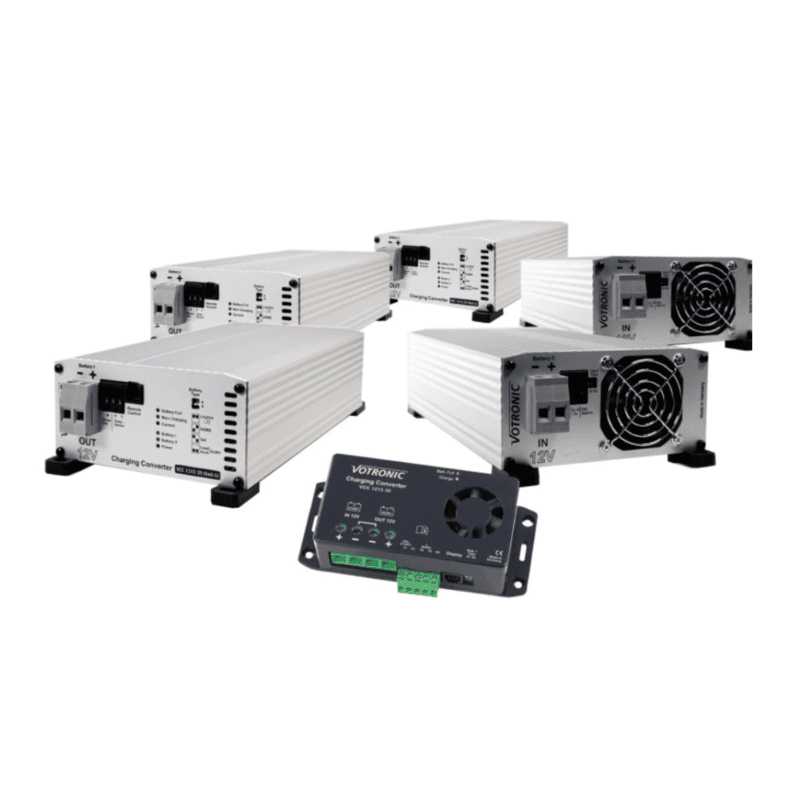
Votronic VCC – The classic for 12V systems
- 12 V → 12 V DC-DC charger
- Maintenance charging of the starter battery while parked via solar or shore power possible
- Fixed IUoU charging curve
- for AGM, gel, lead-acid and LiFePO4
- easy integration
- No app or communication functions
Typical for:
Clear, robust onboard electrics with the added benefit of maintenance charging for the starter battery.
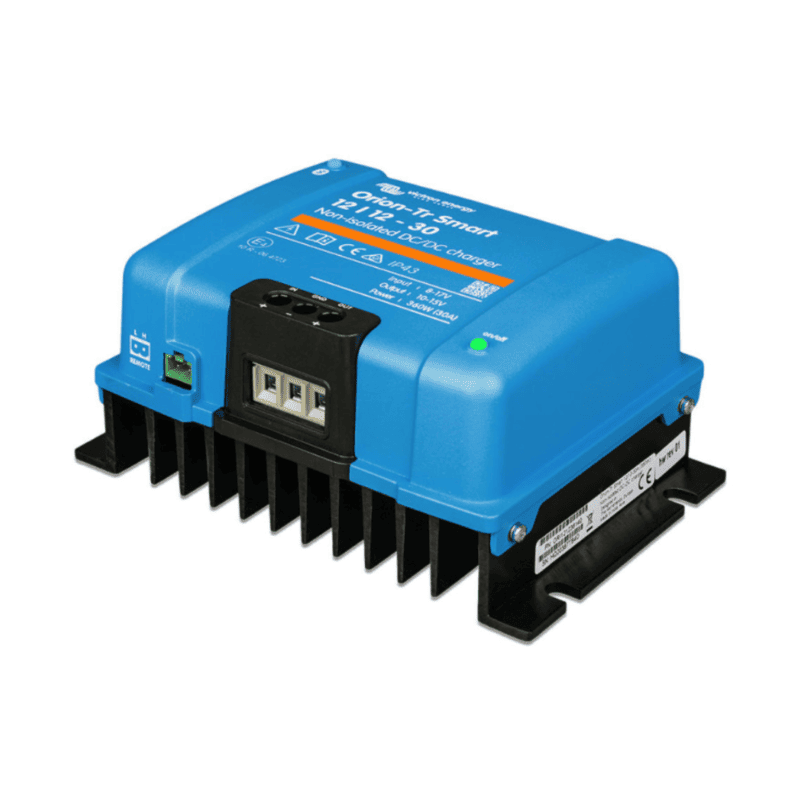
Victron Orion-Tr Smart DC-DC Charger – Flexible, smart, optionally galvanically isolated
- Several voltage variants (12 V / 24 V)
- Bluetooth configuration via app
- Adaptive 3-stage charging
- Variants with galvanic isolation available (for boats)
- Parallel connection of several units possible
Typical for:
More complex vehicle electrics, different voltage levels, or systems where flexible configuration matters.
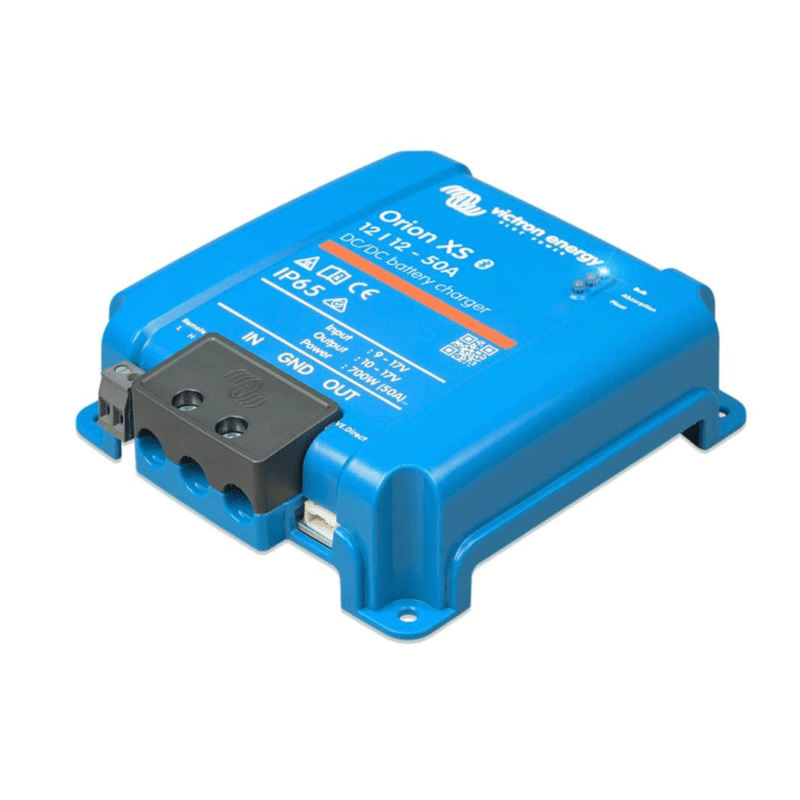
Victron Orion XS DC-DC Charger – High output in a compact format
- All features of the Tr Smart (except galvanically isolated variants)
- higher charging output up to 50A
- Integration into Victron GX systems possible
- Limiting of the max. charging current possible
- Very high efficiency
Typical for:
Powerful onboard systems with lithium batteries and modern system integration. When a compact form and high efficiency are required.
The System Has to Fit Together
Alternator, DC-DC charger and battery capacity must be sensibly matched to each other. In practice this means:
- a realistic assessment of your own energy needs
- additional charging sources such as solar or shore power
- if necessary, even installing a more powerful alternator
A DC-DC charger is no miracle cure – but an indispensable component of modern onboard electrics. It protects the vehicle, ensures clean charging and makes sure the energy arrives where it is needed.
These articles on power in campers and motorhomes might also interest you:



tigerexped technician Nico
brings worldwide travel experience – from Australia to Canada, with vehicles such as the Toyota LandCruiser and Mitsubishi Delica.
As a trained automotive mechatronics technician and experienced, professional vehicle builder, he is a true all-rounder. Whether technical or travel know-how – Nico’s many years of experience solve many a tricky problem.
Did this explanation of DC-DC chargers help you? Feel free to share it with friends and like-minded people who can benefit from it too: