
Hot and drinking water in a camper seems simple at first glance: fill the tank, heat up the boiler, done. In practice, though, it is considerably more demanding.
Different water qualities, long standing times, heating, contact with different materials, partial fill levels without a full water exchange – and often the use of a chemical water disinfectant or system cleaner on top. Many factors come together here.
High-quality 316L stainless steel boilers are designed for exactly these demands and are rightly considered particularly durable and hygienic. But even the best material is not a free pass. Stainless steel does not protect itself through “hardness”, but through a fine chemical passive layer – and under real-world conditions that layer has clear limits.
This article explains the physical and chemical background, shows real limits and describes how to carry out water disinfection sensibly without shortening the life of a 316L stainless steel boiler.
Why Drinking Water in a Vehicle Is a Special Challenge
In travel vehicles, drinking water is taken from public taps, wells or sometimes even streams and other surface waters. The load of solid and dissolved substances in the water can vary enormously. At the same time, the water in the vehicle often sits for days, is heated again and again and is not fully replaced.
This combination leads to long stagnation times, changing oxygen levels, biofilm formation and deposits. Chemical disinfectants are often used as well. From the material’s point of view, these conditions are considerably more demanding than in domestic drinking water systems.


Prerequisites for the Service Life of Stainless Steel
How long a stainless steel boiler actually lasts is not decided by the material alone.
Two areas that are often underestimated are decisive: the quality of manufacturing and the later handling of the material in operation. Both factors act directly on the protective layer of the stainless steel and thus on its resistance.
Stainless Steel Can Do a Lot. If You Let It.
Our boilers are made of 316L stainless steel (material 1.4404). This material has been established for decades in food, pharmaceutical and medical technology and is excellently suited to drinking water applications.
However, the corrosion protection of stainless steel is not based on material thickness or “hardness”.
Stainless steel is passive, not inert. This means it is not a material that does not react at all and needs no protective mechanisms. Instead, stainless steel has an extremely thin, invisible passive layer of chromium oxide. It separates the metal from the water and so protects it from further corrosion. As long as this layer is intact, the stainless steel stays stable and resistant. If it is damaged, in many cases it can even re-form on its own.
If the layer is attacked permanently, however – for example by high chlorine exposure, heat or unfavorable water chemistry – the stainless steel loses its protection. Its resistance depends on this protective layer being maintained.
Manufacturing – Decisive for Service Life
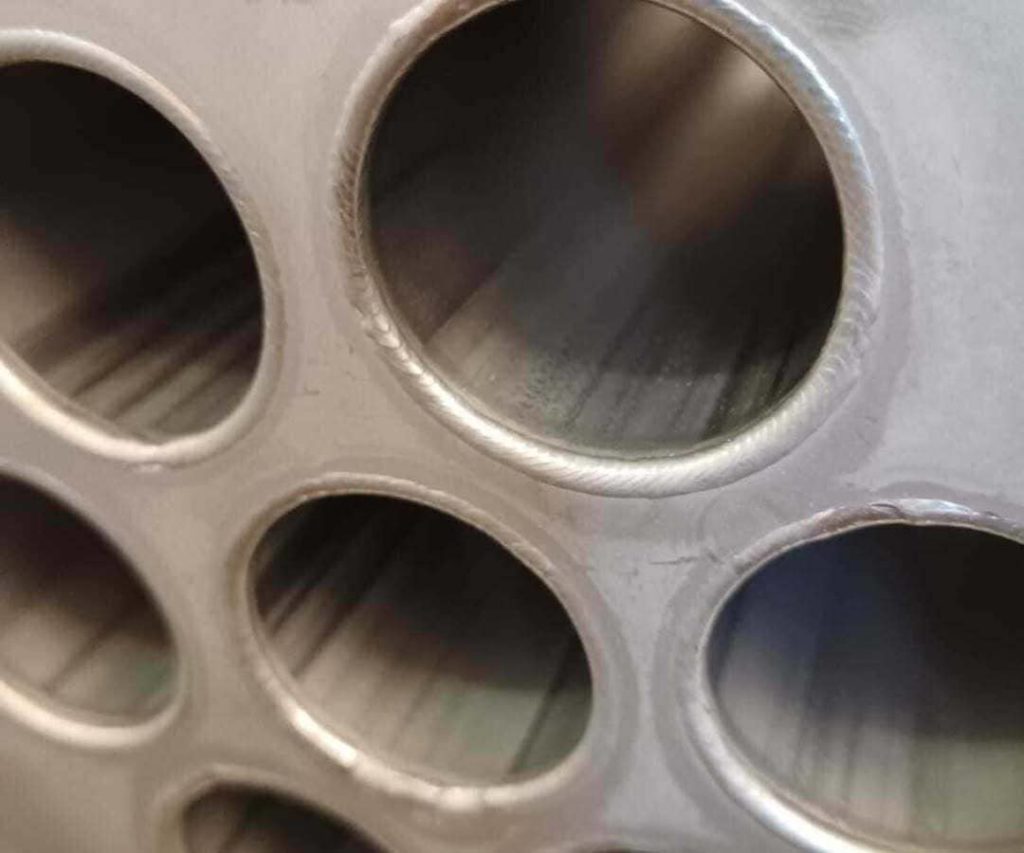
The most sensitive areas of a stainless steel boiler are the welds. Welding creates very high local temperatures, heat tint, metallurgical changes and residual stresses. Without suitable post-treatment, these areas are much more susceptible to corrosion.
This is exactly where high-quality and cheap stainless steel boilers differ.
Our boilers are robot-welded (TIG) and are characterized by a reproducible, consistent weld quality. They are then fully pickled and passivated inside and out. This elaborate process removes weld oxides and heat tint and restores a homogeneous passive layer – a decisive factor for long-term resistance.
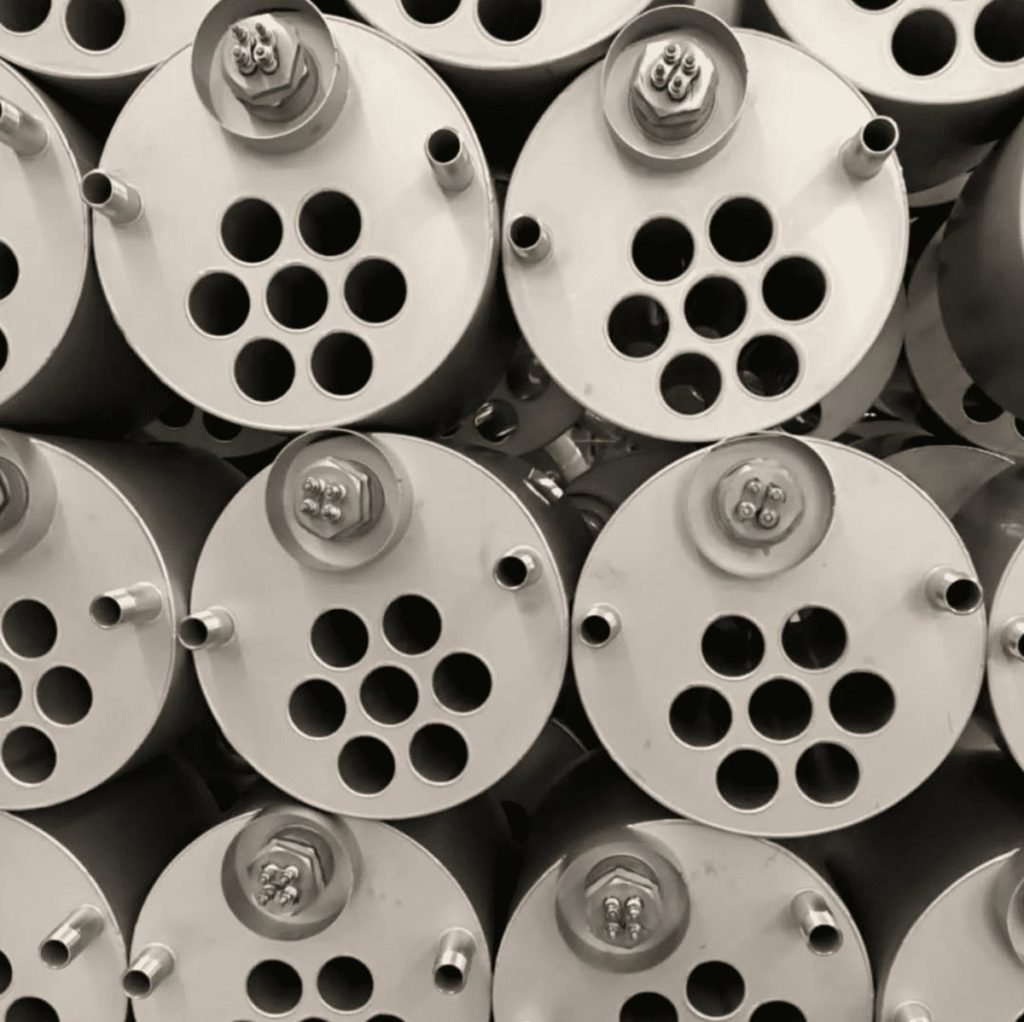
A look at the welded vessels of the tigerexped hot water boilers at the production site. Cleanly executed welds and the subsequent passivation are decisive for long-term resistance. Use appropriate to the material ensures that this quality can take effect in operation.
Relevant Corrosion Mechanisms in Boiler Operation
Three corrosion mechanisms play a role above all in the operation of drinking water boilers.
Pitting corrosion
occurs locally and is promoted in particular by chlorides, elevated temperatures and deposits such as limescale or biofilm. Under such deposits the local water chemistry can change drastically: chlorides accumulate, oxygen is displaced. The attack often goes unnoticed for a long time until it finally breaks through.
Crevice corrosion
occurs in narrow areas, such as at sealing surfaces, threads or material transitions. The cause is an oxygen gradient in the crevice that destabilizes the passive layer. This form of corrosion is among the most common causes of damage in drinking water systems.
In chloride stress corrosion cracking
mechanical tensile stresses, temperature and chlorides act together. The damage pattern is fine cracks that can spread suddenly. Unlike classic corrosion, there is no slow loss of wall thickness, but an abrupt failure.
Water Disinfection – Necessary, but Not Arbitrary
To ensure drinking water hygiene, disinfectants are often used in the vehicle. It is important to distinguish between different modes of action.
Silver Ion Products
Silver ion products such as the well-known “Silbernetz” for the water tank inhibit germs and preserve.
They are gentle on materials and well suited for continuous use and regular topping up.
Chlorine-Based Products
They have a strong oxidizing effect and are very effective, but chemically much more aggressive.
Chlorine becomes a problem in particular with overdosing, long contact times, heating of the water or partial fill levels in the system. Chlorine products should therefore only be used selectively
- in a cold system,
- strictly according to the dosing instructions and always with
- subsequent thorough flushing.
Why Shock Chlorination in a Vehicle Is Not a Good Idea
Shock chlorination, household bleach or pool chlorine come from completely different areas of application. In vehicle systems they often lead to extreme local concentrations, uncontrolled contact times and inadequate flushing.
A stainless steel boiler is not a concrete pool. Even the highest-quality materials can be permanently damaged by such use.
System Cleaning with Active Oxygen – a Sensible Addition
Products based on active oxygen are often used to clean and disinfect drinking water systems. They have a strong oxidizing effect and reliably break down microorganisms and organic deposits. After use they mostly decompose into oxygen, water and simple reaction products.
For 316L stainless steel boilers, this approach is generally compatible with the material. Oxygen is a component of the protective passive layer of stainless steel and, when used properly, does not permanently attack it. The prerequisite is that active oxygen is used in moderate dosage, with a cold system and limited contact time.
Active oxygen is not neutral. Overdosing, long standing times or elevated temperatures can create locally aggressive conditions, especially where deposits are present. Even if the product should generally not require rinsing afterwards, a thorough flush reliably removes reaction residues, loosened deposits and locally elevated concentrations from the system and thus avoids unnecessary stress on the material.
Used correctly, active oxygen is well suited to occasional, targeted system cleaning. It replaces neither regular water changes nor ongoing water care, but complements them sensibly without putting unnecessary strain on the stainless steel.

Alb Clean fresh water tank cleaner – well suited for gentle system cleaning. Please observe the notes on dosage and contact time.
Material Pairings – the Often Overlooked Factor
A stainless steel boiler is always part of an overall system. What matters is therefore not just the boiler itself, but also the material concept of the connected components.
Stainless steel is electrochemically very noble. In combination with less noble metals, galvanic effects can occur – in this case it is not the stainless steel that is damaged, but the less noble components.
Brass , for example, is widely used, but can dezincify under certain conditions and should therefore only be used as dezincification-resistant DZR brass.
Gunmetal is considerably more robust, free of dezincification and combines very well with stainless steel.
Copper should be avoided in the direct vicinity of stainless steel boilers, as should galvanized steel or aluminum in water-carrying areas.
High-quality plastics are galvanically neutral and, from a materials point of view, often the best solution.
Stainless Steel Heat Exchanger and Engine Coolant Circuit
The combiBOIL and duoBOIL boilers have a stainless steel heat exchanger loop that is connected to the engine coolant circuit via rubber hoses. This combination is generally unproblematic, as the hoses provide electrical isolation.
What matters, however, is the condition of the coolant. It must match the vehicle manufacturer’s specification, be mixed correctly, contain enough glycol and be replaced regularly.
If the coolant is aged or unsuitable, it is usually the engine’s aluminum that suffers first – not the stainless steel heat exchanger.

Which Hot Water Boiler for Your Travel Vehicle: monoBOIL, duoBOIL or combiBOIL?
Together we analyze which type of hot water heating is best suited to you and your travel vehicle, and compare monoBOIL, duoBOIL and combiBOIL.
Conclusion on the Service Life of Stainless Steel Boilers
A high-quality stainless steel boiler offers enormous longevity when material, manufacturing and use fit together.
Our boilers are designed in construction and manufacturing to the highest level.
The actual service life, however, is decided in operation.
Anyone who uses chemicals in a controlled way, observes material pairings and follows a few simple basic rules will be able to use warm drinking water reliably for many years.
Silver ions for everyday use, chlorine only selectively and correctly – that is the technically sound strategy.
You might also be interested in these articles:

Did you find the info helpful or interesting? Then feel free to share it with friends or like-minded people from your camper community: