
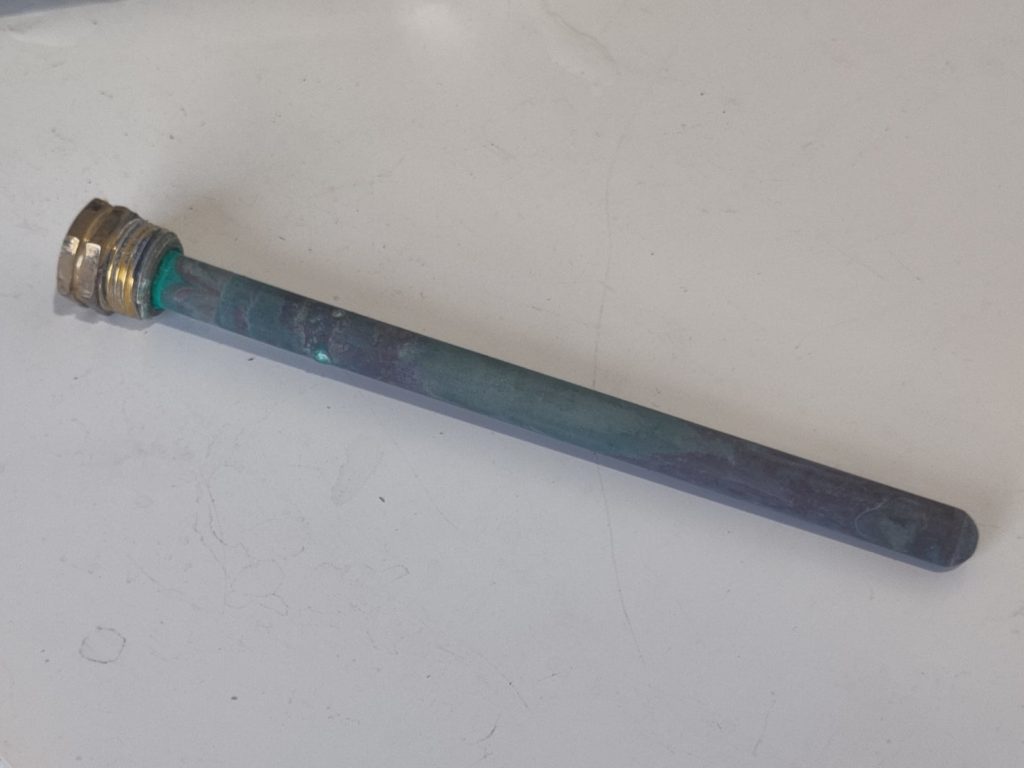
What you see in the title image is a copper immersion sleeve of a motorhome’s hot water boiler – after only a few weeks of operation.
Sadly, we come across this kind of damage, with intense green discoloration and material loss, again and again. What will surprise many: the cause isn’t in the boiler itself at all – it’s the result of electrolytic destruction by stray currents in the vehicle; in other words, an error in the electrical installation. In the worst case, a leak can develop within just a few weeks.
The cause is a missing or faulty connection between the protective earth (PE) of the shore power inlet and the DC negative or the vehicle body.
In this article we look at why exactly this point is so critical, how you spot and fix the problem – and ideally avoid it cleanly from the start.
What Is Galvanic Corrosion – and Why Does It Hit the Boiler?
Galvanic corrosion occurs whenever two different metals are connected via an electrically conductive electrolyte and there is a potential difference. Then a current – often tiny – flows, causing the less noble metal to slowly dissolve.
And this is exactly where water comes in: it is an excellent electrolyte. Tap water with its dissolved minerals even more so.
A boiler inherently combines different metals – copper, brass, stainless steel. This is accounted for in the design, so no harmful current flows in normal operation.
However, that changes immediately as soon as voltage enters the system from outside.
And that is exactly what happens when PE and DC negative in the vehicle are not connected to each other.
The Problem: The “Floating” Installation
In a travel vehicle you usually have two separate electrical systems:
- AC onboard system (shore power / 230 V): with phase (L), neutral (N) and protective earth (PE)
- DC onboard system (12 V / 24 V): with positive and negative, where negative is usually on the body
These two systems must be connected to each other at a defined point – specifically: PE and DC negative (body).
This is not optional, but a fundamental safety requirement.
If this connection is missing, the following happens: the AC system “floats” electrically in the vehicle. It has no fixed reference to the vehicle ground. As a result, voltages can build up via capacitive coupling, leakage currents or parasitic paths – and exactly this voltage ends up in the boiler via the water.
What Happens in the Boiler
The water electrically connects the heating element (which is potential-wise “hanging in the air” via PE) to the boiler body. A classic electrolytic cell is created.
The result: current flows through the water, exits at metal surfaces – and removes material there.
Copper is a noble metal, but not stainless steel. Under electrolytic stress it oxidizes quickly and shows the well-known green patina (copper hydroxide carbonate / malachite). The corrosion can be so aggressive that even soldered joints break open – which explains the leak.
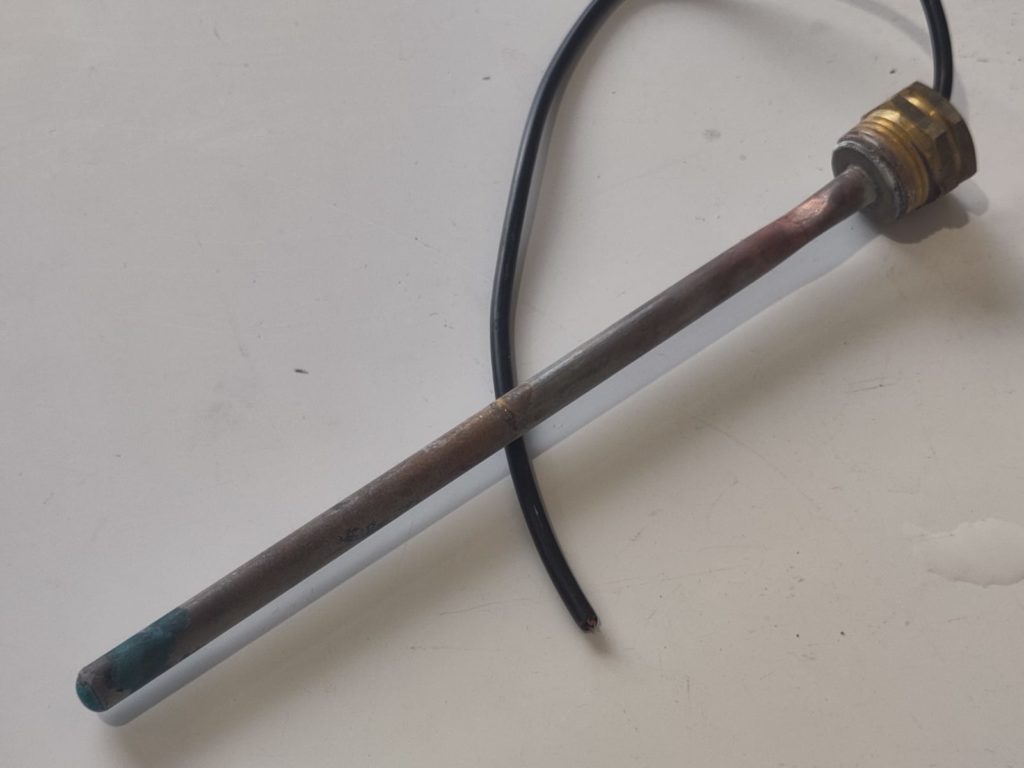
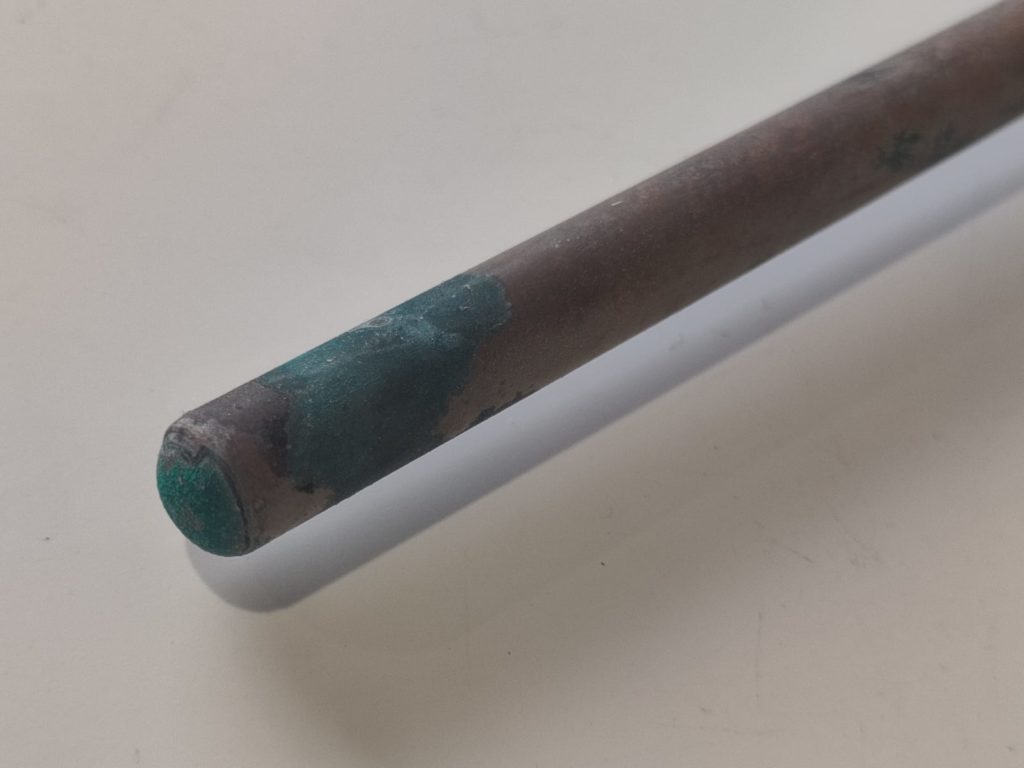
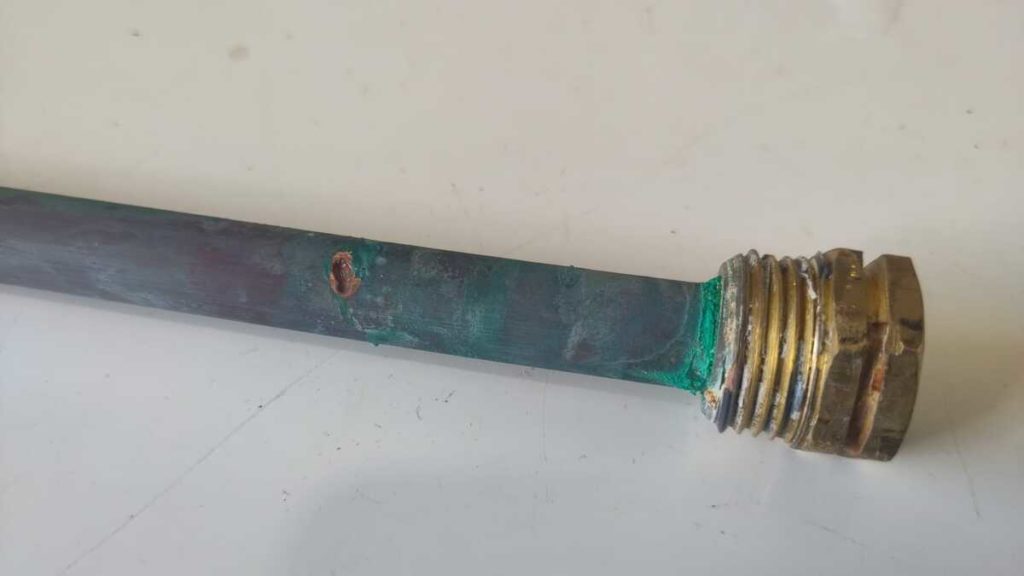
Measure Instead of Guess: How to Check Your Installation
If you suspect a problem or simply want to be on the safe side, you can measure it quite easily. Important: the boiler must be filled and the power supply active.
Measurement: voltage between water and vehicle ground
- Hold one probe in the water (e.g. via the opened faucet)
- Put the other on vehicle ground (DC negative / body)
- Measure both DC and AC voltage
| Reading | Assessment |
|---|---|
| < 0.3 V | Unremarkable – normal measurement noise |
| 0.3 – 1.0 V | Borderline – take a closer look |
| > 1.0 V | Critical – galvanic corrosion likely |
| Initial value drops quickly | Typical of capacitive charging → indicates missing ground reference |
Important: A reading that is high right after applying the probes and then drops within seconds is particularly characteristic. The water has charged up capacitively – because the system has no defined reference point. That is exactly the fingerprint of a floating installation.
If PE and DC negative are connected correctly, the reading should stay permanently below 0.3 V.
The Solution: Connect It Properly – Done Right Once, Peace for Good
The good news: the solution is technically simple. What matters is that it is implemented properly.
PE (protective earth of the shore power inlet) is connected to DC negative or the body at one central point.
This is usually the main ground bar in the vehicle or a defined ground point directly on the body.
What You Should Look Out For
- The connection must be low-resistance (resistance < 1 ohm)
- Clean, firm connection: ring lugs, bolted and secured
- No oxidation, no contact resistance
- The connection stays accessible and testable
- For devices with galvanic isolation: follow the manufacturer’s instructions
A Typical Mistake from Practice
This mistake doesn’t happen out of ignorance about the boiler – it happens because AC and DC installations are often carried out by different people or at different times, and the interface is simply overlooked.
That’s why a simple checklist is worthwhile:
- Is the PE of the shore power inlet connected to DC negative / body?
- Is the connection made cleanly and with low resistance?
- Is the voltage between water and ground below 0.3 V?
- Is the heating element electrically fine (insulation resistance > 1 MΩ)?
The last point is relevant as well: an insulation fault in the heating element itself can lead to similar symptoms regardless of the PE connection. Disconnect the heating element from the mains, measure the resistance between the terminals and the boiler body – the result should be in the megohm range.
Conclusion
Galvanic corrosion on the boiler is neither a material defect nor a quality problem of the device. It is almost always the result of an electrical installation situation in which protective earth and vehicle ground are not connected to each other.
The water in the boiler becomes an unwilling conductor – and the metal components pay the price. Within a few weeks, a new device can be damaged so badly that it has to be replaced. Replacing it without eliminating the cause is pointless: the new device will simply suffer the same damage.
The solution is a correct, permanent and measurable PE↔ground connection – a basic requirement that should be a matter of course in any professional vehicle conversion with a shore power inlet.
You can find more information on causes of corrosion in the boiler – especially through chemical water treatment – in our article 316L Stainless Steel – Indestructible? What Stainless Steel Boilers in Campers Can and Can’t Take.
These articles might also interest you:

Did the article help you? Maybe it will help others too, so feel free to share it with your groups, like-minded people and friends: