

The combiBOIL hot water boiler has a special feature: with connections for a second water loop and therefore an extra heat exchanger, it is equipped, among other things, for integration into the vehicle’s coolant circuit.
Among other options, this lets you enjoy ready-heated shower water after every drive for a relaxed arrival – and without spending any additional energy to do so. Instead, the (waste) heat that the engine produces anyway is simply converted into a usable form.
There are, however, a few things to keep in mind, which we want to go through in this article. So read the following notes carefully before you dive headfirst into the work. Here we go:
UPDATE:
Besides the combiBOIL, the duoBOIL hot water boiler is now also available for connecting a second water loop. All information in this article therefore now applies to this boiler variant as well.
Water Boiler vs. Temperature in the Engine Cooling Circuit
A hot water boiler and the engine cooling circuit can complement each other very well. Keep in mind, though, that the two systems work differently – this matters above all with regard to pressure, temperature and circulation.
Temperature in the Cooling Circuit Varies
In certain situations the coolant temperature in a vehicle rises. Examples include stop & go traffic, long / steep uphill driving or an increased injection quantity to clean a particulate filter. These are just a few examples that can cause the water in the cooling circuit to get hotter than usual. Because of the pressure there, the temperature can then be above 100°C.
Feeding water at such a flow temperature into the boiler is not a good idea – it would start to boil. This can result in dangerous steam formation, which none of the components in the water system are designed for. Rubber hoses deform, start to leak, and so on.
The safety valve on the boiler reacts to this situation by constantly releasing pressure and water, but the hazard itself should of course be avoided in the first place.
Controlling the Coolant Flow Through the Boiler
As a rule, the coolant temperature is around 90°C.
For safety reasons, the electric heating element of the combiBOIL has a built-in thermal fuse (120/230V) that trips at a water temperature of approx. 80°C. This completely disables the heating element until the fuse is reset manually – not an effect you want, especially if the boiler is installed deep inside the vehicle.
The aim should be a boiler temperature of approx. 70°C max.
To achieve this, the vehicle’s 90°C cooling circuit must not flow through the boiler permanently.
This can be done with a 3-way solenoid valve and a T-piece, combined with a temperature-sensitive relay (TSR, item number TEX4275). The solenoid valve is installed in the flow and return of the cooling circuit, upstream of the boiler. The valve is then controlled by the TSR.
When the temperature relay switches the solenoid valve over, the coolant is routed past the boiler – so the temperature in the boiler drops. When it falls below 65°C, the system enables the coolant flow through the boiler again.
This preset temperature threshold can, however, be freely chosen and set between 30°C and 70°C (switch-on/switch-off point = -5°C / +5°C) (you will find more details in the TSR product description).
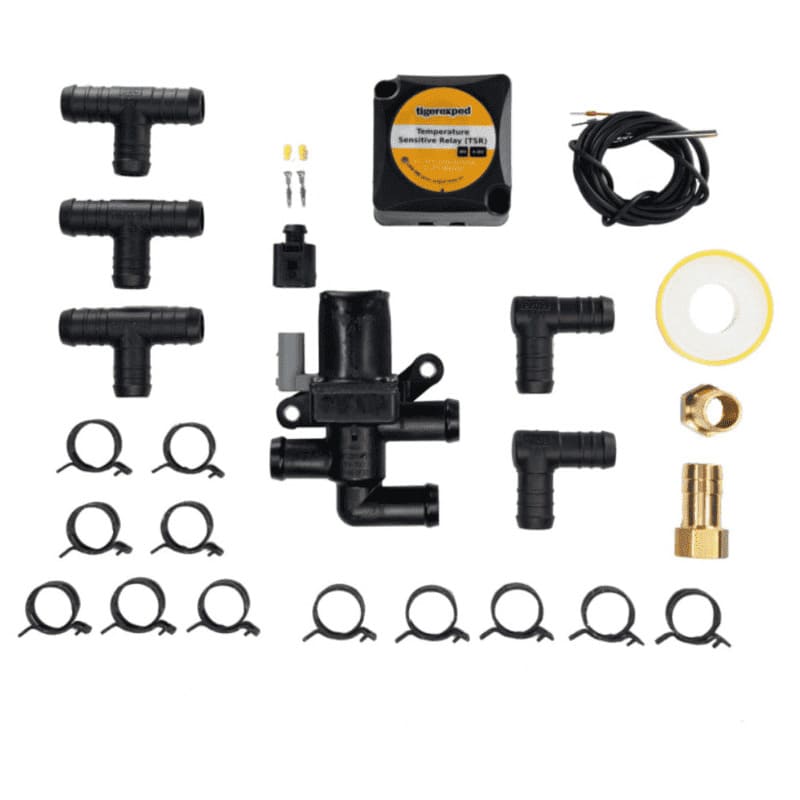
Complete coolant circuit kit with tigerexped TSR for temperature-dependent control of, e.g., the solenoid valve
Integrating the Hot Water Boiler into the Cooling Circuit – How and Where
To get the hot water boiler into the cooling circuit, it has to be integrated into the flow and return of the vehicle’s small engine cooling circuit. For this, a T-piece is fitted at the inlet and at the outlet of the heater core, and the T-pieces are connected to the boiler with coolant hoses.
Vehicles with Flow Rate Monitoring
In vehicles with flow rate monitoring, problems can occur with the direct integration of the boiler into the cooling circuit just described.
As its name suggests, flow rate monitoring monitors the volume of the cooling circuit and controls thermostats and valves to warm the engine up efficiently.
An increase in the cooling circuit volume through the boiler would very likely be detected by the monitoring and answered with an error message in the inverter/charger or even by switching the vehicle into limp-home mode.
Integrating the Boiler via a Plate Heat Exchanger
To integrate the combiBOIL hot water boiler into the cooling circuit even in vehicles with flow rate monitoring, we recommend using a plate heat exchanger.
This device transfers heat from one medium to another without the two mixing. It consists of thin plates mounted in a frame. The two fluid streams, i.e. coolant and domestic hot water, are routed through thin channels between the plates, which allows very efficient heat transfer.
Providing Circulation
Because the two sides of the plate heat exchanger are two completely independent circuits, the water on the boiler side is not circulated by the vehicle’s water pump. A separate circulation pump and a separate expansion tank are therefore needed in the boiler’s water circuit!
The TSR that is already there anyway (as discussed above) to control the solenoid valve, which is essential for temperature regulation, can conveniently switch on the circulation pump in the domestic water circuit at the same time when the coolant circuit is enabled through the boiler.
If the water were not circulated at this point, the water in the plate heat exchanger would keep heating up until it starts to boil, and dangerous steam formation would occur again.
Operation with a Water Auxiliary Heater
By integrating the boiler into the engine cooling circuit, the shower water is heated whenever the engine is running.
If you also want your shower water heated via the cooling circuit while parked, a water auxiliary heater (Flow 5) can additionally be added to the cooling circuit. It then heats the small cooling circuit and thus the boiler immediately. Only after the temperature rises further is the rest of the engine warmed as well (thermostat on the engine opens).
Three useful things can be combined this way:
1. The ability to heat the shower water via the coolant circuit while parked as well.
2. Engine preheating, which allows a gentle start at low temperatures.
3. An emergency heater and redundancy to the existing air heater, by adding a water-to-air heat exchanger to the boiler circuit in addition to the water heater.
Using the combiBOIL’s Second Water Loop Differently
The combiBOIL’s additional heating loop can be used for more than integration into the cooling circuit.
Instead of feeding heat energy into the boiler this way, the connections of the second water loop can also be used to draw energy off and use it for another system – e.g. a small, partial underfloor heating or a towel radiator.
Did these notes on integrating the combiBOIL hot water boiler into the engine cooling circuit help you? Then feel free to recommend them to like-minded people too:
These articles might also be helpful:


