
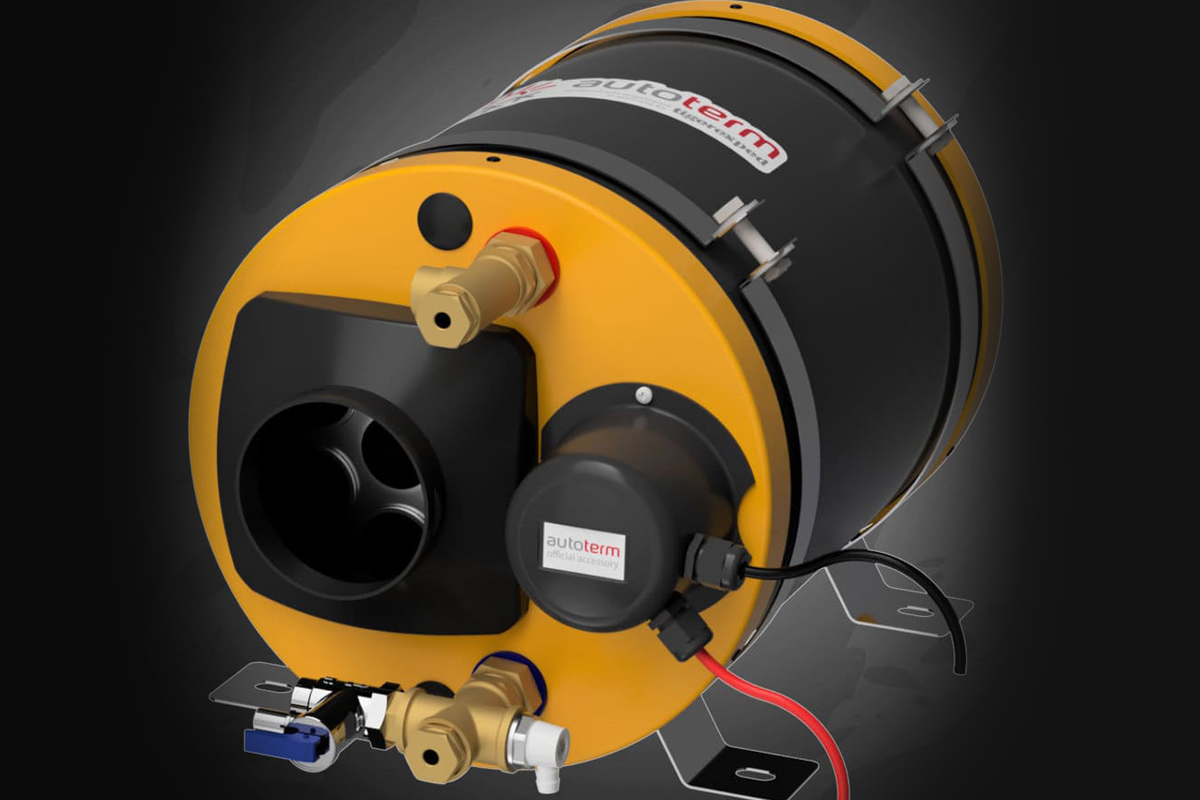
Over the past years, our customers have repeatedly encouraged us to develop a water heater for campers & motorhomes that tackles – and solves – the existing problems of other products.
We took this on and managed to create entirely new versatility in the ways it can be used, as well as a substantial improvement in comfort and safety features.
Improved Flow Resistance in the Water Heater
A very important aspect of a water heater for campers and motorhomes is the heat exchanger, or rather its flow resistance.
All products currently on the market have a relatively high flow resistance. Auxiliary heaters don’t like that at all. For the heater manufacturer it’s quite critical, so it can sometimes even be a warranty issue when another product is connected downstream of the heater.
We put a lot of thought into this: how can you build a heat exchanger that
a) has little flow resistance and
b) also allows really good heat transfer?
We’ve achieved that now.
To develop the boiler, we cooperated with our long-standing partner and auxiliary heater specialist, the company Autoterm from Latvia. Autoterm therefore not only stands behind the compatibility of both products, but has also developed a dedicated heater control panel with software for additional boiler control.
New: Safe Operation with a 4 kW Air Heater
With earlier products, our basic rule was: 2 kW of warm air may be fed into the boiler – no more. That meant a major disadvantage for users of 4 kW heaters. To use the Twin Kit with 2 x 2 kW for full redundancy and more flexibility in heating output, the warm air path had to be split right before the boiler so that one heater could bypass it.
With combiBOIL we’ve taken a different route.
Here there isn’t just a connection large enough to take the air duct – the 90 mm cross-section is maintained over the entire length of the combiBOIL water heater. So passing through 2 kW, as well as 4 kW or 2 x 2 kW, is no problem.
More Heating Output = Hot Water Faster?
Even with a flow resistance designed for higher heating output: the heat exchanger of the water heater only has a certain capacity. That capacity is below 2 kW. This means it makes no difference whether you connect a 2 kW or a 4 kW heater upstream of the water heater – the water heats up equally fast.
One Water Heater – Many Possibilities
combiBOIL didn’t get its name by chance – with it we can produce hot water in three different ways.
Via the Auxiliary Heater
As you can easily guess from the topic of warm air flow resistance, the air heated in the auxiliary heater can be routed through the boiler before it’s released into the room. So when you heat the room, you get hot water as a by-product without using any additional energy.
Electric
If it’s too warm for heating, the auxiliary heater can stay off and an electric heating element built into the water heater can be switched on.
We can use the energy of the sun to heat the water – because it probably shines when it’s nice and warm. It charges the batteries via the solar system, and these power our electric heating element. Of course, a shore power connection can also simply be used.

Do you want to know how much solar you need to install for the consumers you’re planning?
Then read these articles:
Voltage: 12, 24, 110 or 230V
With combiBOIL you can choose between the voltage variants 12V, 24V, 230V or even 110V (for travel on the American continent). However, the smallest boiler (7 l volume) is only available in the 12V and 24V variants. Its output is 300 watts, so it takes about one hour at 12V for the water heater to produce enough hot shower water, or about 35 minutes with the 24V variant.
When using an inverter (with at least 500 watts of power), the 9 and 12 l water heaters can also be run on AC voltage.
To spare the batteries, it would of course be conceivable to heat water with electrical energy only when you’re connected to shore power at a campsite or pitch. For driving days, there is a third option for producing hot water with the combiBOIL water heater.
Via the Water Circuit.
In this case we use the waste heat produced by the engine to heat the water.
The principle is quite simple, because in theory you only need to open the cooling circuit and insert the boiler. In the end it’s not quite that simple, though: anyone who has driven up a mountain in summer with a heavily loaded vehicle will have noticed that the needle of the coolant gauge sometimes moves a bit to the right. The water in the cooling circuit can (due to the pressure there) easily get hotter than 100 degrees.
Such a temperature must not be fed into a water heater; the upper limit should be 75 degrees. Basically nothing would happen at first, except that the pressure relief valve would trip. However, water famously starts to boil at 100 degrees (unpressurized) and steam forms – and we definitely can’t use that in and on the vehicle. Excessive heating of rubber hoses etc. must be avoided under all circumstances.
Avoiding Overheating
To avoid the problems mentioned above caused by overheating of the water heater, it must not be integrated directly into the coolant circuit. It’s safer to use a solenoid valve or a plate heat exchanger together with a circulation pump. The pump can be switched off, or bypassed with a solenoid valve, if the temperature rises too much.
Avoiding Coolant Loss
Let’s also think about what happens when we tap into the vehicle’s coolant system and extend the line to the rear. Especially if you may also want to travel on tracks, damage to the line is not exactly out of the question. If a heat exchanger sits in the front part of the vehicle, the boiler circuit does run empty in case of damage, but the engine is still cooled properly. The engine coolant circuit and the boiler stay two independent systems.
Avoiding Problems with Modern Engine Sensors
Modern vehicles may also monitor the volume flow. If you enlarge the volume of the coolant circuit too much, the engine may well shut down because it assumes there are problems.
Using a heat exchanger instead of integrating the water heater directly into the camper’s coolant circuit therefore makes sense in any case.
Using the Heat Energy from the Water Heater in Other Ways
With the combiBOIL water heater it’s not only possible to put energy into it to get hot shower water. Conversely, you can also use the energy of the once-heated water in several other ways. The option of integrating a second water loop into the system makes the combiBOIL water heater particularly versatile.
Underfloor Heating
Always cold feet? Underfloor heating in the seating area would be great, wouldn’t it?
Once the water in the boiler has been heated, by whichever of the three methods, creating a heated surface is no problem. We simply pump the water in a circle – from the boiler into a small water loop and back.
You need a pump, a bit of hose and potentially a pre-mixer, because you don’t really want 70 or 80 degrees in the floor.
On the term “underfloor heating”
The amount of energy fed into the underfloor heating via combiBOIL is ideal for heating, say, 1-2 sqm of floor in the seating area and creating cozy warmth from below. The amount of energy of this kind of underfloor heating is not suitable for heating the volume of the room.
Towel Radiator
Another way to use the second water loop of the combiBOIL water heater would be a towel radiator for cozy-warm, quickly drying towels. Here too, we simply pump the warm water in a circle.
This system is even easier to build than the underfloor heating, because high flow temperatures are normal in a radiator – no pre-mixer is needed.
Room for Your Ideas
Of course it’s conceivable to combine all the options just mentioned, for example by installing a changeover switch etc.; a lot is possible and feasible here.
The “Hardware” of the combiBOIL Water Heater
Now that we’ve seen what ways of using the new water heater there are, let’s look at the hardware in detail. What’s inside and on it, how is it used, and what is potentially different from what already exists elsewhere?
The Shape
Boiler tanks are always round because of the pressure inside. It makes sense to build a round housing for it too, rather than a square one. That directly gives two advantages:
Advantage: Rotatable Mounting
The mounting clamps around the tank, or rather the tank inside its mounting, can simply be rotated. The screw points can therefore be placed not only on the floor, but also on the wall, on the ceiling, or one here and one there, whatever the available space allows best.
The installation position of the boiler doesn’t have to be changed for that. The correct installation position is: cold water connection at the bottom, hot water connection at the top, because warm water rises – logical.
Advantage: Free Corner
Another advantage is the corner that stays free between the boiler and the wall. In a vehicle, cable ducts, warm air ducting etc. run everywhere. If I install a cylinder or something “round”, then an air duct, a cable duct or something else still fits into the corner at the bottom, and no additional space has to be created.
The Connections
The combiBOIL water heater of course has connections for hot and cold water, and in addition there are two connections for the coolant heat exchanger. There is also a safety valve and a drain valve for the winter to empty the water system.
Advantage: Threaded Connections
All water connections on the combiBOIL water heater are fitted with 1/2 inch standard thread.
That means you can use either a hose barb or one of the various standard push-fit systems. This makes it easy to create a truly tight system, and the hassle with hose clamps that don’t sit right and hoses that don’t fit comes to an end.
Standard threaded connections make it possible, for example, to use a braided stainless steel hose on the hot water side. That’s a big advantage, because up to the pre-mixer the hot water hose carries the full temperature from the boiler, which is usually around 80 degrees – very few (drinking) water hoses withstand these temperatures. In the past we’ve repeatedly seen hoses go soft and deform thermally. It’s clear that this can’t go well forever. The braided stainless steel hoses available on the market do have a standard threaded connection, but they can’t be connected to the common boiler connections. With the combiBOIL water heater we’ve solved this problem too.
Special Feature: Cold Water Connection with Check Valve
On the cold water side there is, as mentioned, a safety valve that opens at overpressure, and a drain valve to empty the water system, e.g. for winter storage, and protect it from frost damage.
We use a special safety valve for this.
Water expands when it gets warm. If the safety valve that the cold water flows into has no check valve, the warm water from the boiler is pushed back. Since only a normal hose is connected there and not a heat-resistant braided stainless steel hose, you could end up with the problem of overheated hose material at this point too.
Connection for Temperature Sensor
In cooperation with Autoterm, a special control panel has been created – a version of the Comfort Control, designed specifically for using the Autoterm auxiliary heater in combination with this water heater. With it, the temperature in the boiler can not only be monitored but also regulated.
Monitoring the Temperature
Being able to check the temperature in the boiler is in some cases not just a pleasant plus but really important. For example when integrating the coolant circuit.
As mentioned earlier, the circuit through the boiler must be switched off if the temperature rises too much. But how can you know how hot it is? With the combiBOIL in combination with the Comfort Boiler Control, the temperature in the boiler can be simply read off the display of the control panel.
Water Hot = Heater Off
With a thermostat and the Comfort Boiler Control panel, the heater can be controlled according to the boiler status – even fully automatically.
If you only want hot water, for example, without heating more than necessary, the heater can be set via the control panel so that it simply switches itself off once the water is hot. The target water temperature can also be set by yourself.
More Comfort AND Safety
If the heater runs for a long time because it’s very cold outside, maybe even at full power the whole time, the water in the boiler could potentially get too hot. As discussed above, no steam formation may take place in the water heater. The heater now watches for this on its own.
If the water in the boiler gets too hot, it automatically switches to fan mode and thereby carries heat away from the boiler. Once the temperature has dropped to a non-critical value, the heater also switches back on automatically. And don’t worry: ice-cold air won’t suddenly be blown out of your heater outlets and cool down your camper. Since the already warmed room air is routed through the hot boiler and picks up its heat, warm air still comes out of the warm air distribution. By switching to fan mode, the boiler cools down much faster, so we can keep heating before the room temperature drops noticeably. The heater does both switchovers entirely on its own.
That means
a) I don’t have to take care of it and
b) I don’t have to freeze either.
The exception that proves the rule:
Rarely there are extreme cases where, for example, a large, poorly insulated living space has to be kept at temperature somehow in the deepest cold. Here you need full heating output the whole time so the room doesn’t cool down immediately. In such a case, you should take the boiler out of the heating circuit – keyword control flap.
In a standard camper or a standard boat, however, you no longer need a control flap, which is an extreme advantage in terms of flow resistance – the symmetrical Y-pieces used for it are, after all, the worst case in terms of flow resistance.
Retrofitting the combiBOIL Water Heater
If an Autoterm heater is already installed, it should belong, for compatibility, at least to the series from the introduction of the altitude kit onwards – that is, it should have been built from roughly the end of 2018.
In this case everything is plug & play: simply unplug the old control panel and plug in the new one. Heater and boiler immediately work together with all comfort and safety functions.

If you have an air heater from another manufacturer, the boiler can of course still be heated with it. It doesn’t care where the warm air comes from. The comfort and safety features via the Comfort Boiler Control panel are of course lost in this case, though, because the software of the heater and the control panel “don’t know each other”.
Here you are responsible yourself for making sure the water doesn’t get too hot, the living space doesn’t get too cold, and so on – like in the old days. This can be implemented, for example, with a manual control flap in front of the boiler, or with your own alternative solutions.
If you have no heater yet: the integrated system of heater and boiler, with three ways of producing hot water and the comfort of heater control via the integrated temperature monitoring, doesn’t exist anywhere else on the market so far. If you want to use all the advantages, this combination therefore definitely makes sense.
Everything You Need in One Package
You have neither boiler nor heater so far: our Hot Shower Kit 2.0 contains everything you need for the system – right down to the matching braided stainless steel hose.

See the Hot Shower Kit 2.0 in the shop and learn more about it:

Connecting the Water Heater Electrically
Of course we’ve also made connecting the boiler as easy as possible for the customer. All boiler variants come with the connection cable already attached.
To connect 230V you need an electrician in Germany, but we’ve solved that too, because our boilers come with a cable and a Schuko plug – that means plug in and done.
A fixed installation connected to 230V is of course possible if desired – and if you have an electrician but no socket. In that case the plug is cut off and the boiler is integrated into the circuit without a Schuko socket.
Besides 12, 24 and 230V, we also offer a boiler variant with 110V. It is of course mainly interesting for motorhome builders who are explicitly building a vehicle for the American continent.
The 12 and 24 volt variants also come with the cables. If the cable has to be extended because of your individual installation situation, this can be done directly on the cable.
Thermostat
At 230 volts only a fairly small current has to be switched, which can be done with a small switch. That lets us build the thermostat module with switch directly into the heating element. The 230V and 110V boiler variants therefore simply switch off at 65 degrees.
This unfortunately doesn’t work with the 12 and 24 volt water heaters, because a fairly high current (25 amps) has to be switched here. The switch that can handle this unfortunately doesn’t fit into the heating element.
We therefore developed an external thermostat module with a relay to which the heating element can be connected. Thanks to the relay, a small switch is then sufficient, because the relay takes over the current and you only have to provide a small control voltage.
Boiler Sizes
The combiBOIL water heater is available in different sizes, with 7, 9 and 12 liters of volume. From couples to a family with two children, we can offer the right volume for everyone.
As a rule of thumb: for two people, the 7 liter variant is completely sufficient. The water in the boiler has a temperature between 65 and 83 degrees, which means cold water must always be mixed in. So 7 liters of volume in the boiler ends up as more like 10 to 12 liters of shower water – it doesn’t quite double, but nearly.

Takeaways on the “combiBOIL” Water Heater
- combiBOIL is the first water heater for campers and motorhomes on the market that not only combines THREE ways of heating water, but together with the auxiliary heater offers an integrated overall system, including some comfort and safety features not seen before.
- The option of integrating a second water loop into the system greatly expands the versatility of the combiBOIL water heater. Underfloor heating or a towel radiator, as well as preheating the engine at very low temperatures, are all feasible options.
- The low flow resistance of the boiler allows, for the first time, problem-free use with 4 kW air heaters.
- Four different operating voltages and three different boiler sizes to choose from.
- Round shape for more flexibility during installation and free corners for cable ducts etc.
- All water connections with 1/2 inch standard thread for better sealing and problem-free use of 1/2 inch accessories, such as braided stainless steel hoses.
- Integrated drain valve for emptying.
- Safety valve with check valve.
- Integrated thermostat for 230 and 110 V. External thermostat module for 12 and 24V variants.
- Extremely high-quality workmanship and materials – made in Western Europe.
- When operating / retrofitting the combiBOIL together with air heaters from other manufacturers (not Autoterm), the boiler can still be used with hot air for heating water, but the comfort and safety features of the Autoterm control panel are lost.
- Complete set of Autoterm heater + boiler + control panel + accessories available at a price advantage as the Hot Shower Kit 2.0.
These articles on the water system in campers and motorhomes are probably also interesting for you:



Was this interesting for you? Feel free to share the post with like-minded people who will also benefit from the info!