
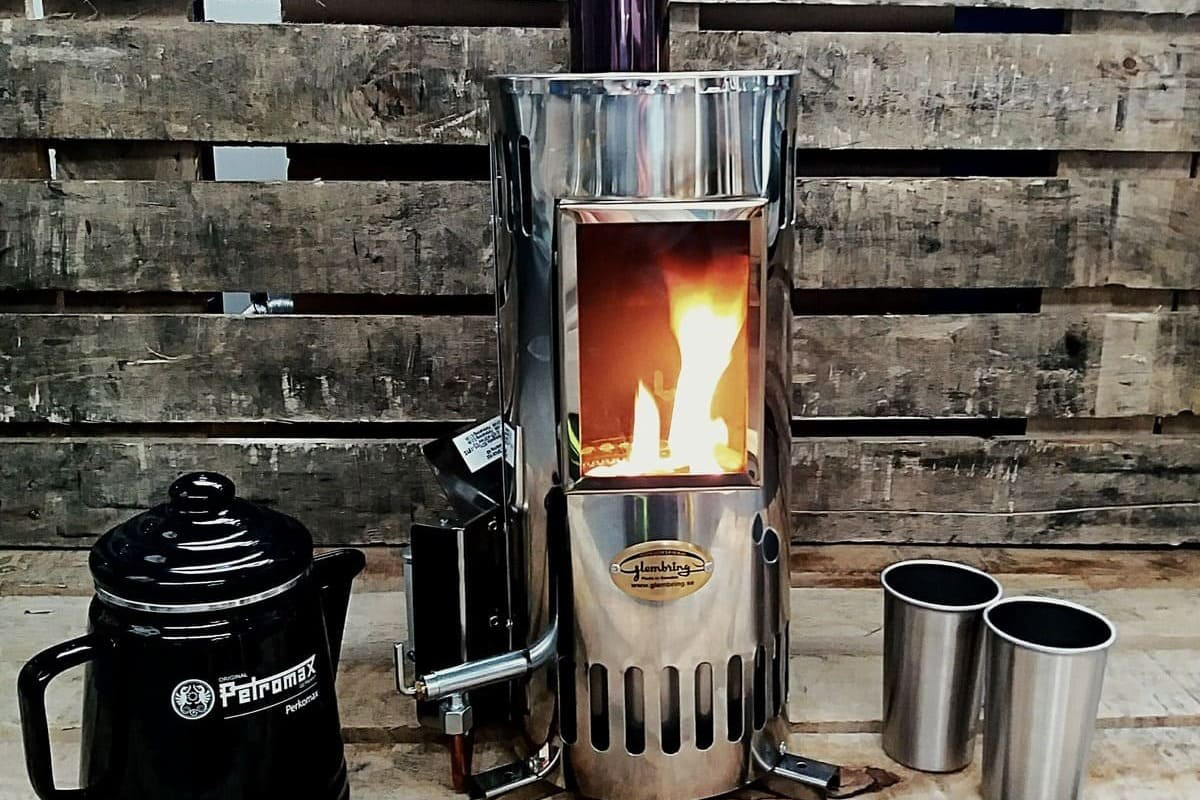
The Sibirien diesel stove is a real eye-catcher. This little gem doesn’t take up much space in a camper, works completely silently, and the dancing flames behind the viewing window give off an incredible coziness along with the heat.
But is the stove suitable for your motorhome? What do you need to keep in mind during installation, and: will it even pass the TÜV inspection?
Svenja and Nils are asking themselves the same questions. The two are converting a four-wheel-drive truck into an expedition vehicle and are considering the Sibirien diesel stove as their heat source.
They contacted our support with a whole list of questions – and because we keep getting the same questions again and again, we gladly agreed to their idea of recording the consultation with chief tiger Martin as a video interview for their YouTube channel. Of course, you’re also in exactly the right place here in the magazine to watch it.
And if you’d rather read: we have written down the questions and answers, paraphrased and shortened in a few places. Here we go:
Sibirien Diesel Stove – Video Interview
General Questions About the Diesel Stove and How to Use It
Stove Instead of an Auxiliary Heater?
Svenja and Nils: When does it make sense to install the diesel stove instead of a conventional diesel or gas auxiliary heater?
Martin: The question is whether there should be an “instead”. A diesel stove is mainly suited for (longer) stays in one place. Lighting it and the subsequent heating-up take a bit more time and are not done at the push of a button, as with normal auxiliary heaters.
Even with a diesel stove, I would always install a normal auxiliary heater as well, so that I also have the option of heating quickly and without any fuss.
In addition, the diesel stove works by convection only. That means that, depending on how the space is laid out, you can get different heat zones. If you heat with the stove and also have a diesel auxiliary heater installed, you can set it to “ventilation without heating” and so mix the room air.
My recommendation: A 2 kW diesel auxiliary heater and the stove for the romantic evenings.
Operating Noise and Power Consumption
Svenja and Nils: That’s what we planned, but it’s hugely important to us that we don’t always have to use the auxiliary heater. Its running noise bothered us enormously in our first camper. Sometimes we’d rather freeze than let the heater run.
Martin: Then you’d probably describe yourselves as above-average sensitive to noise, right!?
Svenja: Yes, we really are. There’s a second reason, though, and that’s the power consumption.
We traveled through Scandinavia in winter, and at those temperatures the auxiliary heater naturally ran around the clock. With our relatively small power setup at the time, we had to drive every second day to charge the battery – running 24 hours a day, the heater used up our small power reserves quite quickly.
Note:
With an Autoterm diesel auxiliary heater, you can expect an average power consumption of about 20 watt-hours (with repeated switching on and off).
You’ll find more info on the Autoterm auxiliary heaters:
- In our corresponding shop FAQs
- here in the magazine under the category Heating
- in our print magazine, available for download
- in the detailed product descriptions of the heaters and our installation kits, see the shop category

Heating Output and Room Size
Svenja: What camper size is the diesel stove generally suitable for? I know this always depends on the insulation of the vehicle in question. But can you pin down an approximate room volume that the 1.8 kW heating output (or 2 kW for the version with water loop) is suitable for?
Martin: Regardless of the type of auxiliary heater, 1.8 – 2 kW is a good value for about 12 to 18 cubic meters of room volume. Of course, as already mentioned, it depends on the insulation and on how much of the volume is taken up by furniture, and so on.
You usually only need the maximum output during the heat-up phase, when the room is still cold. To reach temperature quickly, it’s best to set the heater to the highest possible output. Ideally, though, you wouldn’t let the room cool down completely in the first place.
Both the diesel auxiliary heater and the diesel stove are designed for continuous operation. The stoves originally come from the boating sector, where, figuratively speaking, they are lit in October and put out again at the end of March.
If you live in the vehicle full-time like you do, the problem of a properly chilled living space will come up quite rarely anyway.
Why Not a Bigger Choice of Stoves?
Nils: In your shop you only offer the Sibirien diesel stove, no others. Why is that?
Martin: The technical differences between the stoves from the individual manufacturers are marginal; the decisive difference lies in the oil regulator used. All the well-known manufacturers use the same product here, since there isn’t much choice on the market for it. One alternative would be the Dickinson brand.
Even in terms of looks, there isn’t much between them; some stoves are even almost identical in appearance to our Sibirien diesel stove. So we can narrow our range down to a single model, both technically and visually.
The stove we ultimately chose would theoretically be available in other heating output levels. We chose 1.8 kW because this size is a pretty good solution for most vehicles and you can then easily turn it down to as little as 400 watts.
That’s half the minimum output of a normal diesel auxiliary heater. As many of you will already know: especially in the transitional season and at mild temperatures, 800 watts is simply too much. In a vehicle the size of a VW bus, for example, the outside temperature has to drop to 5 degrees before you don’t get sauna-like conditions when heating at the lowest setting. Unfortunately, the minimum heating output of normal diesel auxiliary heaters can’t simply be lowered any further, because the combustion chamber needs a certain amount of heat so it doesn’t soot up.
Sooting
Svenja: Is sooting a problem for the Sibirien diesel stove too?
Martin: Unlike the small combustion chamber of an auxiliary heater, the stove has a large inner surface where the combustion takes place. A lot would have to happen for it to soot up so badly that no more heat transfer (and thus no more output) could take place.
There’s another advantage too: the inside of the stove is very easy to clean of soot. With an auxiliary heater, on the other hand, the whole unit has to be taken apart, you need a seal kit with you or have one delivered first, and you should roughly know what you’re doing. If this repair comes up in wintry Sweden and you can’t get the heater running again after taking it apart, it gets cold in the vehicle.
Why So Expensive?
Nils: Set against all these advantages, though, there’s the increased space requirement of the stove and the question: why is the stove actually so much more expensive than a normal heater?
Martin: That’s because all the parts are made of stainless steel and because the stove is still built entirely by hand. The relatively small quantities don’t allow robotic production. Instead, you can picture the manufacturing as a small workshop where people with a welding torch in hand build stoves out of stainless steel sheets. That simply costs a lot more money.
With an auxiliary heater, all the parts come ready-made from production lines and are then only assembled by people in a few steps.
If we look at stoves from other suppliers, such as Reflex or Dickison, we’ll see similar, if not tendentially higher prices.
Frankly, the profit for us as a dealer is also extremely limited because of the high purchase price. The reason we offer the product anyway is that we simply think it’s great.

Questions About Installation
No Installation Instructions?
Nils: Why are there no detailed installation instructions for this stove?
Martin: The manufacturer does provide mounting instructions, but they are actually rudimentary.
In principle, we would have to write a detailed A-to-Z guide for motorhome converters, but our efforts have shown that very individual advice has to be given depending on the vehicle and the type of body. A standard guide doesn’t help most converters either. All the general and safety-relevant tips that apply to everyone are actually already in the manufacturer’s instructions.
Assessing an Installation Plan – Mounting the Stove on a Platform
Svenja and Nils: How would you assess our plan?
Note:
At this point in the video (from minute 14:31) we see the build plan of the living cabin.
The stove is positioned at the front in the middle on a small platform, under which the gearbox hatch is located.
The stove pipe runs straight up through the interior almost to the ceiling and then exits toward the front at a 90 degree angle.
Nils: According to the mounting instructions, the stove is supposed to be installed not far above the floor. Is 12 cm for the platform okay?
Martin: Theoretically, the platform could be half a meter high. The problem is that the stove then draws in cold air from higher up.
Warm air always rises and it stays cold below. So the convection takes place from where the stove stands upward. That means the lower it sits, the more room volume it can heat.
Note:
This stove draws in air from outside – so it doesn’t burn the oxygen of the room air! But even if the intake were routed down from a higher platform: the point where fresh air enters the stove and the point where convection takes place stay where it is mounted – so, if in doubt, on a high platform.
Nils: I’ve also heard that the stove doesn’t draw as well and would also soot up if it’s mounted higher up. Can you explain this “drawing” once?
Martin: Right, that’s the second point in favor of mounting the stove close to the floor. You should make sure the stove pipe can be as long as possible.
In that case, the hot air has enough time to rise in it and accelerate while doing so – this acceleration makes sure the stove gets enough fresh, cold air at the bottom. The hot air flowing out quickly literally pulls the cold air along behind it.
If the acceleration effect fails because the stove pipe is too short, less oxygen flows into the stove, the combustion gets worse, and it soots.
As a guideline: you should try to achieve a stove pipe length of nearly two meters.
As you’ve already planned quite correctly, it’s also advantageous to route the stove pipe as far as possible through the interior. If the hot air goes straight outside from the stove, it is immediately cooled down very strongly – that reduces the acceleration in the stove pipe, and less draft is created.
You could additionally insulate the pipe as a support measure, but in the interior it naturally makes sense to use some of the stove pipe’s waste heat to warm the room.
Bend of the Stove Pipe
Svenja: A solar panel is going to be mounted on the roof directly above the stove, so we planned to route the stove pipe out just below the ceiling at a 90 degree angle. Is a 90 degree angle acceptable, or should it rather not bend that sharply?
Martin: A 45 degree angle would definitely be nicer in terms of flow. One problem is the wall pass-throughs, which only exist for 90 degree angles. Because your stove sits nice and low, it works even with this sharp bend.
Wind and Storms
Svenja: On our rig, the stove pipe exits the cabin at the front face of the living cabin, that is, in the direction of travel. The driver’s cab sits lower, so the stove pipe is fully exposed to the wind. Is that a problem?
Martin: The wind isn’t a problem, because the stove should only run when the vehicle is parked. While driving, nobody is in the back in the cabin to watch the stove, so in theory the flame could get blown out without you noticing right away. You should definitely avoid that.
To prevent wind or storms from pushing into the chimney, the caps are specially designed. Pure rain covers, like the stainless steel salad bowls that are sometimes used, can’t do that.
In the shop we even offer an H-shaped terminal pipe that provides the best possible wind protection. This way the stove can also draw properly in a storm and won’t be blown out.
With your position at the front face directly above the driver’s cab, though, you should consider that the wind is forced upward by the cab and then, unfavorably, pushes into the cap from below. With air conditioners or other roof structures close to the exhaust pipe, you should also take the effect of turbulence into account.
That’s why there are precise regulations for houses on how far the end of the chimney must be from the roof.
A higher position (sticking out about half a meter above the living cabin) would be an advantage for the function of the diesel stove.
Since this has a strong effect on the overall height of the vehicle, the stove pipe can be made foldable or removable (with a blanking cap).
Fuel Supply Without a Pump
Nils: Since we’re very sensitive to noise, the option of supplying the fuel purely by gravity is tempting for us. What do we need to keep in mind?
Martin: The fuel pump for the stove is a carburetor pump that works almost inaudibly – there’s also none of the typical clicking you get from an auxiliary heater’s fuel pump.
So operating noise shouldn’t be a problem. But yes, heating completely silently and without any power consumption at all works if you install a fuel tank above the stove. In your case, it’s best to install the tank in the gap between the living cabin and the driver’s cab. In our shop, flat fuel tanks for the Autoterm auxiliary heaters are available that are perfectly suited for this. A vent still has to be installed, though.
As a feature, a small electric pump can be added that refills the diesel stove’s fuel tank from the vehicle’s fuel tank at the push of a button. That avoids awkward manual refilling and spills.
Fuel Tank in the Interior Prohibited?
Nils: Is it true that it’s prohibited to install the fuel tank in the interior?
Martin: It is prohibited to install fuel tanks in the interior where people are transported; to do so, they must at least have a certain pressure-resistance approval mark and the construction must be inspected by the TÜV after installation.
In your case we have a special situation if the living cabin counts as cargo – but my recommendation: definitely mount the tank outside, because the smell of spilled diesel lingers extremely stubbornly.
Diesel Stove With Water Loop
Svenja: The Sibirien diesel stove is available with and without a water loop. We would like to connect a hot water boiler to the stove and also work with water radiators, e.g. in the separate bathroom. What are the pros and cons of the water loop version?
Martin: Of course, with this version of the diesel stove you can run external water radiators or a hot water boiler. The problem is that you have to take meticulous care to get the water circulation working by gravity, which means you have to work with rising and falling lines.
If you can’t manage that, a circulation pump has to take over this job, and you will definitely hear it. Also, you can’t simply switch it off, e.g. when you don’t need the boiler. Since it represents a resistance in the water system, it has to run whenever the stove is running.
Gravity water circulation is achievable; on boats, the stoves’ original field of use, it’s done regularly. But then you really have to think very carefully about how the pipes need to be laid.
I would also advise against trying to run a radiator very far from the stove, say at the other end of the living cabin.
The system itself is an open circuit with an expansion tank.
The system itself contains a coolant that protects the water circuit from frost in winter when the vehicle isn’t heated. So it doesn’t have to be drained or specially winterized.
Cooking on the Stove?
Nils: Can you really cook on the stove’s small hotplate?
Martin: Trying to prepare a meal on the stove is, in my opinion, very ambitious. For tea water and the like, it definitely works, though. After our own tests with the stove, I would do it like this: I’d keep a filled kettle on the stove whenever it’s running. Whenever I need hot water in between, e.g. for tea or for washing up – it’s already there, ready on the stove.

Operating the Diesel Stove
Control via Thermostat?
Nils: How do you control the diesel stove? In this context, the manufacturer’s mounting instructions also mention a thermostat …
Martin: The thermostat isn’t a regulating device but an emergency shut-off.
It measures whether the stove is still hot. If it detects a strong cooling, it cuts the fuel supply, because it has to be assumed that the flame has gone out. The oil regulator itself is not capable of detecting this and would keep dripping fuel into the stove regardless. Once the burner bowl is full, the diesel eventually runs out at the bottom.
For this reason, the stoves are mounted in a shallow tray. In reality, though, this danger exists more in the boating sector, where you have to deal with strong winds and heeling caused by waves. This shouldn’t happen in a road vehicle, especially if a suitable cap is used on the exhaust pipe that prevents wind from getting in.
The degree of tilt that you’re willing to park at overnight with a travel vehicle is no problem for the stove. The bowl inside the stove is round, so the diesel doesn’t collect in a corner. The output therefore stays the same too.
The actual control is done via the dripping rate of the fuel and can be adjusted continuously.
Tilt vs. Gravity Circulation
Svenja: Can tilt become a problem for the gravity circulation of the water loop?
Martin: If tilt doesn’t bother you and you park without leveling the vehicle, then make the angles of the rising and falling pipes larger!
Heat Exchanger for the Water Loop
Nils: The manual mentions an additional electric heater for the water loop. What’s that about?
Martin: That’s a fan heat exchanger, to use the energy of the water loop even better than with a normal radiator. With just 600 watts on the water circuit, though, I don’t think it’s worth installing one.

Sibirien Diesel Stove – You Can’t Heat a Motorhome More Cozily!
The Diesel Stove and the TÜV
Svenja: What does the TÜV say about the diesel stove?
Martin: The fact is: there is no vehicle approval for any stove from any manufacturer. When you install one in the passenger area, you’re always in a gray area. Most TÜV inspectors therefore want to see that the stove installation meets the criteria for secured cargo. These are clearly defined:
For something to be declared as cargo, it must be removable with simple on-board tools.
The question then is of course: what about the stove pipe that is routed through the roof and sealed in? As long as you can separate the stove from it, it’s generally okay. The assessment, however, is at the discretion of the TÜV inspector. If in doubt, simply switching to a different TÜV station has helped many a time.
In your case, the stove has to be removable anyway for access to the gearbox hatch, which is a very good argument.
Especially if the living cabin itself counts as cargo, all the other TÜV problems for installing the stove are actually settled.
Cargo is not a passenger area, and installing the stove therefore does not constitute a structural modification of the vehicle either.
Bonus Tip for Lighting It
Svenja: Do you have any good final tips for us?
Martin: I do have one good tip for lighting the diesel stove. If you first drip a few milliliters of methylated spirits into the burner bowl (with a syringe, for example), it ignites more easily and the stove preheats with an extremely clean-burning flame and without sooting.
Once the spirit has almost burned off, you open the oil regulator to start the diesel supply.
That’s a very elegant solution that saves you any fiddling with fire-lighting papers for the harder-to-ignite diesel.
Sibirien Diesel Stove: Pros & Cons Summarized
Pro
Con
- Great looks and a viewing window onto open flames -> extraordinary room decor and total coziness
- Perfect heating output for the “transitional season”
- works absolutely silently
- can be run completely without electricity
- Diesel as a fuel is always on board anyway, unlike with solid-fuel stoves / easier to carry than firewood for gasoline vehicles)
- With the water loop version, radiators (e.g. towel radiators in the bathroom) or a hot water boiler can be run in addition.
- The stove’s cover serves as a small hotplate (e.g. for a tea kettle)
- increased space requirement -> best included in the planning from the start
- more expensive than an auxiliary heater
- Lighting it takes more effort / takes time
- The stove pipe’s end cap affects the overall vehicle height
- Poor heat distribution -> an additional fan or similar is recommended.
Dimensions of the Sibirien Diesel Stove
The dimensions of the stove are really compact. Even so, it’s best to include it directly in your conversion planning.
Creating the right conditions afterward in a finished conversion – to place the stove in a suitable spot, run the stove pipe in a fitting line, and lead it out through the roof at a free spot – is generally an effort that is hard to justify.

Update from Svenja and Nils – Installation Video Online!
Svenja and Nils have in the meantime finished installing the diesel stove in their travel vehicle. They documented their work in detail and captured it both in a YouTube video and in writing in a blog post.
Why not visit their channel and give them a thumbs up for their good work, with which they want to make things easier for other DIY converters.
Did these questions and answers help you? Then feel free to share the article with others who could benefit from it!
More information on motorhome conversions:
Take a look at our Electrical category or request your personal consultation from one of our experts!

Find out which certificates to look for when buying drinking water hoses – and why!

Get to know the Steck + Weg system – it makes building camper furniture almost as easy as playing with LEGO!