

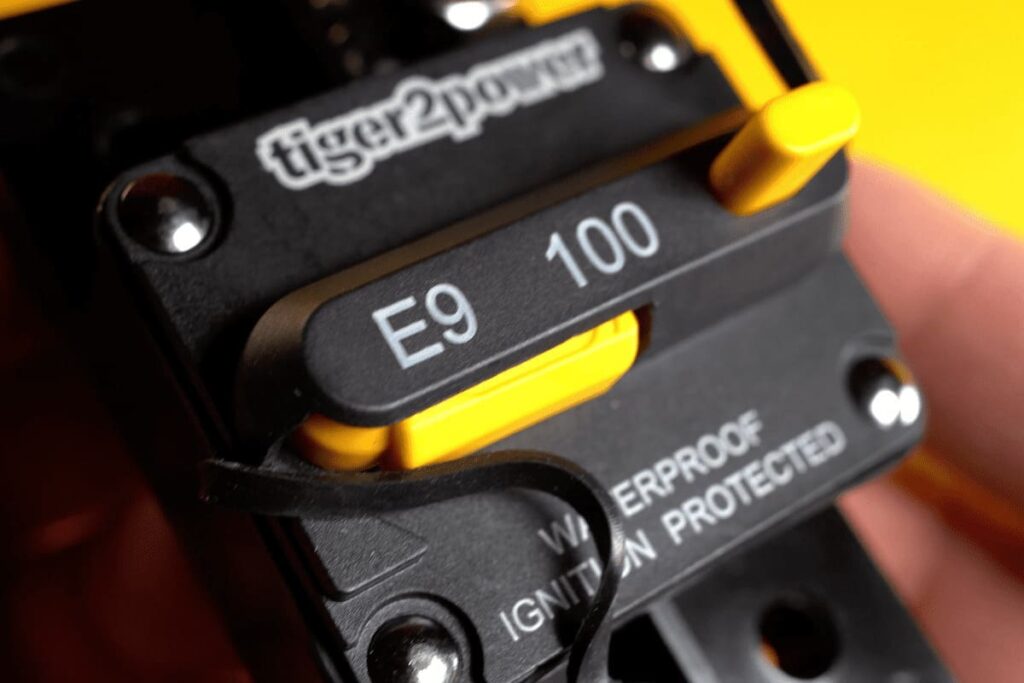
This good question from a customer reached us after they bought one of our circuit breakers. Despite the stated value of 100A for the breaker, it did not trip at a measured 100A.
So is the circuit breaker broken?
To find out, let’s take a look at the construction and behavior of fuses that work on the thermal principle.
A quick clarification of terms first: fuse vs. circuit breaker
By a fuse we generally mean a single-use product. Once blown, it is broken and has to be replaced.
A circuit breaker, on the other hand, does not blow but trips. It can be returned to its original state by flipping a small lever and can thus be used permanently and over and over again. Our tigerexped circuit breakers, by the way, also allow the circuit to be disconnected manually (which corresponds to “pulling” a normal fuse). This way you can, for example, work safely on the circuit and then close it again afterwards with the lever.
How a Fuse Works
A fuse blows (or trips, in the case of a circuit breaker) when the bimetal inside it gets warm.
That means it must not already be warm when the stated amperage is reached; otherwise the fuse could not permanently withstand this current load (at which it is not yet supposed to blow) and would blow far too early.
To create the decisive temperature difference, even more current has to flow.
Time vs. Current
If you look at the datasheets of fuse manufacturers or, as in our case, simply at the packaging of the circuit breaker our customer bought, you will find tables or graphs giving times and currents.
They clearly show that every fuse can withstand considerably more than the value stated on it. The printed amperage can sometimes be exceeded by 150 – 200% for minutes before the point of blowing is reached, and for several seconds the fuse even withstands up to 500% of the value.
So it regularly takes a current load above the stated value, which causes not only an electrical but also a time delay until the bimetal is hot enough to blow.
The rule is:
The further the current exceeds the stated value, the shorter the time until it blows.
This behavior of fuses is therefore completely normal. The point is that in continuous operation they should not yet blow at the stated value, but only above it.

Couldn’t a Fuse Trip at Exactly the Right Point?
No. Fuses that work on a thermal principle cannot be used for blowing or tripping at an exact point.
If, as in our example, you wanted to disconnect the circuit at exactly 100A, a current measurement would have to be built into the circuit and other disconnecting elements such as relays, MOSFETs or similar would have to be used.
The Topic as a Video
Conclusion on Fuses That Do Not Trip
A fuse that does not trip at exactly the printed value is not broken.
So that it does not blow too early in continuous operation, the heat acting on the bimetal first has to be increased, and this happens through a current load above the rated value. The further the current is above the printed value, the shorter the time until the bimetal gets too hot and blowing is triggered.
For this reason, fuses working on the thermal principle cannot be used for tripping at an exact point.
Tables and graphs on the behavior of the respective fuse can be found in the manufacturers’ datasheets.
Do you like our articles? Then subscribe to the tigerexped newsletter! Get interesting news on products around motorhome conversions and never miss a helpful article again. Of course, you can unsubscribe at any time with no hassle.
You might also be interested in these topics: