
If you’re planning the build-out of your travel vehicle, deciding on hot water is an important point, because it greatly increases comfort on the road.
But which boiler should you choose, and what fits your requirements?
What matters here is, once again, your travel style, which ideally your whole technical setup is tuned to. Closely tied to this are which energy sources are easiest for you to keep available and how much space you have for the installation at all. Last but not least, price naturally plays a role too.
Below we’d like to look at the three options monoBOIL, duoBOIL and combiBOIL from these individual but closely interlinked angles, and finish with a summarizing decision aid.
First Off: How the Hot Water Boilers Differ in Principle
The three boilers first of all differ in the use of different, or different numbers of, ways to heat water.
This comes with certain features and conveniences in use, which we’ll cover in the Features section.
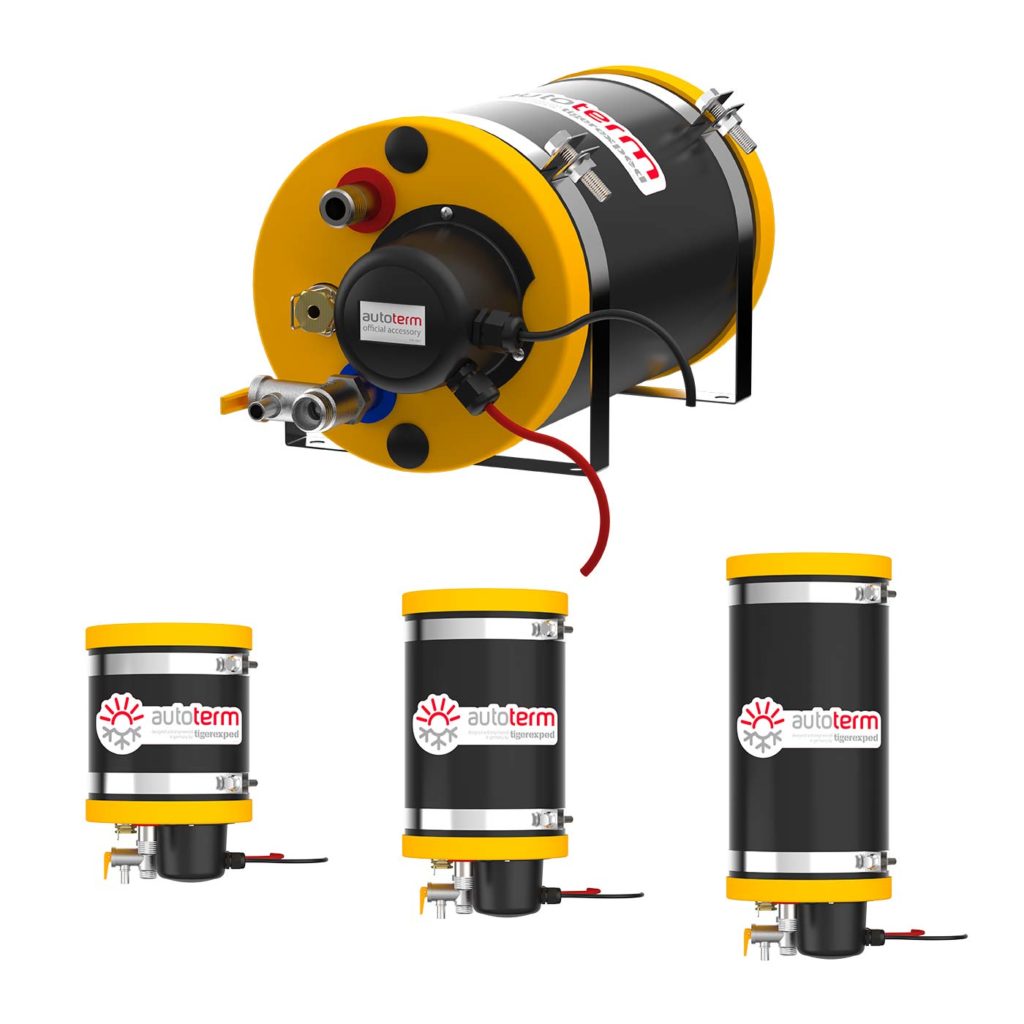
combiBOIL
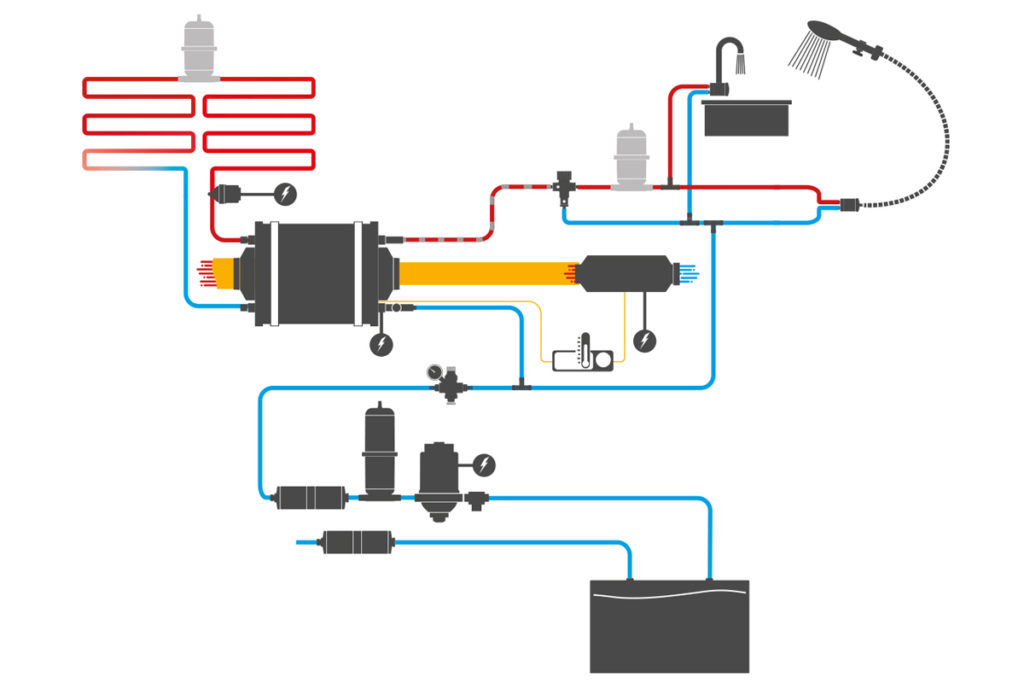
The most versatile boiler model can use a total of three energy sources for heating:
- Warm air from the auxiliary heater
- Electric heating element
- Waste heat from the vehicle engine
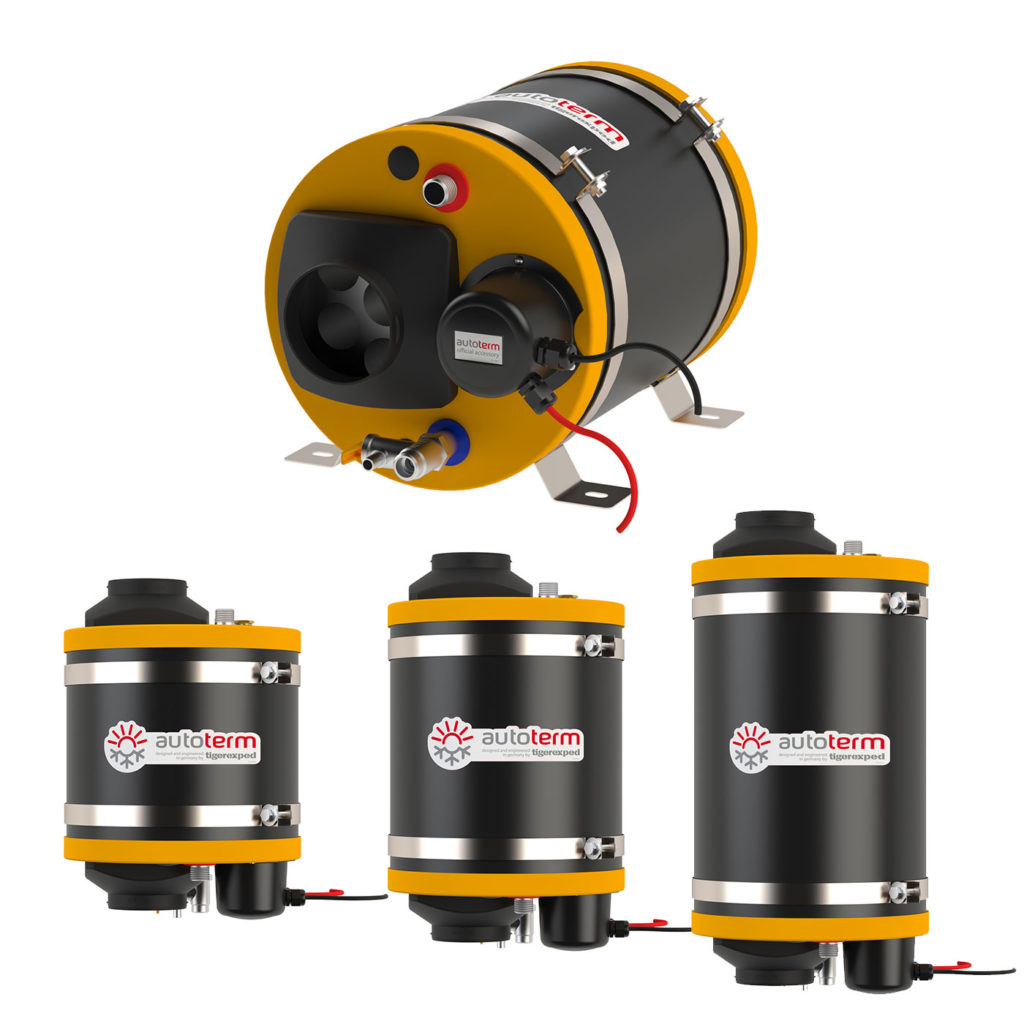
duoBOIL
With duoBOIL, the option of running it from the air auxiliary heater is dropped. It only uses
- Waste heat from the vehicle engine
- Electric heating element
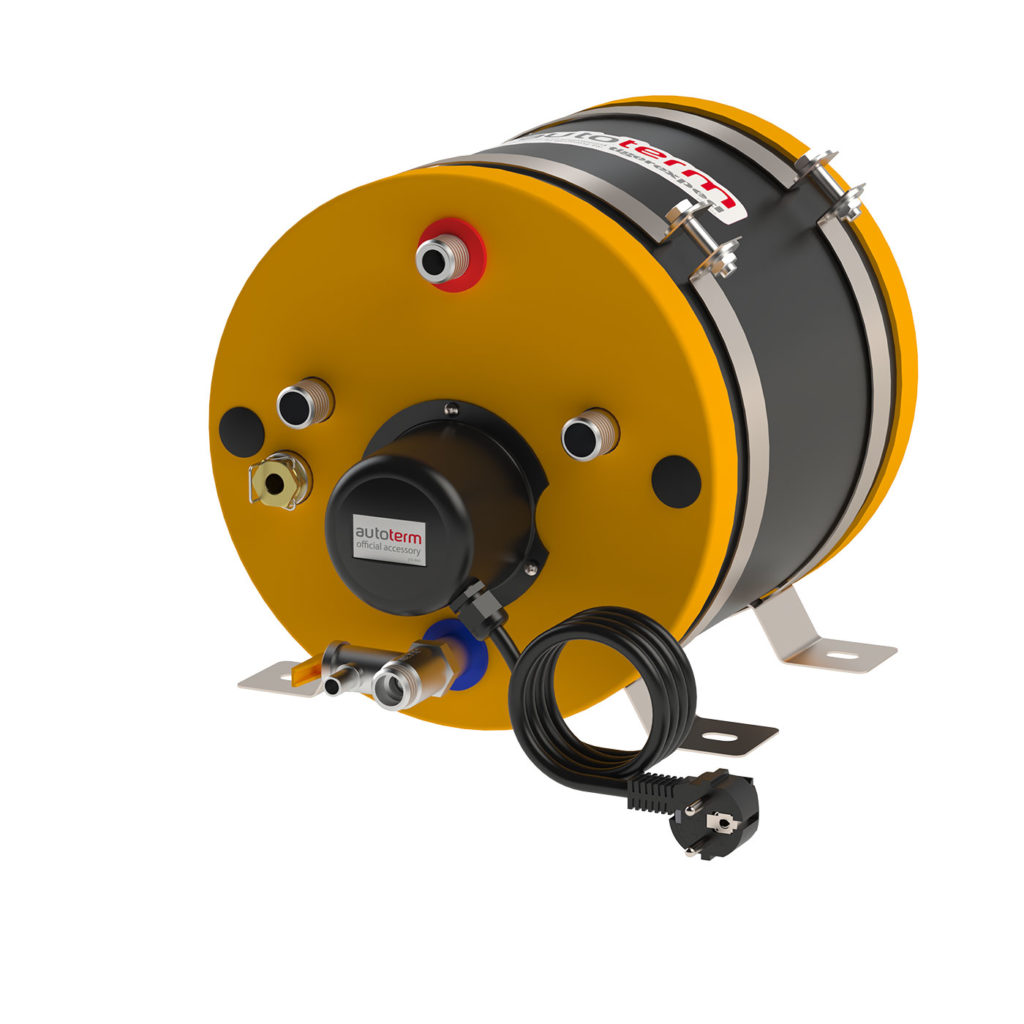
monoBOIL
monoBOIL is a purely electric hot water boiler, so it only produces hot water using electricity.
You may think at first that this is not an option for you because you’re not planning a large battery capacity. But as you’ll see in the analysis of your travel style, the chances of having electricity “to spare” for this are in many cases quite good.
monoBOIL is then an interesting option, as it takes up the least installation space and is the lowest-priced variant to buy.
Analyzing Your Travel Style
The first step toward choosing the right boiler is to analyze your travel style. This point in particular is extremely individual, and what is the perfect solution for you may be completely unsuitable for someone else.
Take, for example, the question of whether you like to sleep out in the wild or at pitches and campsites:
Do You Often Stay at Pitches or Campsites?
If you often use an external power supply, monoBoil as a purely electric boiler is ideal. Because it uses only electricity to heat water, it is especially space-saving and low-priced to buy.
Of course, it isn’t a given that you also want to use the power hookup (often not included in the price) when staying overnight at such facilities. If you use pitches “only” to sleep legally and safely / quietly, and have enough power reserves on board, you can of course save the cost of the power post.
When designing your power concept, also keep in mind that, depending on the region you travel to, it can be difficult to find a power source to connect your vehicle to at all.
Tip:
How you can make your vehicle more power-independent, taking your travel style into account, is examined in this article:
Do You Cover Driving Distances Almost Every Day?
If you’re one of the frequent drivers who doesn’t stay in one place for long, monoBoil is also an excellent choice. By using the alternator, the leisure battery is charged while driving, so enough energy is available to run the boiler.
If you mainly use hot water after driving, e.g. for a refreshing shower, duoBOIL is also a nice concept, since the service water is heated by the waste heat of the vehicle engine while you drive.
Is Self-Sufficiency Important to You?
In that case you have probably designed your electrical system accordingly. Here your batteries are fed not only by the alternator but also by a solar system, and if still necessary, you can top everything up via a shore power connection.
The batteries, in turn, are probably sized large enough to bridge several days with the energy stored in them.
Tip: For a vehicle that is meant to be as self-sufficient as possible, plan the hot water boiler into this concept of power generation and energy reserves from the start.
So you have enough power available to use the electric heating element that every hot water boiler has. To extend the self-sufficient (stationary) time as far as possible, though, (especially at cooler outside temperatures) it makes sense to combine the hot water boiler with an air auxiliary heater.
If you have to heat the vehicle anyway using fuel from the vehicle tank, combiBOIL lets you produce hot water without any additional energy use.
Space Requirements and Installation
Besides your travel style, the space the boiler, or the whole water installation, requires is another important factor. This, as well as the amount of hands-on work for the installation, can differ considerably.
Compact Vehicle, Limited Space for Technology
Because monoBoil focuses on the electric heating element, this boiler variant is particularly space-saving. Air or water heat exchangers take up no volume here.
That makes it ideal for smaller travel vehicles.
Installation of monoBOIL is virtually “plug & play”.
Medium Space Requirements, Dedicated Engagement with the Vehicle’s Technology
duoBoil needs somewhat more space because it uses two energy sources. It is well suited to vehicles from small van size upward.
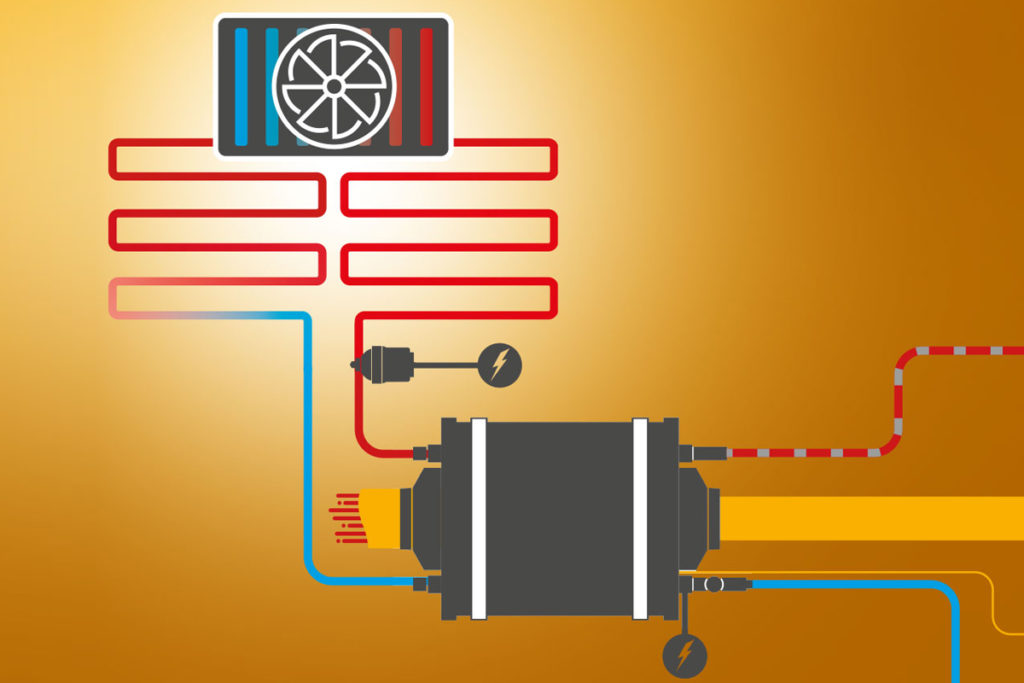
The integration into the engine coolant circuit has to be done specifically for your vehicle. You therefore need to engage with the vehicle’s technology itself, if necessary researching with the manufacturer how and where the boiler is best integrated into the coolant circuit.
Tip:
You’ll find introductory information on this topic in this article:
Of course this variant is much more demanding in terms of hands-on work than the purely electric variant.
For Sophisticated Space-and-Technology Design or Large Vehicles
combiBOIL, through its combination with the auxiliary heater, is a particularly attractive hot water solution and offers additional, useful features.
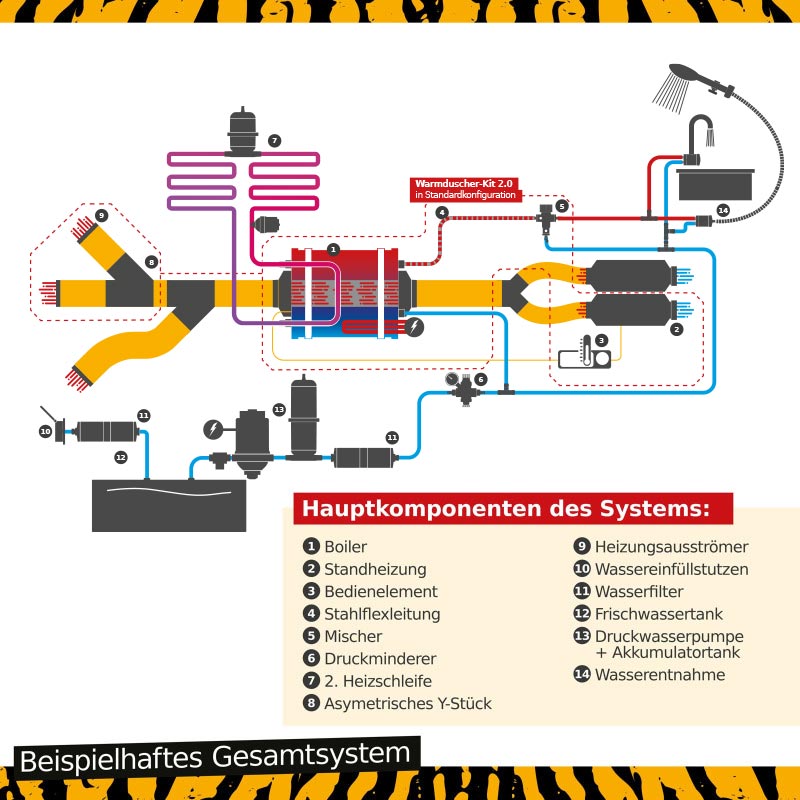
This versatility needs its space, though. To install the system properly, a certain length of installation space must be available. It has to accommodate the air intake, the boiler, a roughly 50cm connection to the auxiliary heater, the heater itself and the warm air outlet, ideally in as straight, kink-free an installation as possible.
Our tech tigers Lars and Nico explain here how this system is installed and everything worth knowing about it:
By the way, it is not a must to connect combiBOIL to the engine coolant circuit, even though it offers that option. If you don’t want to use this option, you don’t need to do anything else, not even close any connections or take any other action.
Either way, with this boiler variant you still have the electric heating element available to heat service water without running the auxiliary heater.
Additional Features
Besides their operating options, the three boilers also differ in their additional functions.
Extra Comfort Such as Floor “Heating” and Towel Radiator
A piece of real living luxury for travel with a feeling of home.
Are you moving into your camper for a while, planning long-distance trips or long stays, or will you be on the road in extreme conditions such as severe cold and / or expected continuous rain!?
The more your plans point toward “mobile living”, the more important it is to really feel at home and be able to recover in your vehicle – because even traveling isn’t always Instagrammable. Also keep in mind that you might get sick on the road or have several sets of wet clothes to dry.
For such situations, features like a heated floor in the seating area or a towel radiator in the bathroom are simply priceless luxury that can greatly improve the trip even under perhaps unpleasant conditions.
duoBOIL and combiBOIL offer you these options thanks to a second water loop.
Note:
Please note that heating the floor with a hot water boiler cannot be used to heat the room volume. The term floor “heating” is therefore not to be understood as in house building.
An Integrated Heating Water System
While the combiBOIL hot water boiler initially doesn’t care which air auxiliary heater is connected to use this option, comfort and range of functions only improve enormously through the combination with an Autoterm air auxiliary heater.
Not only can you monitor the boiler temperature on the shared control panel. The auxiliary heater can also react automatically to certain conditions and switch itself off and on, which makes use particularly safe and makes a control flap unnecessary in the vast majority of cases.
This system integration into the Autoterm heating system enables further features:
The Frost Protection Function
If you’re not in the vehicle to heat it adequately in sub-zero temperatures, you have to drain the water system and make it frost-proof.
Water-carrying components can be destroyed by freezing, and water damage threatens in the vehicle from the resulting leaks. A matter of course before winter storage.
But what if you only want to leave the vehicle for a short time (a few days) and then return? The integrated system of combiBOIL and Autoterm auxiliary heater protects your vehicle from frost damage.
When the water temperature drops to 2 °C, the heater automatically warms the water to +15 °C and the ambient air to +7 °C.
Preheating the Vehicle Engine
As a reversal of the function of heating the service water via the engine coolant circuit, combi- and duoBOIL make it possible to use energy from electricity (or, in the case of combiBOIL, from the auxiliary heater) to preheat the engine via the coolant circuit. This allows a gentler start of the vehicle.
Important to note, however:
This type of engine preheating is not suitable for arctic conditions!
If you explicitly need to protect the engine on planned trips into extreme cold, a water auxiliary heater designed for that, such as the Flow 5D, should be installed.
Costs
Besides the technical properties and features, budget also plays a role in choosing the hot water boiler.
The Cheapest Solution
monoBOIL – Perfect if you’re looking for a simple and cost-efficient hot water solution without frills.
monoboil is available from 434.95 euros (as of Dec. 2024) with a volume of 3 liters. monoBOIL is also available in 4.5 and 6l sizes.
Mid-Range
duoBOIL with a volume of 9l is available from 589.95 euros (as of Dec. 2024).
Premium Solution
combiBOIL is available from 899 euros (as of Dec. 2024) as a standalone product, to be run with any air auxiliary heater or to retrofit an existing Autoterm heater.
TIP: The fully integrated system of an Autoterm air auxiliary heater and combiBOIL is available as the Hot Shower Kit 2.0 at an attractive bundle price from 1559 euros (as of Dec. 2024).
As an upgrade for existing Autoterm heaters, the boiler is available with all required connecting elements as the Hot Shower Upgrade Kit.
Video: The Three Boiler Models Compared (German)
Conclusion: The Right Hot Water Solution for Your Travel Vehicle
Choosing the right hot water boiler depends decisively on your travel style, the available energy sources, the space on offer and your budget.
monoBOIL convinces with its compact design, easy installation and cost efficiency – ideal above all for smaller vehicles or trips with frequent access to electricity.
duoBOIL, through its integration into the engine coolant circuit, offers additional flexibility and is perfect for frequent drivers who rely on efficient solutions such as automatic hot water heating while driving without additional energy use.
combiBOIL, in turn, is the premium solution with maximum versatility. It offers additional comfort functions such as frost protection, the option of floor heating and seamless integration into the vehicle’s auxiliary heating system.
Whether you value minimalist practicality or luxurious travel comfort – with monoBOIL, duoBOIL and combiBOIL you’re sure to find the right solution to give your trips that extra bit of well-being.
If you have further questions, feel free to contact our support!
Did these tips help you? Share them with like-minded people facing the same questions: