

When buying drinking water filters for motorhomes and campers, the service life of the filter cartridges is a key question. There is, however, no simple or even universally valid answer.
Durability depends on various factors, with water quality probably the most important one. Even if the water looks clean, it can contain high amounts of suspended solids, microorganisms or dissolved biofilm residues.
Besides water quality, there are other influences that determine how long a filter lasts on the road. We want to help you put the manufacturer’s figures into better perspective in the context of your own trips and your vehicle.
Manufacturer Specifications
Important to know: the filter lifespan values in liters stated by the manufacturer were determined under laboratory conditions – not while traveling in a motorhome.
That makes the figures easy to compare, but in everyday travel the amount of water actually filtered before the necessary cartridge change will often deviate from them (sometimes strongly).
Note: In this article we focus on the filter cartridge that serves as the so-called “germ barrier”. While activated carbon can filter dissolved substances out of the water, the germ barrier, consisting of a hollow fiber membrane (ceramic with some other manufacturers), retains solid particles that can make you acutely ill, such as E. coli bacteria.
You can find out more about which filter to use how, and which system suits you, in this article: Which Water Filter Do You Need? Finding the Right Kit in 5 + 1 Questions.
How Does a Hollow Fiber Membrane Filter Work?
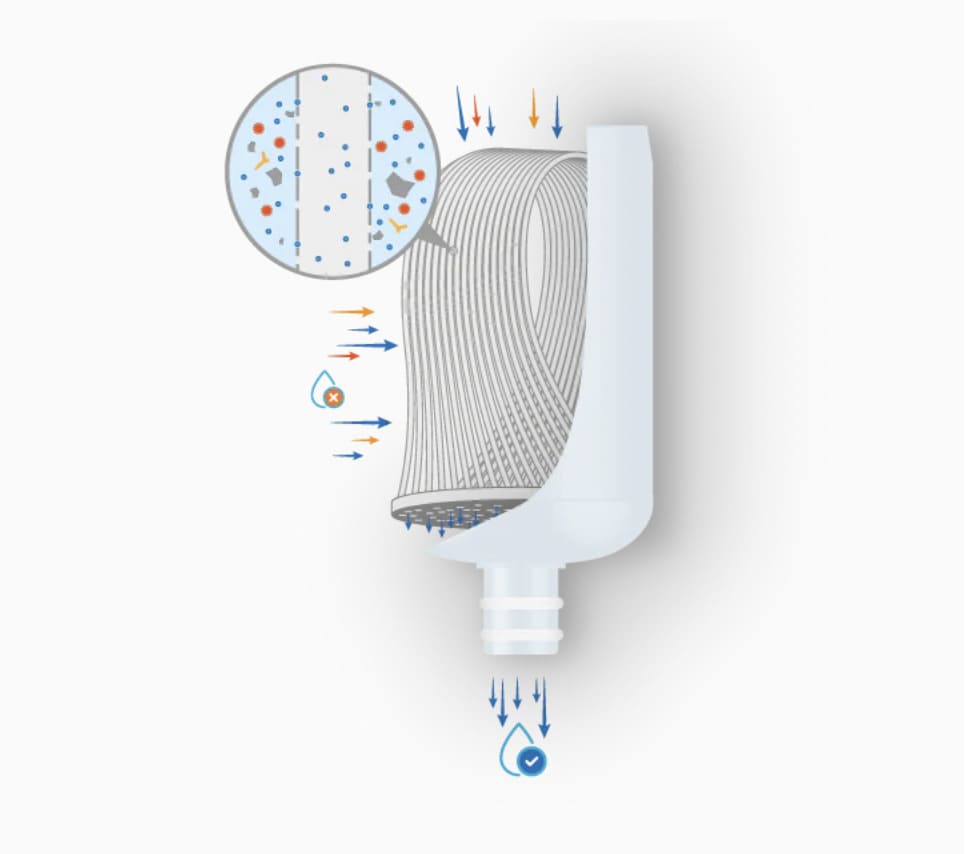
To judge a filter’s service life correctly, it is important to understand how it works. A hollow fiber membrane filter that retains disease-causing germs works – unlike activated carbon – purely mechanically.
The filter consists of a bundle of tiny, hollow fibers with microscopically small pores – comparable to drinking straws full of tiny holes. The water is routed through these fibers, and contaminants such as bacteria and suspended solids get caught on the fine pores of the outer wall.
The pore size of Alb Filter is only 0.1 µm – so fine that even the smallest pathogens are retained. Over time, though, the pores clog with particles in the water. You notice this because the water flow decreases. Eventually no water can be pushed through the filter at all and a filter change is required.

Which Factors Influence How Quickly the Filter Clogs?
We have already briefly met one factor, but there are other influences that can decide how soon you have to change the filter. Let’s start once more with the most important criterion:
Water Quality
In some countries, there can be more particles in the drinking water pipes, because water treatment and the pipe network there often follow different standards than in Germany or central Europe.
This is due, for example, to older or poorly maintained pipes. Metal pipes corrode over time and release rust particles into the water. Leaks and damage to the pipes can also allow dirt or microorganisms to get into the tap water from the ground.
In some regions, sediments, sand and other suspended solids are not filtered out of the water as thoroughly, or the water may be taken directly from surface waters or shallower wells, where it naturally contains more suspended solids.
In dry countries or during the dry season, water quality can also be poorer because the remaining water resources are more heavily concentrated with contaminants.
In tropical regions or after heavy rain, on the other hand, stirred-up mud and sediments can cause a temporary deterioration in water quality.
That does not mean the water in these countries is generally undrinkable – but it may contain more sediments or show a higher microbial load. That is why a good water filter is often indispensable when traveling (especially for our “spoiled” digestive tracts).
Cleanliness of the Tank and Water Installation
Not only the quality of the water you fill up is decisive, but also the condition of the entire water system in the vehicle.
In standing water supplies, biofilm forms on the inner surfaces of tanks, hoses and other water-carrying components. Parts of it can come loose and clog the filter. Regular cleaning and disinfection of the system extends the filter’s service life considerably.
What Is Biofilm and How Does It Form?
Biofilm is a slimy layer of bacteria, algae and fungi that forms on surfaces that regularly come into contact with water. The microorganisms attach to the surface, produce a protective slime coating and multiply.
This process is particularly encouraged by water standing for a longer time (e.g. in large tanks) and by warmth.
Components of the biofilm can come loose and load the water with particles that clog the filter. Regular cleaning of the water system minimizes biofilm formation and extends the filter’s service life.
Try feeling the inside of your water tank with your fingertips. Does it feel greasy or slimy? Then it is high time for a thorough cleaning!
By the way: Biofilm does not only arise from contaminated water you fill up. A camper’s water system is not hermetically sealed and will never be sterile or germ-free. As a result, so-called recontamination can occur even with water that was filtered when filling. The necessary intervals between tank cleanings can, however, be extended enormously under some circumstances by filtering when filling.
Tank Size
A small tank that is refilled often is less prone to biofilm formation, because the water does not stand long enough to offer microorganisms ideal growth conditions. In addition, the tank’s inner wall is flushed by the regular water exchange, making it harder for biofilm to settle.
A large tank, on the other hand, often stays filled with the same water for a longer time, which encourages biofilm formation and the settling of microorganisms.
Materials Used
Drinking-water-certified hoses and tanks reduce the risk of contamination and biofilm growth. These materials are not only tested to ensure they release no harmful substances into the water, but also to offer microorganisms a poorer growth basis.
Read more on this topic in this article: Drinking Water Hose – Look for These Two Certificates!

Temperature
The warmer the water, the better bacteria, algae and biofilm can multiply. In hot regions this can lead to faster contamination of the water – which in turn clogs the filter faster.
Vehicle Movement
If the motorhome stands still in one place, biofilm that forms will develop on the surfaces and mostly stay there. Through the vehicle’s movement and the sloshing of the water in the tank, parts of the biofilm can come loose and then float freely in the water, from where they get into the filter.
Pump Pressure
A weak water pump has more and more trouble pushing water through the filter as it gets dirtier. A more powerful pump maintains the water flow longer – even when the filter is already partly clogged. It cannot prevent the clogging, but it can get the maximum out of the filter.

A full 4.2 bar of pressure and a balanced, smooth water flow for your system – with tigerexped’s pressure water components at a bundle discount.
What Can You Do to Extend the Filter’s Service Life?
Alb Filter, with a pore size of 0.1 µm, offer maximum protection for your health. But precisely because the filters are so fine, they clog faster than coarser models – which is, however, a necessary compromise for clean drinking water.
Here are some measures to extend the filter’s service life:
- Use a pre-filter (Alb “Protect” pad) – Definitely use the pre-filter pad! It holds back rust, sand and other coarser dirt before it reaches the actual filter cartridge, effectively extending its service life. The Protect pad is much cheaper to replace than the filter cartridge, and the more expensive filter does not get clogged by unnecessary dirt. Note: the pre-filter in front of the pressure water pump cannot be compared to the drinking water filter’s pre-filter pad, as the latter filters much more finely. So make sure to use both!
- Connect several filters in parallel – This spreads the load across several filters, so each one lasts longer.
- Filter drinking water only – A separate (second) faucet is used to draw water for drinking, cooking and brushing teeth, while water from all other outlets stays unfiltered. By greatly reducing the total volume of water to be filtered, the filters’ service life can be extended considerably without taking any risk with drinking water hygiene.
- Leave shower water unfiltered – If you don’t want to install a separate drinking water faucet, you can at least leave the shower water unfiltered, since on the skin the contaminants it contains usually do no harm.
- Increase water pressure – A stronger water pump maintains the flow even when the filter is already partly clogged.
- Clean the water system regularly – Prevents premature clogging by biofilm.
Experiences from Practice
Practical tests by tigerexped staff, as well as our customers’ experiences, show how much a filter’s service life can vary. Here are a few examples:
Canada/USA Long-Term Trip (tigerexped employee, truck)
Filter system used:
Alb Filter Fusion + Protect for fixed installation
Operating environment:
- Tank volume 2 x 150 liters,
- Refilled about every 10 to 14 days.
- Cool ambient temperature.
- Water always from municipal water supplies.
Filter performance under these circumstances:
about 3000 liters each.

South Africa (customer with truck):
Filter system used:
Alb Filter Fusion + Protect for fixed installation and additionally Alb Filter Fusion + Protect as a fill filter
Operating environment:
- Large tank volume,
- hot ambient temperatures,
- probably much more heavily contaminated water sources (even if it is “drinking water quality” locally) than in the Canada example above,
- No Protect pre-filter pad used!
Filtered water under these conditions:
Only a few hundred liters!
Albania, Bosnia, Southern Europe (tigerexped employee, mini van)
Filter system used:
Alb Filter Fusion for fixed installation (without Protect pre-filter)
Operating environment:
- Filters used for 6 – 8 weeks spread over the year.
- Tank filled almost exclusively from wells, springs, rivers or similar, no municipal water supplies.
- Tank volume 55 liters,
- daily filter throughput of only about 1/3 of that through a dedicated drinking water faucet (for drinking, cooking and brushing teeth).
- Between vacations, the filters are removed from the system, dried and stored as recommended in a cool room without high humidity.
- Tank cleaning with active oxygen before every major vacation.

Filtered water under these conditions:
In this use, no cartridge change was needed after 3 years, even though no Protect pad is used because of a relatively low-pressure pump. At a good 18 liters a day, an average of 50 days of use x 3 years, we would be at over 2,700 liters without a filter change.

Tank cleaning with active oxygen: find out how it works here:
Spain / Portugal (customer with van)
Filter system used:
Alb Filter Fusion + Protect for fixed installation
Operating environment:
- Tank volume 80 liters,
- warm ambient temperatures,
- Filled from municipal water supplies.
Filtered water under these conditions:
Filter performance about 1500 liters.

Customer on Long-Term Trip in Canada / USA
Here is the written reply to our question about filter performance:
“We estimate we used at least 7,500 L of water [on the trip]. The pre-filter [Protect] lasted between 50 L and >1000 L, depending on water quality.
– @IAonTour
The active filter before the tank definitely lasted several 1000 L, although the chlorine filtration felt like it got a bit worse after that. The water was also partly like from a swimming pool.
At the start, the Nano filter only lasted 4 weeks, which was surprisingly short despite the pressure water pump, but this got much better with the additional pre-filter. I think our tank wasn’t 100% clean at the start either. Since, because of the build, we also had to route the shower water through the Nano filter, an unnecessary amount naturally went through it. The next [vehicle] will definitely be built differently! Per filter, though, surely > 1500 L. Unfortunately I can’t say anything more precise, as we really didn’t keep better track. The quality of the water is undisputed, though. We drank it straight from the tank the whole time.”

Maybrit and Niklas from the YouTube channel this old truck
They answer the question about filter performance on their long-term trip through Europe, Central Asia and Africa like this:
“The Protect filters clog first (that’s what they’re for).
– this old truck
Otherwise 4 months at roughly 25 – 30 liters a day.”
With what is surely strongly varying water quality, that comes to 27l x 30 days x 4, or 3,240 liters until the filter change.
Conclusion
The service life of a hollow fiber membrane drinking water filter in a motorhome depends heavily on the water quality and the condition of the water system.
Anyone who treats their filter and water resources consciously can extend its durability noticeably. Clogging of the membrane cannot be prevented, but suitable measures such as filtering only drinking water, using several filters or regular cleaning of the system can optimize the service life of each filter – without compromising on the quality of water that is meant to be enjoyed.
Were these tips on the durability of drinking water filters valuable to you? Then feel free to share them with friends and like-minded people who are asking themselves the same questions:
You might also like these magazine articles:


