

Too little power (more precisely: insufficient voltage) can be behind a wide range of problems with the auxiliary heater in your camper. Typical symptoms include the heater shutting off while running, or the control panel staying black.
This article is meant to help you fix heater malfunctions caused by voltage problems / undervoltage and, where possible, avoid them in the first place. We cover running the heater from the leisure battery as well as using “power boxes” as an alternative to a battery.
Voltage at the Battery vs. Voltage at the Heater
To find out where things are really going wrong, it is important to first measure the voltage correctly.
When malfunctions already point clearly to a problem with the electrical supply, most people tend to measure battery charge and voltage at the battery. That is a good starting point. But what if you find “there is plenty of juice in there“?
You need to know this: the voltage at the battery is not necessarily the same as what arrives at the heater. So you need to check the cable runs and connections and put the multimeter directly on the heater’s plug connection.
The same voltage should be present here as at the battery itself. If not, the cable runs may be faulty or corroded, or connections such as fuses may have come loose.

How Does the Problem with Your Auxiliary Heater Show Up?
As a distributor of Autoterm from Latvia, the information in this technical guide mainly relates to the Autoterm Air 2D and Air 4D air heaters.
The technical basics apply in the same way to auxiliary heaters from other manufacturers, so you will surely find useful tips here as well.
Heater Does Not Start
Starting an Autoterm diesel heater includes a glow phase of about two minutes for the glow plug, to preheat the combustion chamber.
Producing a lot of heat from electrical energy always means high consumption, so the heater draws up to 11A at 12V from the battery or from the power box, if you use one. The power source must therefore be able to supply the heater with this for long enough. In addition, the voltage at the heater must not drop below 11.8V.
If the heater is to run from a power box, check the data sheet to make sure it can provide more than 10A continuously at the DC output. In this mode of operation, this is a common reason why the heater does not start.
Starting or running the auxiliary heater from battery chargers is generally not possible either and leads to the same symptom of a heater that does not start at all. A battery is needed here as a buffer.
Control Panel Stays Black or Shows “no connection”
If the heater’s control panel does not wake up, shows nothing or cannot connect to the heater (display “no connection”), you should check not only the power supply but also the cable runs between heater and control panel. Ideally, disconnect them once and reconnect them. If an extension cable is used, leave it out for diagnosis and try a start without it.
If the “no connection” error or a black display persists after unplugging and replugging all electrical connections, disconnect the whole system from power completely to test whether the control panel or the heater itself might be faulty.
Next, as just described, the connections between heater and control panel should be checked. Measure the voltage. If the reading is fine in this case too, there is one last test to find out whether the control panel and not the heater itself is causing the fault:
“Emergency Start” Switch Input
The heater has a switch input, which we call emergency start – on the Autoterm Air this is the brown and white wire on the wiring harness.
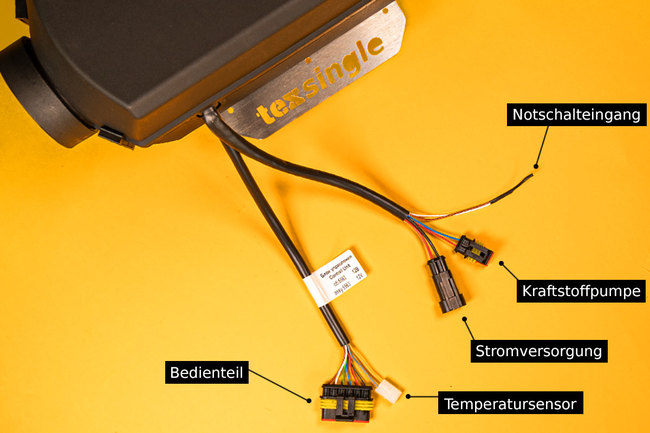
When these two wires are connected, the heater runs, depending on the series, either for two hours at full load (from Nov. 2019) or in the previously set operating mode (before Nov. 2019).
If it does, the control panel appears to be faulty and must be replaced. Until then, the heater can be run temporarily via the emergency start.
Heater Shuts Off Due to Undervoltage
During operation, the Autoterm Air 2D has a rated power of 29 watts at the highest and 10 watts at the lowest setting; the Air 4D is specified with a power consumption of 10-62 watts.
So the heater shuts off during operation with error 15 when the battery voltage is too low, below 10V in a 12V system or 20V in a 24V system. In this case the connections must be checked, but above all the battery must be charged.
Attention, winter travelers: Keep in mind that cold temperatures have a negative effect on battery voltage, and keep your batteries warm to avoid undervoltage!
You must absolutely avoid the heater’s power supply being cut off abruptly, e.g. by a BMS or battery protector, so that the heater shuts down without a controlled cool-down. The latter can have serious consequences such as warped combustion chambers or glow plug towers, and thus leaks.
Undervoltage Problems with Diesel Auxiliary Heaters – Takeaways
1. Make sure that at least 11.8V arrives at the heater for at least 120 seconds at start. Check whether battery, power box and wiring can provide this.
2. During operation the heater always needs at least 10V in a 12V system or 20V in a 24V system. Make sure that the battery or power box is sufficiently charged for the planned heater operating period.
The supply must not be interrupted by a BMS or falling battery voltage, to avoid damage to the heater from the lack of a controlled cool-down.
Did these tips help you? Feel free to share them with like-minded people who might also be glad to read them!
These topics might also interest you:

