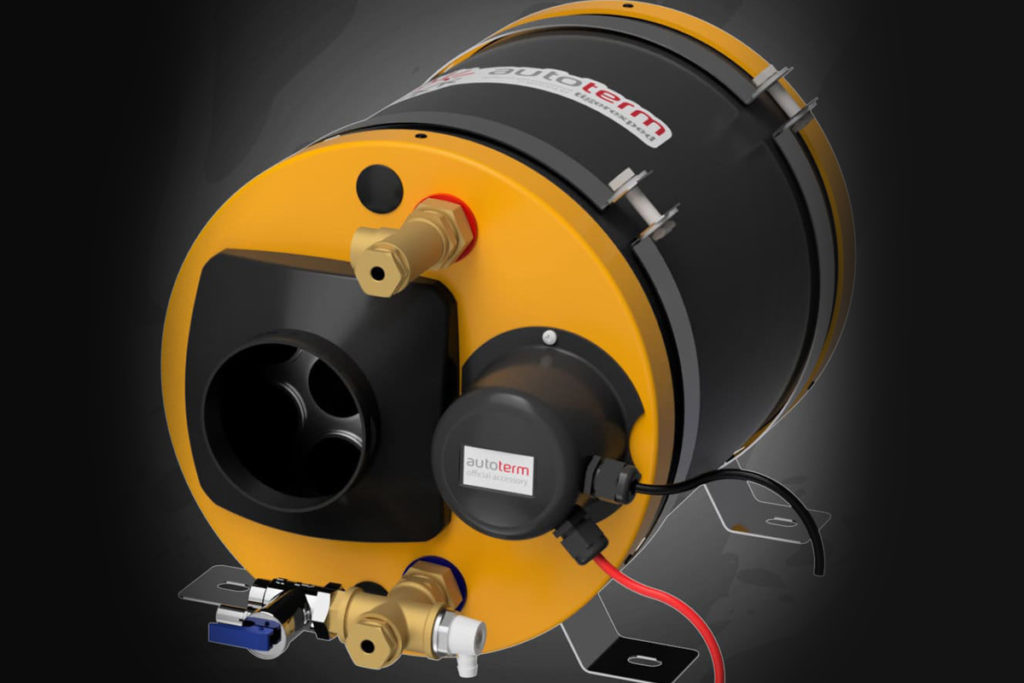
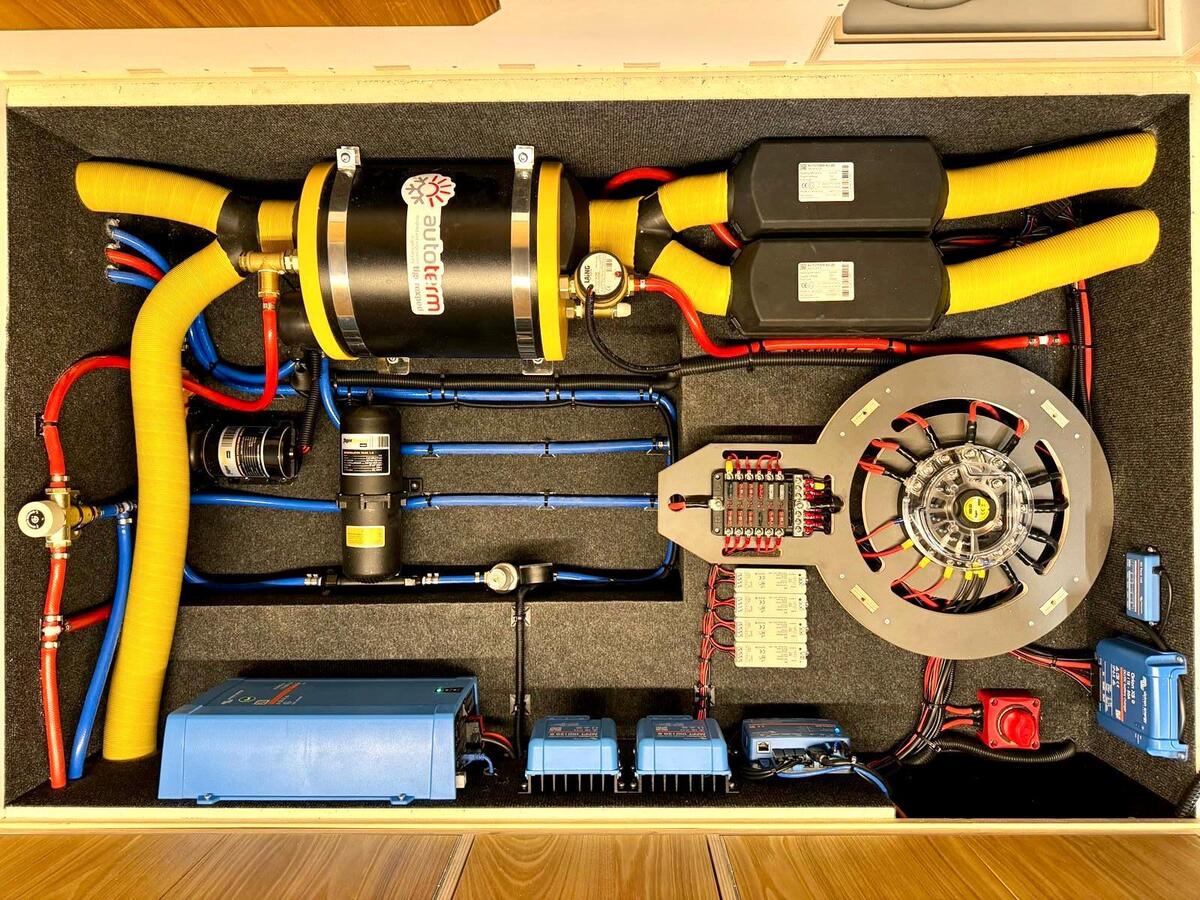
Hot water is part of the comfort of traveling in a motorhome – whether for a shower after a long day on the road or for washing up.
How quickly hot water is available depends largely on the boiler you choose and the heating method.
In this article we look at the different ways of heating the water and how long the heat-up time is for each.
We also don’t want to withhold the odd extra tip at the right spot.
General note
While the basic information and calculation principles, such as the formula for calculating the heat-up time with an electric heating element, naturally apply to any hot water boiler, here we explicitly refer to the combi-, duo- and monoBOIL series.
We can’t make any statement about the heating behavior of other models.
Heating with an Electric Heating Element
With all versions of the tigerexped hot water boilers, you have the option of heating via an electric heating element, i.e. electricity.
The heat-up time with this method can be calculated with a simple formula. For that we need a few values, which we will go through below.
Factors for the Calculation
Even if you certainly won’t calculate the exact heat-up time every time, it is worth knowing the calculation factors. They give you a good idea of what the heat-up time of the water depends on and help you better estimate when the hot water will be ready.
Among other things, the boiler volume, the water temperature at the start, the desired target temperature and the electrical heating power are decisive. The more you know about these factors, the better you can adapt heating water to your own needs and use energy and time more efficiently.
Boiler Volume
The first value you need for the calculation is the boiler volume. Since a boiler can only ever heat its entire volume, the entire amount of water has to be heated even if you need very little hot water.
With large boilers this increases energy consumption accordingly. So when choosing a boiler, think about whether you really want to install, say, the 12 l boiler if your need for hot water may not be that large and a smaller model would be enough.
Keep in mind: the water in the boiler is heated to temperatures far too high for showering, which is why a scald protection / thermostatic mixer is necessary to blend in cold water. This way, 7 or 9 l of boiler volume ends up (depending on the mixing ratio) as roughly twice the amount of pleasantly warm shower water.
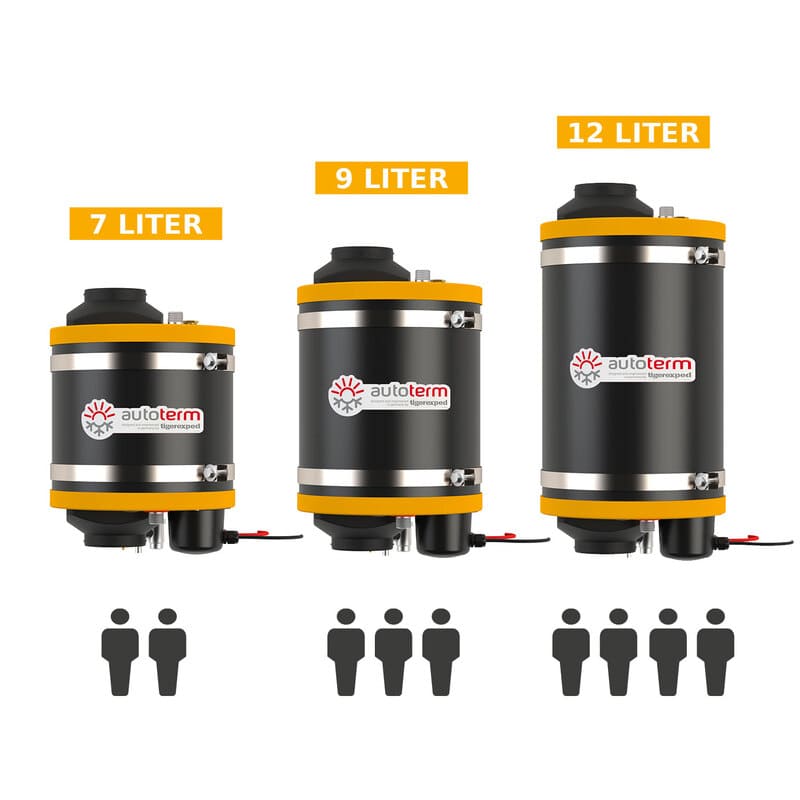
Size recommendation when buying a boiler.
Buying a boiler that is too large takes up unnecessary space and, when run on electricity, also uses unnecessarily much energy.
Important
Even if, depending on the model, a lower temperature is set on the TSR or heating element: we expressly recommend using a downstream thermostatic mixer and regularly heating the boiler to over 60 degrees to rule out colonization and growth of Legionella!
Starting Temperature of the Water
The water temperature when filling is often relatively low, especially in winter. The water then enters the tank at around 4-10 degrees. With 100 l in the van’s wheel arch tank, it is unlikely that it ever reaches more than 10-15 degrees while stored – probably more like just 8-12 degrees. That already includes the auxiliary heater running continuously.
In the GRP cabin of an expedition vehicle, with tanks in a heated rear garage, it can of course be significantly warmer.
The water temperature is an important factor for our heat-up time. The colder the water, the more energy is needed to bring it up to the target temperature.
By the way, it is generally desirable to keep the water in the tank as cool as possible (but of course not freezing). Too high ambient temperatures (from hot summer days or also the auxiliary heater) and the resulting permanent warming of the tank create ideal conditions for the growth of algae and bacteria, which can endanger your health!
Target Temperature
As already mentioned under boiler volume, for reasons of water hygiene it is advisable to regularly heat to over 60°C to prevent Legionella from forming.
Even though the target temperature can be lowered, saving energy and heat-up time, you should therefore generally heat up to the maximum temperature.
Electrical Heating Power
The power of the boiler is decisive for the heat-up time. 12V models usually have 300W, 24V models 600W, and 230V models often 500W.
Clearly, a more powerful boiler heats the water faster.
But: running a 230V boiler via an inverter causes conversion losses and increases power consumption by at least 10% compared to the 12V or 24V version.
If your travel vehicle has electricity in abundance and a correspondingly powerful inverter, you can of course also run a 230V boiler off-grid. We just don’t want to leave this possible drawback unmentioned in favor of faster heating.
Energy Required per Degree Celsius of Temperature Rise
The last number we need to calculate the heat-up time is the amount of energy the water absorbs to be heated by 1k.
Note
Temperature differences are given in k for Kelvin and not in degrees, but 1k is practically 1°C.
This value is always the same, namely 1.16Wh/liter/K.
So to heat 1 liter of water by 1k, you need 1.16Wh.
To simplify the calculation and at the same time account for a few likely losses, we round the value to 1.2Wh/liter/Kelvin.
For calculating the energy required, this means: per liter of water and per Kelvin (°C) of temperature difference, around 1.2 Wh are needed.
Formula for Calculating the Heat-Up Time
With this formula you can calculate the heat-up time of any electric boiler:
(Target temperature in °C – starting temperature in °C) x boiler volume in L x 1.2 / boiler heating power in watts x 60 = heat-up time in minutes.
Heat-Up Time Example Calculation
A 7-liter boiler with 300W power is to be heated from 15°C to 65°C.
- Temperature difference: 65°C – 15°C = 50°k
- Energy required: 50°k x 7l x 1.2Wh = 420Wh
- Heat-up time: 420Wh / 300W = 1.4 hours (approx. 84 minutes)
To calculate it with a pocket calculator in one go:
Enter the formula as follows:
(65-15) x 7 x 1.2 / 300 x 60 = 84 minutes
Don’t forget the two brackets!
Alternatively (if you want to leave out the brackets), press the equals sign ( = ) once after the 15.
Heating with the Air Auxiliary Heater
Heating the boiler via the air auxiliary heater is particularly energy-efficient if the vehicle is to be heated anyway. The method then uses no additional energy.
When heating via an air auxiliary heater, the heat-up time depends strongly on the heat transfer of the integrated heat exchanger. The heat transfer is not constant and decreases as the water temperature rises. So at the start it is relatively quick, and the closer you get to the target temperature, the slower the water temperature rises.
Since calculating the time when heating via the air auxiliary heater is harder because exact factors must be determined, we want to give you an estimate here based on experience values.
You can say that heating with the air auxiliary heater takes about 1 h.
It makes almost no difference whether you heat with 2kW or 4kW, since the heat transfer is below 1kW. The boiler volume also hardly matters, because as the boiler gets larger, the air-to-water heat exchanger gets larger too. As a result, a 12L boiler heats up about as fast as a 7L boiler.
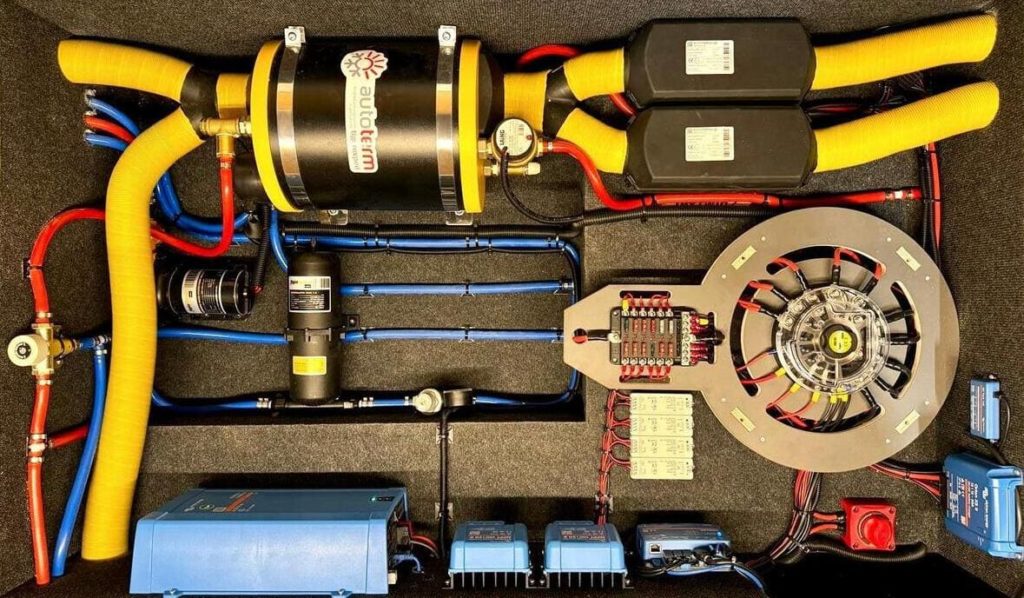
Attention
This information refers explicitly to the tigerexped hot water boiler combiBOIL and should not simply be applied to other models, since to our knowledge (as of November 2024) it is the only boiler on the market that can be operated reliably and safely with a 4kW auxiliary heater at all.

Heating via the Coolant Circuit
Using the coolant circuit to heat water in the boiler is also an off-grid solution, which can be realized with the two models combi- and duoBOIL. How long this takes is even harder to predict exactly, because the relevant factors are far more uncertain.
The model-dependent warm-up time of the engine and the outside temperature play a role. An engine block frozen through at -10°C is of course slower to warm up than one at 20°C. Also, the engine warms up faster if you drive straight onto the motorway than if you crawl through city traffic at low revs.
In addition, where and how the boiler is connected into the coolant circuit also plays a role.
As a rule of thumb:
Once the engine has reached operating temperature, heating the boiler in about 20 minutes is realistic.
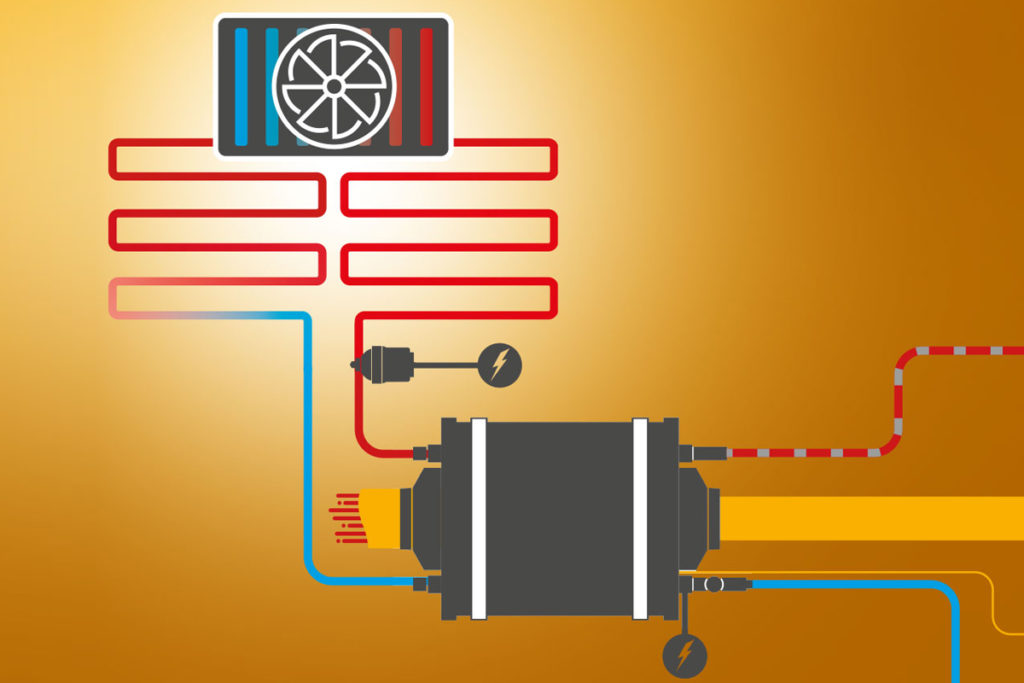
Learn more about the most important points for integrating a hot water boiler in our related magazine article:
Conclusion
Depending on how you use it and your individual technical conditions, the different heating methods vary not only in their pros and cons but also in their heat-up times.
Only the heat-up time via electric heating element can be calculated with simple means.
Experience values for heating with an auxiliary heater and for integration into the coolant circuit are quite close together, so that 1 hour, or 20 minutes after reaching engine operating temperature, give good reference points.
Either way – with a well-considered choice and correct use of the technology, hot water in the camper is always within reach!
Did you find this info helpful? Then share it with other camper builders and vanlifers:
More articles on hot water in the camper that might interest you: