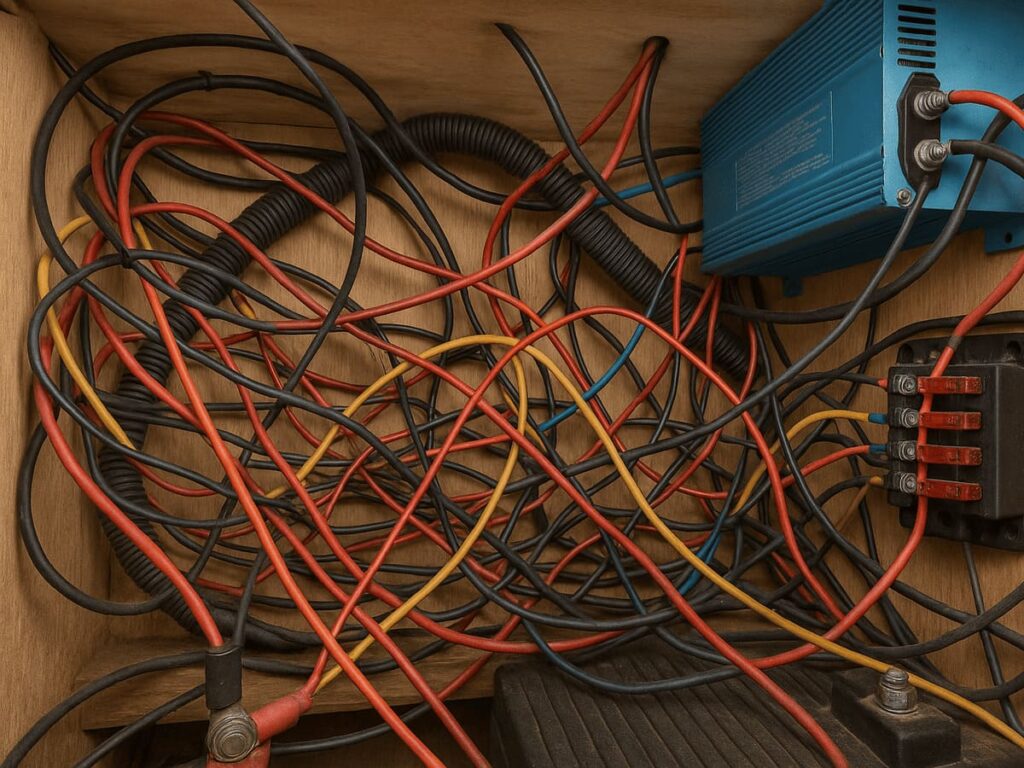
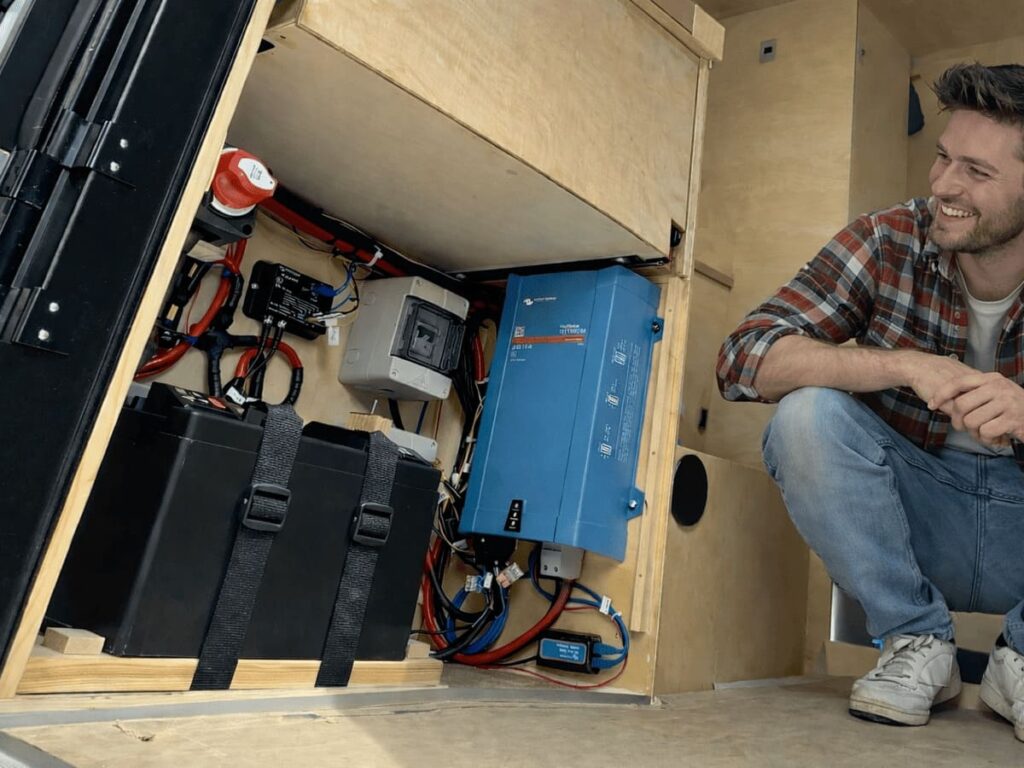
The leisure battery is the heart of your onboard electrics. Imagine waking up in your camper in the morning – not on a pitch next to a charging post, but wherever you simply happened to end up. Thanks to a properly chosen battery, the auxiliary heater has kept you warm all night, your food is nicely chilled, and your devices, as well as the batteries for camera and drone, are ready for the day. That’s how you travel relaxed.
But which battery is the right one? The answer depends heavily on your travel style, your technical requirements and, of course, your budget. In this article we dive deeper – technical, practical, and so that in the end you can say with confidence:
“Now I know what I need.”
Why Choosing the Right Battery Matters
Many campers underestimate how differently batteries work. Starter batteries, for example, deliver short, powerful bursts of current – perfect for starting the engine, but completely unsuitable for long-term energy delivery. A leisure battery, on the other hand, works for hours under an even load. It’s like a reliable travel partner who stays awake at night to keep the campfire burning.
An incorrectly sized or technically unsuitable auxiliary battery may work fine at first, but will quickly lose performance under real operating conditions. Causes include repeated deep discharges or too little cycle life relative to your actual energy needs.
In practice this typically shows after the first winter or after several longer periods of parking and driving: the usable capacity drops noticeably, appliances run for less time, and the battery no longer reliably reaches the required states of charge. The result is a shortened service life, up to premature total failure – with correspondingly high replacement costs. That is exactly what you want to avoid from the start.

Different Battery Types in Campers
So that you can judge which battery type best meets your requirements, let’s take a detailed look at the common technologies and their characteristics in mobile use.
1. AGM Batteries
AGM batteries are the entry point into onboard electrics for many people. They are considered uncomplicated and robust – qualities that make them especially popular with people who just want to hit the road without thinking too much or spending a lot of money.
How Do AGM Batteries Work?
The liquid electrolyte (sulfuric acid) is absorbed in glass fiber mats placed between the lead plates.
These glass fiber mats hold the lead plates firmly in place so they don’t move, even with vibrations or when the vehicle is tilted. This creates a stable “plate pack” that is much more resistant to vibration and extends the battery’s service life. The bound structure of the electrolyte also allows a leak-proof design.
AGM tolerates high charging currents and briefly delivers high power – handy for heavy loads such as inverters.
AGM: Advantages in Practical Use
Robust Against Uneven Charging Conditions
AGM batteries tolerate fluctuations in voltage and charging current much better than gel systems. Charging behavior such as that of classic alternators, variable solar yield or less precise shore power chargers leads to material fatigue or premature aging less often with AGM. That makes them practical for vehicles with mixed or not optimally regulated charging sources.
High Power Output for Short-Term Peak Loads
AGM batteries have an internal resistance that is 30–50% lower than flooded or gel batteries, so they can reliably supply high discharge currents for short periods. Loads such as water pumps, compressor fridges or smaller inverters benefit because voltage drops are smaller and the system runs more stably.
Reliable Behavior at Low Temperatures
In winter or when traveling in cooler regions, AGM batteries generally remain functional.
Charge and discharge currents are possible even at low temperatures, so typical loads such as the auxiliary heater or lighting can be run reliably.
However, as with all lead batteries, usable capacity drops noticeably as the temperature falls. This should be taken into account when sizing the battery capacity.
Economical With Moderate Energy Needs
For user profiles with modest consumption – such as weekend travelers or campers without large loads – AGM systems offer an attractive price-performance ratio. They provide a solid basic supply without high investment costs.
Disadvantages in Practical Use
High Weight and Large Space Requirement
Due to their low energy density, AGM batteries need considerably more space and noticeably more weight than lithium systems. In vehicles with limited installation space or tight payload, this can be a decisive factor.
Limited Cycle Life Under Intensive Use
AGM batteries have better cycle life than classic flooded batteries, but they react sensitively to regular deep discharges and long-lasting high loads. Many camper installations produce exactly these load profiles, which leads to comparatively fast capacity loss.
Reduced Usable Capacity
To preserve their service life, AGM batteries should only be discharged to about 50% of their nominal capacity. As a result, a large part of the theoretical capacity is not available in practice, which means: if you know what you need, you have to buy double the capacity to cover it.
High Self-Discharge
With irregular use and long periods of standing, regular recharging is important.
AGM batteries have a comparatively high self-discharge, so if they are not used for a long time without a maintenance charge, they can suffer harmful deep discharge.
AGM Batteries Are Ideal for You If …
… you run a small to medium setup, keep moving regularly and have a limited budget.

2. Gel Batteries
Gel batteries are something like the “long-distance runners” among lead batteries. They don’t like high currents, but they feel at home with slow, steady charging – perfect for large solar systems or long periods of standing.
What Sets Them Apart Technically?
The electrolyte is gelled, which makes the battery especially stable. Gel cells age more slowly and stay in good condition for a long time even through longer charging pauses.
Advantages in Practical Use
Good Cycle Life Under Moderate Loads
Gel batteries show their greatest strength when operated with steady, low to medium discharge currents. In such scenarios – for example lighting, water pump, charging electronics or smaller compressor fridges – they achieve a higher cycle count than most AGM variants and stay stable for many years.
Efficient With Steady Solar Charging Currents
Gel batteries work especially well with solar systems that deliver mostly constant charging current levels throughout the day. Under such conditions the material is treated gently, the battery reaches good charging efficiency and benefits from the long absorption phase, which is important for a full charge.
High Mechanical and Thermal Stability
The gelled electrolyte makes gel batteries very insensitive to vibration and changes in position. Temperature fluctuations – for example between day and night or during longer periods of standing – also affect their performance only slightly. This ensures reliable operation in a wide range of environments.
Lower Self-Discharge
Gel batteries discharge more slowly than classic flooded batteries, but for very long periods of standing they also need regular maintenance charging to reliably avoid deep discharge.
Maintenance-Free and Safe Design
As VRLA systems (Valve Regulated Lead Acid), gel batteries are completely sealed and leak-proof. The gas pressure that builds up is vented in a controlled way through a valve, so no water needs to be refilled. This makes them especially reliable and safe indoors, under seats or in hard-to-reach installation spaces.
Disadvantages in Practical Use
Sensitive to High Charging Current Peaks
Gel batteries only tolerate limited charging currents. If they are subjected to currents that are too high – for example by a relatively large solar system, a powerful shore power charger or unregulated charging via the alternator (using a simple split-charge relay) – this can lead to overcharging or increased cell temperature. Both have a negative effect on service life. They therefore need chargers and controllers that limit the maximum permissible current precisely.
Sensitive to Highly Dynamic Charging Patterns
A gel battery works best when voltage and current stay relatively stable. In systems where the charging situation changes frequently – e.g. due to strongly varying sunlight or load changes during charging – the battery cannot be charged as efficiently and gently. This rapid sequence of charge and discharge pulses stresses gel more than AGM or lithium.
Not Suitable for High Discharge Currents
Loads with high starting currents, such as larger inverters or powerful compressor devices, quickly push gel batteries to their limits. The voltage drops more markedly under such loads, which both reduces usable capacity and accelerates aging.
Low Usable Capacity Due to Required Depth of Discharge
Like all lead batteries, gel batteries should not be deeply discharged, to preserve their service life. In practice, only about half of the nominal capacity is permanently available. This has to be taken into account in planning and, for the same energy demand, leads to larger battery banks than with lithium.
Longer Charging Times
Gel batteries need a pronounced absorption phase at low current before they are fully charged. In situations where only short charging windows are available – for example short drives or variable solar yield – they often don’t reach 100% charge. In the long run, this can lead to a gradual reduction in capacity.
Gel Batteries Are Ideal for You If …
… you don’t run large loads and inverters and want a battery that is reliable and long-lasting, especially with moderate, steady use.
3. Lithium (LiFePO₄) Batteries
Lithium batteries have fundamentally changed camper travel and are today’s modern standard for off-grid travel. Once installed, they deliver reliable, high performance for years while dramatically reducing both weight and space requirements.
Why Lithium Is Technically Superior
- Voltage stays stable over most of the discharge.
- Almost the full nominal capacity is usable.
- Lithium can be charged very quickly and with high currents.
- An integrated BMS protects the cells from overcharging, deep discharge and incorrectly set temperatures.
LiFePO₄: Advantages You Really Notice on the Road
High Usable Capacity in a Compact Form
LiFePO₄ batteries allow depths of discharge of 80–90% without significantly affecting service life. As a result, a large part of the nominal capacity can actually be used. Combined with the high energy density, this gives an extremely space- and weight-efficient energy system, ideal for vans and offroad vehicles.
Stable Voltage Under Load
Lithium batteries keep their voltage almost constant even at high discharge currents. Inverters, compressor fridges and other sensitive loads therefore work much more efficiently and reliably. The stable voltage is a key advantage in modern camper builds.
Very High Cycle Life and Long Service Life
LiFePO₄ systems reach several thousand cycles while retaining a large part of their original capacity. Even with intensive use – such as daily discharging in full-time travel mode – performance stays stable for years. No other battery technology you could use is as long-lasting.
High Charging Efficiency and Short Charging Times
Lithium can accept high charging currents without problems and has very good energy efficiency when charging. Short drives or variable solar conditions are therefore used optimally. With a suitable DC-DC charger (battery-to-battery) or solar charge controller, the battery can be recharged quickly.
Very Low Weight and Nearly Maintenance-Free
Thanks to the high energy density and stable cell chemistry, lithium batteries often weigh less than half of an AGM battery for the same usable capacity. In practice this means: more payload reserve, fewer installation constraints and nearly maintenance-free operation.
Highest Safety
LiFePO₄ batteries are among the safest energy storage devices there are.
LiFePO₄ batteries are not only safer than other lithium technologies (e.g. in a phone or laptop), but also offer clear safety advantages over classic lead batteries.
In operation, no explosive gases such as hydrogen are produced, since no electrolyte evaporates and no electrolytic splitting processes occur as in open or valve-regulated lead batteries. This eliminates the risk of gas accumulation in enclosed installation spaces, and no special ventilation measures are required.
Even internal short circuits or thermal stress do not lead to uncontrolled temperature rises with LiFePO₄. The solid electrolyte and the stable cell chemistry prevent outgassing or chemical reactions that can certainly occur with lead batteries – especially with wrong charging parameters or defects in the charging system.
In addition, the integrated battery management system ensures that situations that could lead to overheating, gassing or damage with lead (e.g. overvoltage, deep discharge) are detected early and prevented. Besides this software protection, some batteries even have a hardware-based safeguard that switches off and prevents a short circuit even in the unlikely event of a BMS malfunction.
Charging Infrastructure
Since the battery’s integrated BMS constantly monitors all relevant parameters such as cell voltage, state of charge and temperature, and the battery effectively decides on its own whether and to what extent it can be charged, it actively protects itself from harmful charging states. Unlike with lead batteries, there is therefore no need to adjust charging voltages depending on temperature or to use external temperature sensors.
In practice, this often makes the charging infrastructure with LiFePO₄ not only more reliable but also simpler.
LiFePO₄: Disadvantages
Charging Restrictions Below (approx.) 0 °C
Lithium batteries must not be charged at sub-zero temperatures, as this damages the cells. Models with an integrated heating system or well-planned temperature management are necessary if the vehicle is used in winter or the battery is installed in a cold place (read here: everything you should know about operating self-heating LiFePO₄ batteries in winter)
Higher Purchase Cost
The investment in lithium is considerably higher than with AGM or gel. Thanks to the long service life, these costs even out over the period of use – nevertheless, the entry price is an obstacle for budget-oriented projects.
Ideal for You If …
… you spend a lot of time off-grid, use modern appliances, or simply want maximum performance in minimal space.
Flooded Batteries and EFB Batteries (Enhanced Flooded Battery)
These are typical starter batteries, explicitly suited for that purpose. EFB is standard today in many start-stop vehicles.
Characteristics of Starter Batteries
- They deliver very high currents in a very short time (cold cranking current).
- They are not designed to be regularly deeply discharged.
Why They Are Unsuitable as a Leisure Battery in a Camper:
Even if they seem inexpensive: starter batteries are out of place in camper use. They age extremely fast once used cyclically and lose capacity rapidly. After a year of intensive camper use at the latest, failures follow.
In short: Cheap at the start, expensive in the end.
Overview: Which Battery Suits Which Travel Style?
| Travel style | Recommendation | Why |
| Weekend trips, low loads | AGM | inexpensive, robust, sufficient capacity |
| Lots of solar, calm consumption | Gel | long-lasting, very stable with solar charging |
| Off-grid travel, heavy loads | Lithium | highest performance, light, quick to charge |
| Winter camping | AGM or lithium with heating function | AGM is insensitive to cold, lithium delivers consistently high power |
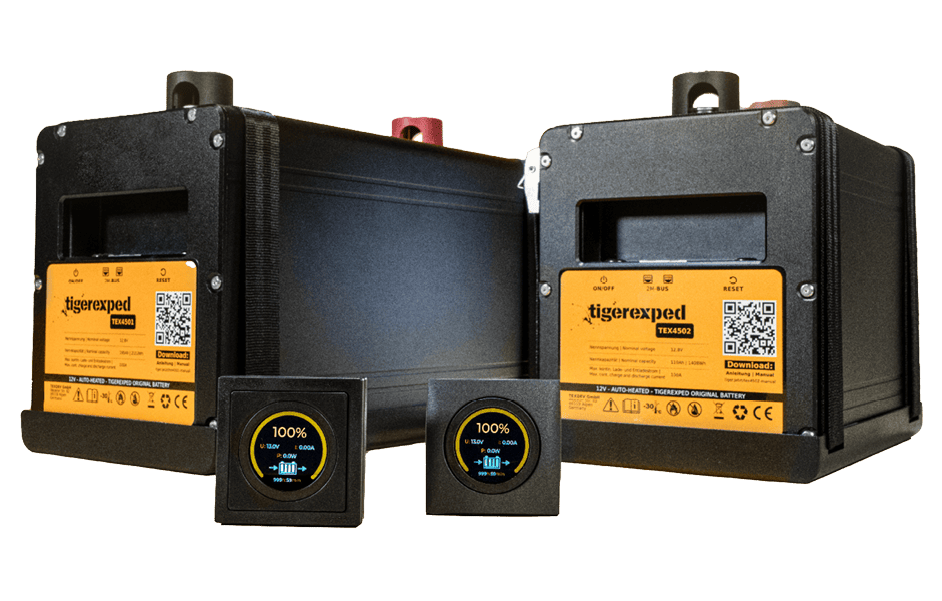
LiFePO₄ batteries from tigerexped – maximum power in the smallest space.
- extremely small and light
- integrated cell heating for full charging performance in the cold,
- minimal self-discharge,
- dual protection system (BMS + hardware)
- RS485 interface for updates
- Ideal for Victron GX systems and series connection up to 48V
- Aluminum housing with thermal separation
- including Slim Line mounting bracket, robust terminal covers and fastening straps
- available with 110, 165 or 320 Ah
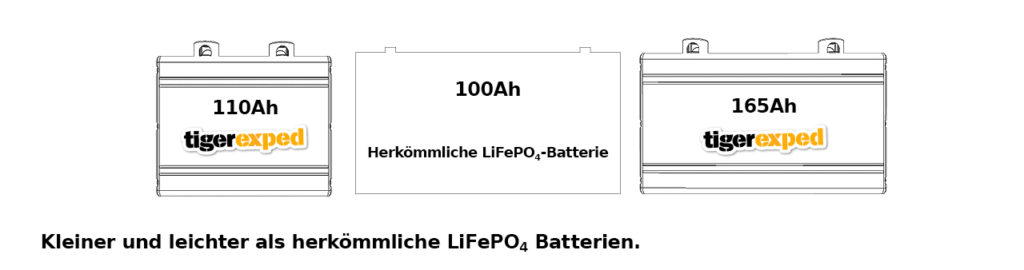
Direct size comparison with conventional LiFePO₄ batteries:
Checklist: Your Battery Decision in 8 Steps
1. How many days do you want to stay off-grid?
- 1–2 days → AGM or gel
- 3+ days → lithium
2. Which appliances do you use regularly?
- Only lights, water pump, phone → AGM/gel
- Cooler + laptop → AGM or lithium
- Induction, powerful inverter → lithium
3. How much space do you have in the vehicle?
- Tight installation space → lithium
- Plenty of space → all options possible
4. How important is weight?
- Very important (e.g. vans, offroad vehicles) → lithium
- Doesn’t matter → AGM/gel are fine
5. What is your budget?
- Low → AGM
- Medium → gel
- Economical in the long run → lithium
6. Which charging sources do you have?
- Alternator only → lithium + DC-DC charger very sensible
- Solar → gel/lithium
- Shore power → all possible, charger must match
7. Are you traveling in winter?
- Yes → AGM or lithium with heating function/BMS
- No → all options open
8. Do you want peace of mind in the long run?
- Yes → lithium
- No / project with a fixed timeline → AGM or gel
Conclusion: The Battery That Suits You
AGM and gel are solid lead solutions, still widely used and entirely sufficient for many people.
Lithium, however, sets the standard for off-grid living, efficiency and service life. As soon as you use larger loads or plan longer trips, you’ll clearly feel the difference, and the higher entry cost pays for itself through the service life.
Now that you know which battery type suits you, you need to calculate how large it has to be to cover your individual needs exactly. You can find out how in our article on calculating energy needs:

Did this information on choosing the right battery for your camper help you? Then feel free to share it with friends and like-minded people who will also be glad to read it:
You will probably also be interested in these articles: