
A guest post by Florian Kugler
Hello dear readers!
My name is Florian, and I run the workshop “Feincamper” in Berlin for fully custom camper conversion projects – out of a love of craftsmanship and of traveling on four wheels. In this post I will share some thoughts, numbers and tips on cooking with induction in all kinds of motorhomes.
We have been on the road with an induction hob in our own vehicle since 2019 and have never regretted that decision. Whether cooking with induction is the right choice for you depends entirely on what you plan to do with your vehicle. To give you a better basis for deciding on your own motorhome, I would like to share my experience from our own trips over the last few years and from running my workshop.

Cooking with Induction in a Camper: Pros and Cons
In recent years, induction hobs have grown into a real alternative to the long-established gas hob – not just in the really big expedition vehicles, but increasingly in camper vans and other smaller vehicles as well. And there are good reasons for that:
- The gas installation can be dropped entirely.
- The hob is easy to clean and it is very pleasant to cook on.
- There is no open flame in tight spaces.
I have come to appreciate the absence of an open flame in particular in everyday use. You can simply lay a kitchen towel next to the hob without a worry, or use paper towels right on the stove, e.g. as a splash guard or when something boils over.
At the same time, though, electric cooking has a downside: without a shore power connection, the available energy is far more limited than with a gas stove. You have to think harder about how much energy you use for cooking and how you can recharge that energy.
If you want to shortlist an induction hob as an alternative to gas, then, as with any electrical appliance, the first thing to do is estimate the daily consumption. Only then can you plan the vehicle’s electrical installation accordingly and decide whether the induction hob is the right solution for your intended use. In the next section I will give you some numbers and examples.
How Much Energy Does the Induction Hob Need?
First, let’s look at the power consumption of the hob itself (in this case a two-zone Neff induction hob), that is, behind the inverter on the 230 volt side.
The chart below shows the power consumption depending on the power level, each time with a small and a large pot (the hob has a nominal output of 2.2 kW):

Here you can clearly see that the power consumption rises exponentially with the power level: level 7, which on this hob is a good middle setting for e.g. sautéing vegetables, needs only about half as much power as level 9.
You can also see that with a small pot the induction hob cannot deliver its full output at all. Only with the 22 cm pot does the hob reach its rated output of 2.2 kW.
Since the 230 volts AC needed for the induction hob has to be generated from the leisure battery by an inverter, losses occur at this point. The following chart shows the power consumption of the hob (in yellow) compared with the power consumption of the inverter (in gray, here a Victron Multiplus with 3 kVA on 12 volts was used):

The gap between the power consumption of the hob and that of the inverter keeps growing with the power level. This means that the inverter’s efficiency gets worse and worse at higher output.
At level 9, where the hob needs about 2.2 kW, the inverter draws about 2.75 kW from the battery, so it burns off more than 500 watts. For comparison: that is roughly the output of a hot water boiler running on 230 volts!
Energy Consumption When Boiling 1 Liter of Water
Now that we have put numbers on the hob’s power consumption and the inverter’s efficiency, let’s look at a somewhat more practical example next: how much energy does it take to bring one liter of water to a boil?

Depending on the power level, about 140-155 watt-hours were drawn from the battery before the water started to boil (pot with a 22 cm diameter and lid). It is somewhat more efficient to bring the water to a boil on the high setting (even though the inverter losses are larger there) than to wait more than twice as long for it on level 7.
Energy Consumption of the Induction Hob in Everyday Travel
Experience from over 350 days of travel in the last five years shows that we use about 650-800 watt-hours per day for cooking on the induction hob. A bit less in summer and a bit more in winter.
Since energy consumption depends heavily on your own habits – that is, how and what you cook – I have put together some practical examples that will hopefully help you estimate your own consumption better.
Large pot of vegetables, 4 servings: 510 Wh

Pasta peperonata with fresh tagliatelle, 2 servings: 490 Wh

Toasting white bread: 115 Wh

Potato and kohlrabi vegetables with grilled bratwurst, 2 servings: 360 Wh

Omelette with spring onions and zucchini, 2 servings: 230 Wh

Falafel and couscous with vegetables, 4 servings: 440 Wh

Tips for Energy-Saving Cooking
Even when cooking on an induction hob you can be frugal or wasteful with energy, which makes a considerable difference to total consumption. Here are a few ideas for keeping your cooking energy use lower:
Better a Short Burst at Full Power Than Long on Low
Use the highest power level to bring water to a boil. All in all you use less energy if the water is brought to a boil as quickly as possible than if you wait twice as long on a lower level. The difference is not huge, but it adds up over time.
Put the Lid On!
Even if it may seem obvious: when you boil water or want to keep a pot of vegetables simmering, be sure to put a lid on. That lets you turn the power level down and use much less energy.
It’s All About the Right Amount
Whether you are boiling a small pot of tea water or a big pot of pasta water for the whole family: try to measure the amount of water so that it is no more than necessary. You waste a lot of energy if you keep heating water you did not actually need.
Differences Between Induction Hobs
Besides our Neff induction hob, which is in the higher price range, I have also tested cheap hobs of the kind you can buy in various versions on Amazon, for example. My measurements show that there are no significant differences in efficiency. Put differently: a cheap induction hob does not need more energy to bring e.g. 1 liter of water to a boil than a more expensive one.
The hobs do differ, however, in how the various power levels are implemented. Our Neff hob generates a continuous magnetic field from level 5 (approx. 530 W) upward. That means the cookware is heated continuously by the magnetic field of the induction plate. Cheaper hobs generate an equally strong magnetic field at every level and regulate the output only by switching on and off at intervals. The Neff hob uses this technique only for the levels below 5, which we rarely use anyway.
I found this (clearly noticeable) switching on and off while cooking annoying. I also found the fan noise used to cool the hob unpleasant and less well regulated on the cheaper models. Both are certainly subjective, though, and you have to try out for yourself what suits you.
Energy for the Induction Hob
The Achilles heel of induction cooking in a motorhome is the limited amount of energy we can reasonably carry in batteries, and the equally limited options for recharging the energy used.
In this section I will go into battery types and capacities specifically from the perspective of induction cooking, and then take a closer look at the various ways to recharge.
Which Battery Type Is Suitable for Cooking with Induction?
Since an induction hob with about 2 kW of output draws currents of up to 250 amperes on the 12 volt side of the installation, the whole thing really only works with a lithium battery. AGM batteries, for example, can also deliver very high currents (which is why they are used as starter batteries), but their voltage sags much more under high continuous current than that of lithium batteries.
When the battery voltage sags, even more current has to flow on the low-voltage side so that the inverter can provide the same output power (since electrical power = voltage x current). If the battery is no longer fully charged, an AGM battery may no longer have enough voltage to run the inverter. With a lithium battery I have cooked quite comfortably on the induction hob even at 20% state of charge.
Another advantage of lithium batteries is that they can be charged faster, which is a nice side effect when consumption is high. But we will get to recharging in more detail in the next section.
How Much Battery Capacity Do You Need for Cooking with Induction?
The answer to this question can be split into a technical aspect and a travel-style aspect.
First the technical aspect: the cells of a lithium battery come with specifications for the optimal and maximum permitted continuous discharge current – both increase with cell capacity.
Since currents of 100-300 amperes are nothing unusual when running the induction hob, the battery should be able to supply them without already getting into critical ranges where the cells may be damaged. So when choosing a battery, pay attention to the manufacturer’s continuous discharge current figures and plan in some safety margin so that you still have headroom at higher ambient temperatures.

Besides these technical aspects, you need to think about how many days your energy reserve should last if you have no way of recharging. In my example I calculated as follows:
Average daily consumption for cooking: 650 Wh
Daily consumption of other devices: 450 Wh
Target stay without recharging: 3 days
Consumption over 3 days: 1100 Wh * 3 = 3300 Wh
Consumption in ampere-hours at 12.8 volts: 3300 Wh / 12.8 V = 258 Ah
So I chose a 300 Ah battery, which has also proven itself in practice for us. That said, the calculation above only works out in summery regions. When it gets colder outside, daily consumption (especially because of running the auxiliary heater) quickly climbs above 1500 Wh. However, since we stay in one place for even shorter periods than usual in the colder season, the capacity still works well for us.
Inverter for Running the Induction Hob
An inverter has to do its work between the leisure battery and the induction hob, turning the battery’s DC voltage into 230 volts AC. Since an induction hob places heavy demands on the inverter, I recommend using a high-quality unit here.
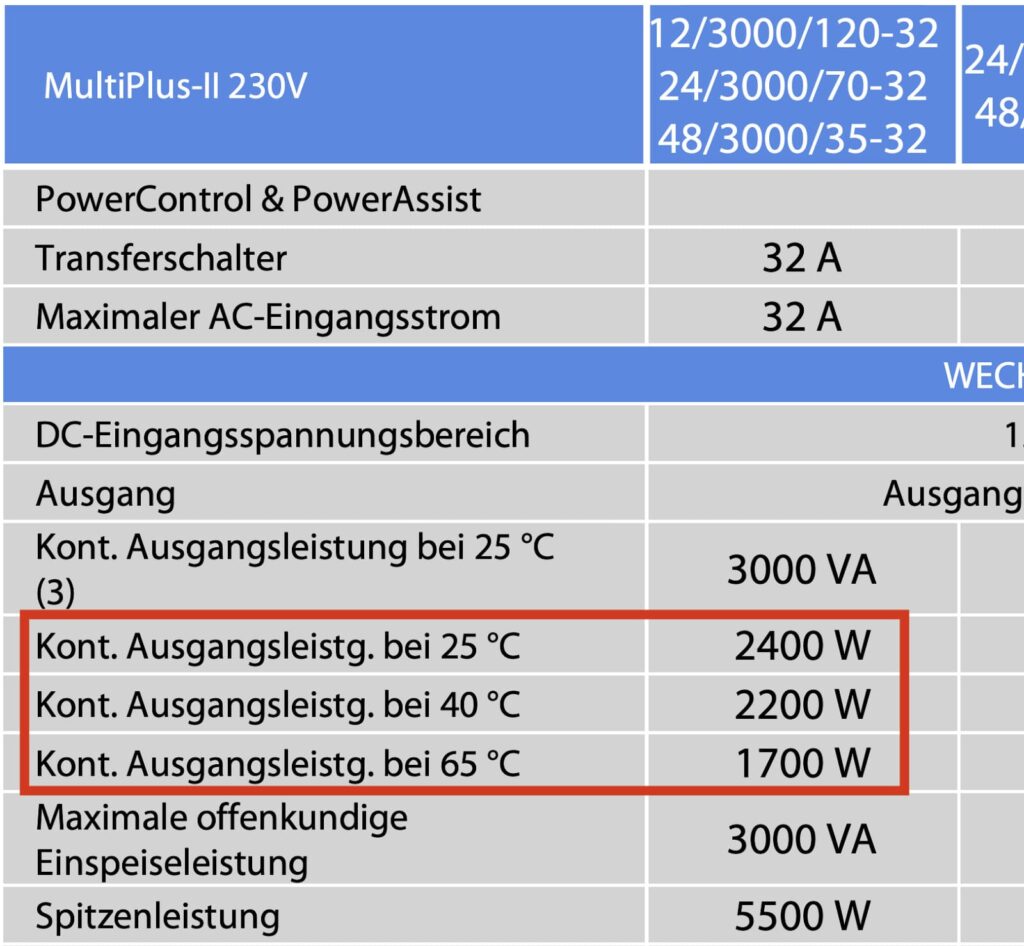
For inverters, the continuous output power they can deliver is usually specified as a function of ambient temperature. The base figure usually refers to an ambient temperature of 25 °C, which is quickly exceeded in summer. Victron, for example, specifies the output power in the data sheet for 25, 40 and 65 °C:
And while we are on the subject of ambient temperature: when sizing the cable cross-sections, too, it is very important to keep in mind the possible temperatures the installation is to work under. You can find more on this in the post “Calculating Cable Cross-Section”.
Recharging – DC-DC Charger, Solar and Shore Power
Once you have settled on the battery capacity, which determines the maximum time you can be self-sufficient without recharging, you can think about how to get the daily energy consumption back in.
Shore Power
Lithium batteries can be charged very quickly with high currents. For example, I can charge our 300 ampere-hour battery with about 100 amperes from shore power through the Victron Multiplus. That way the battery is full again after a good three hours even when completely empty. Shore power paired with a powerful charger is therefore a good option for emergencies, when all else fails.
DC-DC Charger
The most reliable way to make up for energy use on the road independently is a powerful DC-DC charger while driving (assuming a correspondingly powerful alternator). This way of generating energy is independent of climatic conditions and works just as well in winter as in summer, in sun or rain – as long as you regularly drive the vehicle.
We installed a DC-DC charger that charges the battery at 60 amperes while driving and thus made up the daily consumption in about 1.5 hours. Since the battery is designed for three days without recharging, we have to drive about 4.5 hours on a three-day average if we want to fully compensate the consumption with the DC-DC charger.
Solar System
A solar system can extend how long you can stay in one place – provided the weather is good and the sun is not too low. So you have to find a kind of balance between battery capacity and solar output: the battery capacity guarantees the minimum autonomy you want at a given spot even in bad weather. The solar output determines how much the self-sufficient time can be extended, depending on the weather.
If you only travel in very sunny regions, the solar system can enable very long to unlimited stays even with an induction hob. If, on the other hand, you also travel in the colder season or in regions that are not blessed with that much sun, the solar system is more the icing on the cake alongside the other energy sources that are independent of the weather.
The Right Electrical System for Your Camper
Complete electrical packages put together by an expert, or personal advice for your individual project?
With our three package options for all kinds of requirements and the matching installation instructions, you do not need to feel like you have to earn a degree in electrical engineering for your camper conversion.
- Get our ready-made “Ready for Vanlife” complete package,
- Configure a package yourself to suit your needs, or
- have a technician advise you and tailor a package for you!
There Are Many Roads to Rome
That working vehicle concepts with an induction hob can look very different is nicely shown by our bus and the one belonging to Busbastler Manu: while he travels with a 480 ampere-hour battery and 900 watts of solar on the roof, we have only 300 ampere-hours of battery capacity and no permanently installed solar on the roof at all, just a 180 W foldable panel in the luggage.
Since we use the vehicle only for traveling and usually do not stay long in one place, we make up our consumption almost entirely via the DC-DC charger. When the sun is shining and we are at a particularly beautiful spot where we would like to stay a day or two longer, we put out the foldable panel. This has the advantage that you can also angle it toward the sun when the sun is low (e.g. at higher latitudes).
If, on the other hand, you live and work in the vehicle as well, the base power consumption is already higher than ours, and you sometimes depend on being able to stay in one place longer. If shore power is then not an option, the solar system has to be sized generously to cover the demand even under less than ideal conditions.
Conclusion on Cooking with Induction in a Camper
I have come to appreciate our induction hob a lot over the last few years and would not want to be without it. But you also have to be honest: electric cooking does not work well for everyone – it depends entirely on what you plan to do with the vehicle.
The longer you want to stay in one place without a shore power connection and with little sun, the harder it gets to make cooking with induction work sensibly. The cost and the extra weight of the necessary battery and solar capacity make the induction solution less attractive under these conditions.
If, however, you find yourself more in the “the journey is the destination” category when traveling, or only need longer self-sufficient stays when the conditions for the solar system are also good, then cooking with induction might be for you – especially if your fridge already runs on electricity and you use a diesel auxiliary heater.
Did Florian’s article help you?
Visit him on his website and follow him on Insta!
🌐 Feincamper
Instagram: Feincamper
These topics might also interest you: