Autoterm Responds to Customer Requests
Autoterm has responded to a request from many heater users and changed the way the temperature mode works on all heaters (this affects all the different control panels).
Until now, when the preset target temperature was reached, the heater turned down to its lowest power level (or to one that holds the target temperature as well as possible), without ever switching off.
That means: even if the heater’s lowest heat level (800W on 2kW heaters, 1kW on 4kW heaters) is too large for the volume of the vehicle, the heater just keeps going, while the vehicle slowly but surely turns into a sauna.
You could deal with this by opening a window and letting part of the heat escape outside – not the most environmentally or wallet-friendly way to get a suitable room temperature.
That has now changed, because the heater now switches off completely once the target temperature is reached.
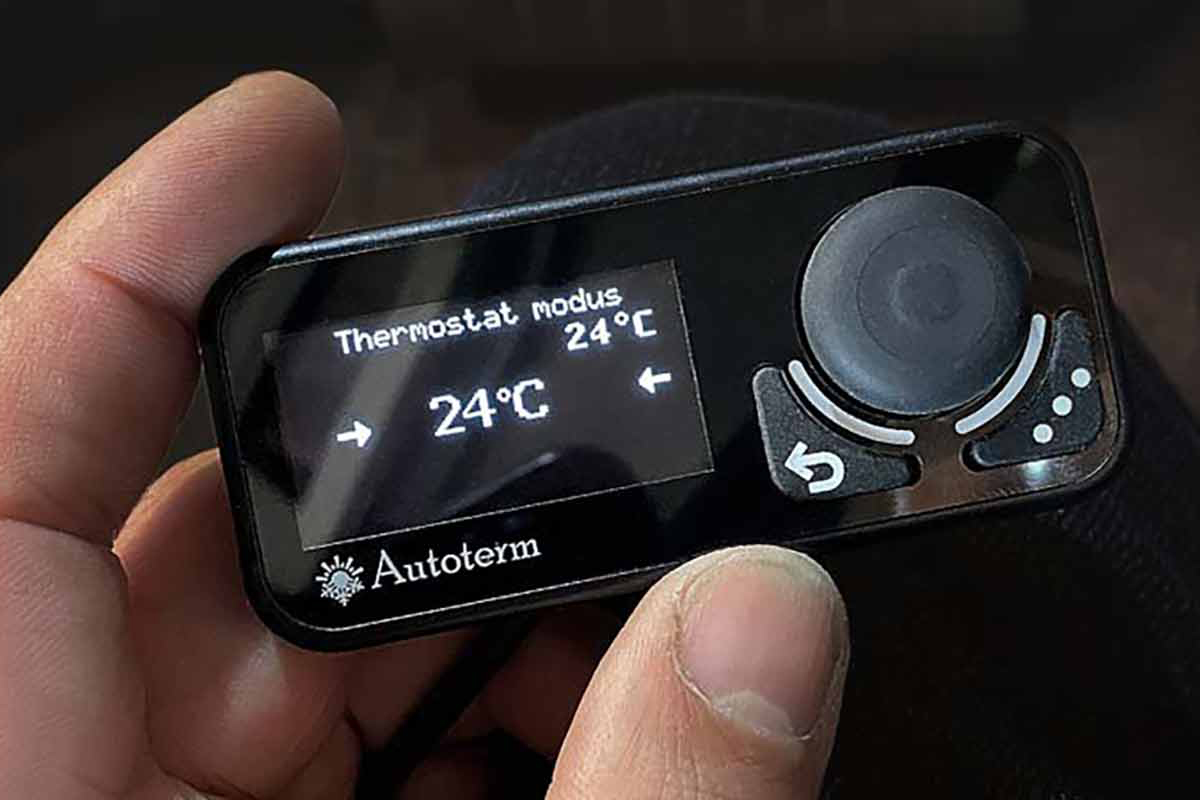
PU5 and PU27 users thus now get a similar luxury to users of the Autoterm Comfort Control control panel, which until now was the only one to offer the thermostat mode.
Differences: Temperature Mode vs. Thermostat Mode
The difference between the temperature mode and the thermostat mode on the Comfort Control panel nevertheless remains large. It lies in a different control of the heater, as well as a hysteresis that is either adjustable or fixed – that is, the span between maximum and minimum temperature.
Hysteresis Setting
In temperature mode, the hysteresis is fixed at +1/-4 degrees Celsius.
In thermostat mode, the hysteresis can be freely selected between +3 and -7°C.
Control in Temperature Mode
In temperature mode, the heater gradually turns down as it approaches the upper target temperature, until it is reached. Then it switches off and, when the temperature drops below the lower target temperature, restarts at a low level.
Control in Thermostat Mode
In thermostat mode, the heater runs at full load until the upper target temperature is reached. Then it switches off and, when the lower target temperature is reached, starts up again at full load.
Difference from the ‘Heating and Ventilation’ Mode
In the Heating and Ventilation mode, the hysteresis is fixed at +/-5 degrees Celsius, which is also quite large.
In Heating and Ventilation mode, too, the heater switches off the combustion chamber completely and stops heating. Unlike the other heating modes, however, the fan keeps running here to ensure the most even possible heat distribution in the room. This function is a big advantage, because it prevents, for example, cooling at the window while heat builds up elsewhere. Nevertheless, because of the audible fan noise, users often asked for the heater to switch off completely (that is, burner AND fan).
Note on When the Change Took Effect
Heaters with this change have been delivered since the second quarter of 2023. However, the change has not yet been incorporated into the user manuals supplied by Autoterm.
By the way, you can download the manuals for all Autoterm control panels here:
A Small Clarification on the Explanation
You notice the changes discussed here through functions of your control panel, but the function itself is defined in the heater. That means it doesn’t matter when you bought a control panel, nor which software generation it has. What is decisive for how all control panels work is the series of the heater.
Important for Economical, Low-Noise Operation
Even after this adjustment is implemented, the following still applies:
The heater must be correctly sized to prevent it from switching on and off too often.
You will find some considerations on how to choose a heater suited to your room volume in our article on the Twin-Kit heating system.

Conclusion
The change to the temperature mode brings an improvement and brings the temperature mode on PU-5 (with the separately available temperature sensor connected) and PU-27 control panels closer to the thermostat mode of the Comfort Control panel.
The Comfort Control’s other advantages, such as improved menu navigation (and finally in German, too), more timer functions, a more modern design, or the burn-off reminder, remain exclusive to the Comfort Control.
Did you find this information helpful? Share it with like-minded people and help them, too.
These articles might also interest you: