
Which solar charge controller you need for your motorhome is luckily not that hard to work out. Whether a solar module and controller go together takes just two figures and one very simple calculation. Here’s how it works.
SOLAR CHARGE CONTROLLER TO MATCH THE SOLAR MODULE
When planning a solar system for a motorhome, you will usually start by picking modules that deliver good values according to the data sheet and whose dimensions fit the roof of your vehicle well. The solar charge controller is then matched to the output of the module or modules.
Let’s look at an example and assume that our black tiger module with 150Wp is a good fit for the camper roof on these grounds, and now we want to find a suitable solar charge controller for it.
Specs on the Module – the Open Circuit Voltage
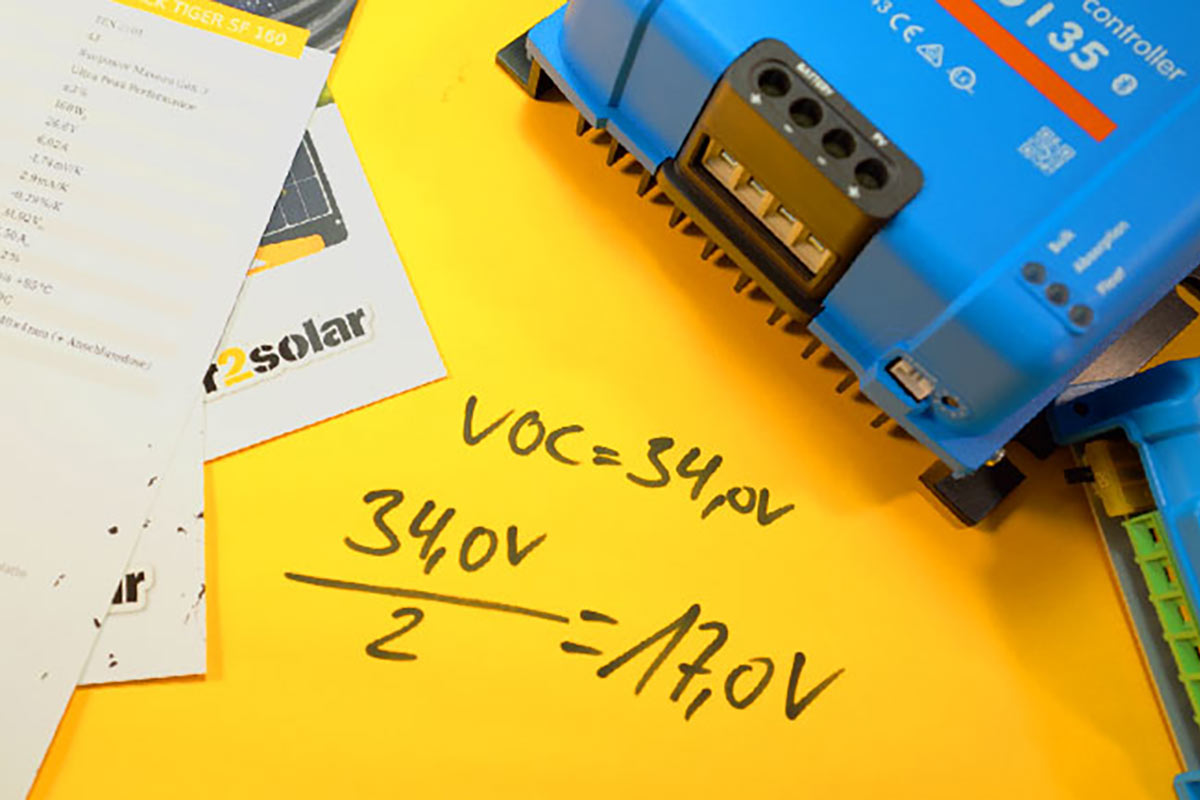
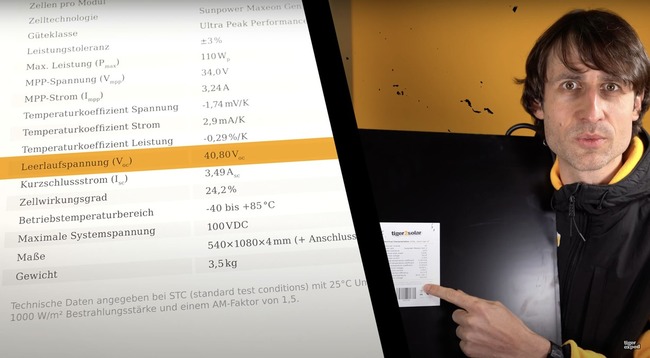
The first, very important figure can be found on the data sheet, or in the technical data of the module in question: the open circuit voltage (Voc). This is the maximum voltage (volts) that will be present at the controller – so it has to withstand this value.
For our example solar module, the “open circuit voltage” line shows a value of 58.38 Voc.
Specs on the Solar Charge Controller – the Maximum Voltage
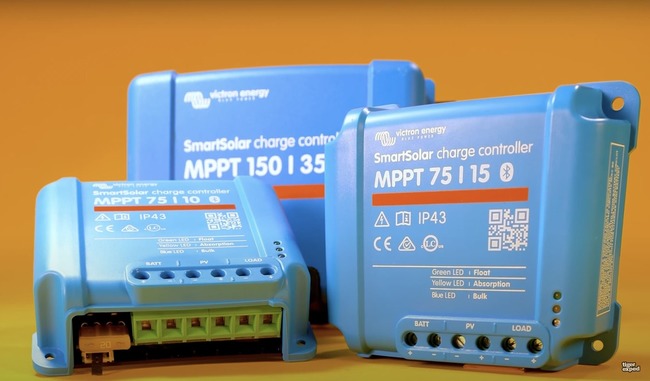
With a solar charge controller from the proven and frequently bought supplier Victron Energy, the most important values (maximum photovoltaic open circuit voltage and rated charging current) are conveniently built right into the product name. With all other manufacturers, they can of course be found in the technical data of the device.
For our example, we have, well, an MPPT 75/10 charge controller. Other sizes would be 75/15 or 150/35, for instance.
The first number stands for the maximum voltage it can handle, which for this controller is 75 volts. Our module, with its 58.36 volts, does not exceed this value – it fits!
The Maximum Charging Current
The second important value is the maximum charging current the controller can handle – the second number on our controller.
To find out whether the solar module fits the 10 amps stated here, look in the technical data of the solar module for the maximum power it can deliver: the rated power or nominal peak power, given in watt peak (Wp). For the black tiger sf 150, that is 150 watts.
CALCULATING THE MAXIMUM CHARGING CURRENT FROM THE WATT PEAK FIGURE
The Charging Current Changes
If one value in a circuit changes, other values change with it. The basic rule, and the one that matters here, is: When the voltage gets smaller, the current gets larger!
How Low Can the Voltage Get
The voltage of lead-acid or lithium batteries in 12V systems naturally drops as they discharge. However, it is not realistic for a charger to have to cope with voltages below 12.8V. So in a 12V system you calculate with about 12.8V as the lowest voltage.
Calculating
Our super simple calculation now goes like this:
Power divided by voltage.
The result must fit within the second value stated on the charge controller, the rated charging current.
So here we have a power of 150 Wp, divided by a voltage of 12.8V. That gives a maximum current of 11.72 amps. So it looks as if the controller with 10A rated charging current is too small for the module.
But that is only part of the truth, because the values on the data sheet of solar panels are always determined under standardized laboratory conditions so that they are easier to compare. These conditions were chosen so that a panel can be measured properly during production; in real-world use, at best we only see them briefly.
Test Conditions vs. Reality
The test conditions define, for example, a temperature of 25°C. In full sun on a car roof, however, a panel temperature of 60°C is far more likely – and its output drops in that case (find out more under Temperature coefficient – A must-know when calculating your solar system). A perfect sun position of 90° above the panel and absolutely cloudless skies are also defined conditions that we all wish for on vacation, but that are by no means there all the time.
For the poorer real-world conditions, you can apply a factor of about 0.8. If you extend the formula above by this factor, you may be able to choose a smaller controller. It does exactly what it should in use, but saves you real money at the time of purchase that would otherwise be thrown out the window.
Applied to our example, the formula looks like this:
150Wp / 12.8V = 11.72A x 0.8 = 9.375A – The 75/10 controller can be used.
Calculating a Solar Charge Controller for Several Modules
What if you want to connect not one but several solar modules to one solar charge controller? In that case only one thing really matters, namely the maximum voltage, and it depends on how your modules are wired.
Wiring the Charge Controller
In Series Connection
With a series connection of two 150 watt modules, you get 300 watts and OVER 75 V, namely in our case 2 x 58.38V = 116.76V. The 75/10 charge controller could therefore no longer be used.
In Parallel Connection
Alternatively, you could connect the two solar modules in parallel. That still gives 300 watts of power, but the voltage does not increase.
What does double along with the power, though, is the current. So we would not be at 9.375 amps but at 18.75 amps – and our 75/10 charge controller is out of the running in this case too.

Should you wire your solar panels in series or in parallel ?
Here you’ll find everything you should know to answer this question:
12V or 24V System
Which charge controller you use therefore depends on whether you wire the solar modules in series or in parallel, and also on the total power you want to end up with in the system.
If, as in our example, you want to charge the battery with the 150 Wp module in a 24V system, the charge controller only needs to be half the size. After all, the 150 watts are no longer divided by 12.8, but by roughly twice that. That also means you can buy a cheaper controller.
A DC-DC converter gets more expensive the higher its maximum voltage and maximum current. In a 24 V vehicle electrical system you can save money here.
Of course, both 12V and 24V systems have their advantages and disadvantages, which should be weighed against your personal needs.

A solar package that includes not only a suitable controller but EVERYTHING you need for a working system – wouldn’t that be handy?
Here it is: choose the size you’d like and off you go!
Example picture with 150Wp. Many other variants with one or two solar panels available!
Did we help you out? Then feel free to share this article with like-minded friends with just one click!
These topics might also interest you: