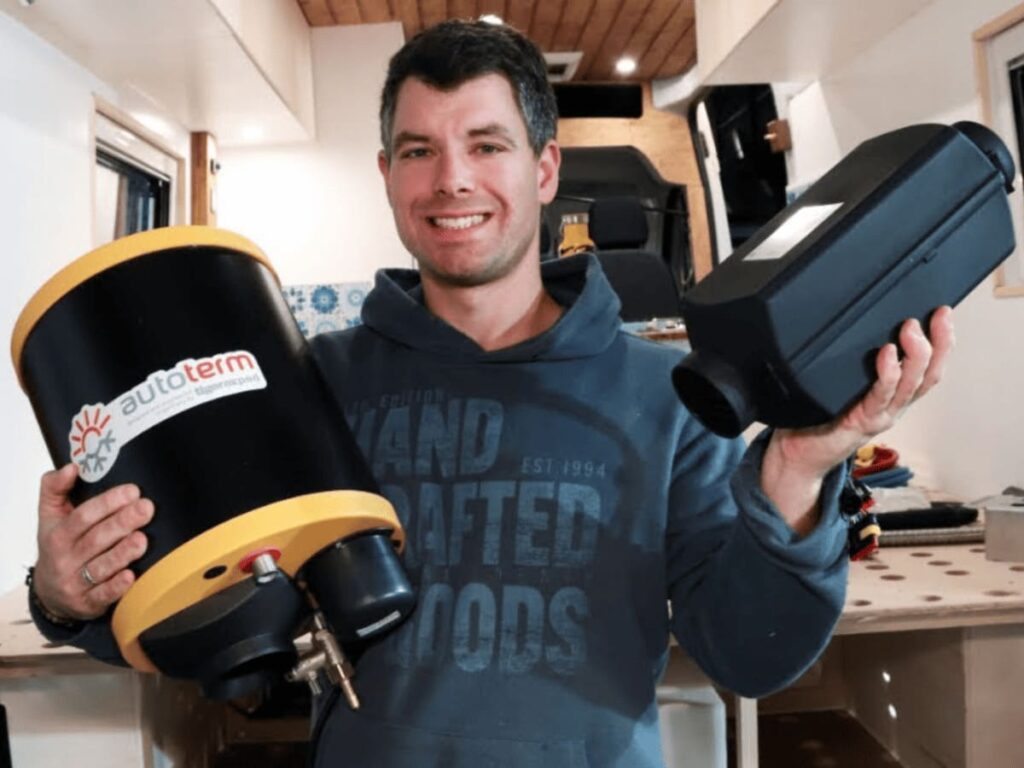

Connecting a boiler to the cooling system of a vehicle comes with a few challenges. A direct connection is not possible because the cooling system can get very hot. To safely control the temperatures in the hot water boiler, we developed a special coolant circuit kit.
In this article, our technical specialists Nico and Lars explain how it works and what to keep in mind during installation.
Video
You will also find the information from the video below in written form. That way you can decide for yourself whether you would rather watch or read.
Which Vehicles Is the Kit Suitable For?
Our coolant kit is designed for vehicles that have no flow rate monitoring. This means that no sensors or electronics monitor the flow rate of the engine coolant.
If your vehicle does have such monitoring, connecting the boiler in this way can cause problems. Read more about installation in vehicles with flow rate monitoring using a plate heat exchanger.
In this case, we recommend contacting a specialist workshop.
What Is Included in the Coolant Kit
The kit contains all the components needed for a safe and efficient integration into the cooling system:
- Temperature relay with temperature sensor – for controlling the coolant circuit.
- Coolant control valve – makes sure hot coolant is diverted in a targeted way.
- Connector for the relay – has to be pinned by yourself (instructions with the terminal designations are included).
- T-pieces and elbow pieces – for a secure connection to the cooling system.
- Hose clamps in different sizes – 18 mm for the elbow and T-pieces, 19 mm for the coolant valve.
- Connection nipples for the boiler – please use the supplied thread sealing tape here.
- Thread sealing tape – prevents leaks.
- Spring band clamps – in different sizes, depending on the connection point (see instructions).
- Coolant hose (standard length 2 m) – the length has to be determined individually for each vehicle and adjusted when ordering.
To fasten the spring band clamps you can use either special pliers or a pair of water pump pliers.
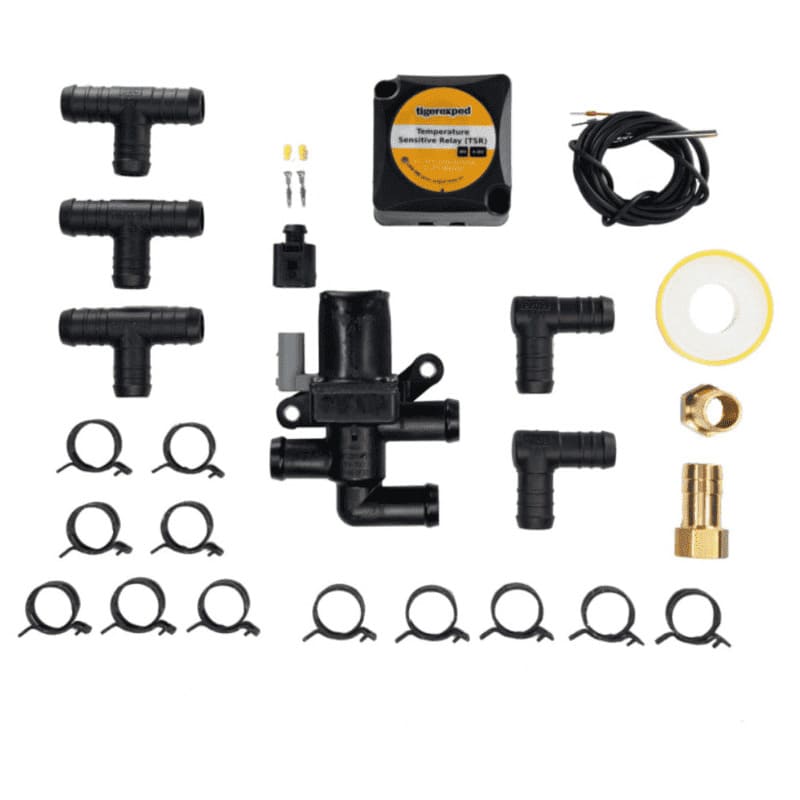
The tigerexped coolant circuit kit:
Installation and Connection
If your vehicle has no flow rate monitoring, the kit can be installed in parallel to the heater core supply line under the dashboard.
The T-pieces allow a parallel integration into the cooling system without adding extra resistance. This ensures that the engine does not overheat due to the additional load.
If you are unsure, you should always consult a professional. Work on the cooling system requires technical understanding and experience to avoid unwanted consequential damage.
Important Notes on the Power Supply
The relay should definitely be controlled with D+. D+ is a voltage that is only present when the engine is running – which means the water in the boiler is only heated while the engine is running.
If you simply connected the boiler to battery positive, i.e. a permanent power supply, it would lead to very high power consumption. Control via D+ or a D+ simulator is therefore the better choice, because the battery is then recharged by the running alternator.
If you are not sure whether your vehicle supports D+, feel free to contact us – we know this by heart for many vehicle models. Alternatively, you can find out with the vehicle identification number from the manufacturer. If there is no D+, a D+ simulator can generate the required signal.
By the way, a water auxiliary heater would be one way to heat the shower water even when the engine is not running. More info here.
Conclusion on the Coolant Circuit Kit
With the tigerexped coolant circuit kit, the combiBOIL hot water boiler can be integrated safely and efficiently into the cooling system of your camper. It makes sure the engine heat is used optimally without overheating either the vehicle coolant system or the domestic water system in the camper.
What matters is a professional installation and respecting the technical requirements of your own vehicle.
Found this interesting? Feel free to share the info with other campers who will appreciate it too!
These magazine articles might also interest you: