
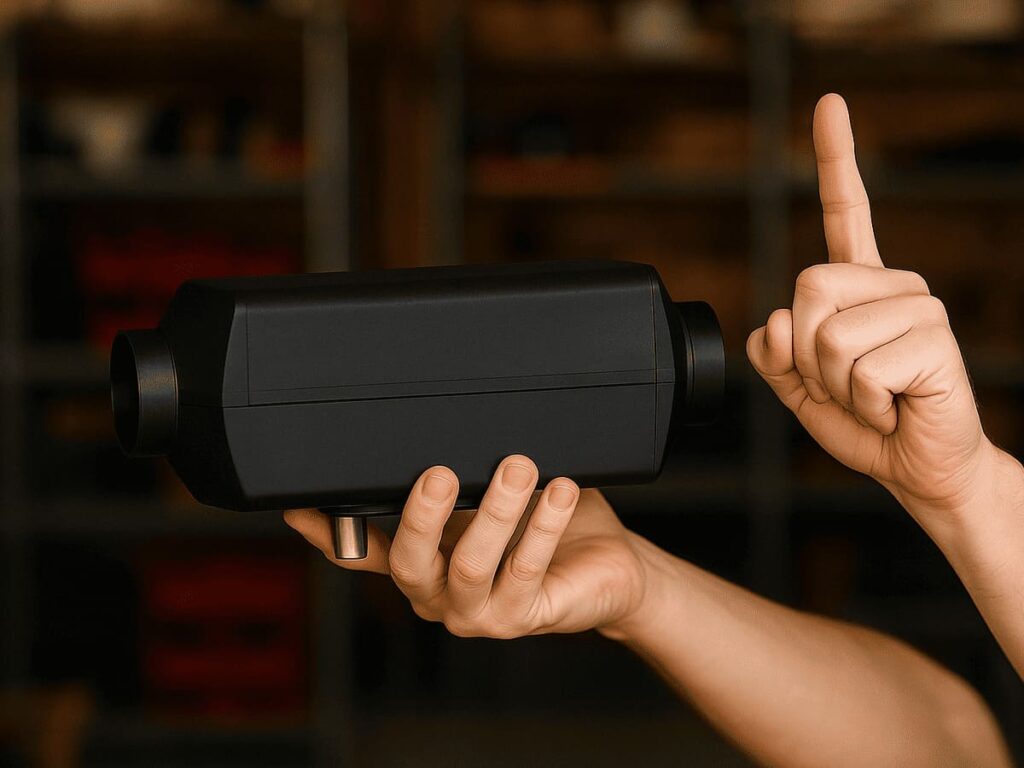
If you want to retrofit a diesel air heater in your travel vehicle, one thought comes up quickly: “I’ll just keep using the existing warm-air ducting from my old Truma gas heater.”
It does sound logical at first – but technically, unfortunately, it’s a really bad idea.
Our technician Nico explains in detail why that is and what the better solution looks like.
Two Systems – One Crucial Difference
A Truma D6 – whether gas or diesel – works with an external fan that moves the warm air across the heat exchanger. The big difference from a diesel auxiliary heater is that this fan plays no role at all in combustion.
A diesel air heater (e.g. from Autoterm), on the other hand, works completely differently:
It has an internal fan, and this fan handles three jobs at the same time:
- moving air across the heat exchanger and also
- drawing in combustion air and
- expelling exhaust gases
That means:
Any change or restriction in the airflow directly affects mixture formation and combustion.
Why the Old Gas Ducting Is Unsuitable
If you look at warm-air systems from old gas heaters, they usually consist of four separate runs with several branches, inconsistent diameters, tight bends and constrictions. For an external fan system, that’s no problem.
For a diesel air heater, however, it’s disastrous. The complicated layout of the ducting massively increases flow resistance, so the heater can no longer run cleanly. The result is almost always overheating – with a probability of 99%.
Why Auxiliary Fans Don’t Help (and Lead to New Problems)
Many installers consider adding an extra fan to compensate for long air paths. That only works in theory, though.
In fact, an auxiliary fan would have to run exactly in sync with the fan of the air heater:
- If it’s too slow, it blocks the airflow, because the faster airflow from the heater runs into the slower airflow and is slowed down.
- If it’s too fast, it pulls the air too hard and the heat exchanger doesn’t get properly warm.
Since the heater can’t control the auxiliary fan, the whole thing is simply unrealistic.
In short: auxiliary fans are not an option in systems like this.
Why a Separate Air Run Is the Best Solution
Instead of tinkering with the existing gas ducting and possibly separating off one run, we recommend:
An Autoterm diesel air heater should sit in its own warm-air run that is kept short and as straight as possible.
That is not only safer and more efficient, but also meets all the manufacturer’s requirements, which are:
- no tight bends or kinks within the first meter
- keep the duct system as short as possible
- do not reduce the diameter
- gentle bends instead of sharp angles
If you take a look at the typical gas ducting in a camper, you’ll see right away that it meets practically none of these criteria.

How to Use Gas and Diesel Heating Together Optimally
With an independent, minimalist air run, you can use the diesel heater very well as your base heating.
It runs efficiently and economically and provides the vehicle with pleasant, dry warmth.
When it gets really icy cold or you want to warm certain corners additionally, you can simply switch on the existing gas heater as well. That saves you a lot of gas – the real motivation behind many retrofits.
Conclusion: Don’t Mix – Complement
The existing gas ducting is technically unsuitable for diesel air heaters.
The risks range from poor combustion to constant overheating shutdowns.
The best solution:
Leave the gas heater as it is and install the diesel air heater at a suitable spot with its own simple air system. That gives you maximum efficiency, safety and heat output.
More information:
Follow this link to read what else you should know about retrofitting a diesel air heater.
More helpful articles about diesel auxiliary heaters that might interest you:


tigerexped technician Nico
brings worldwide travel experience – from Australia to Canada, with vehicles such as the Toyota LandCruiser and Mitsubishi Delica.
As a trained automotive mechatronics technician and experienced, professional vehicle builder, he is a true all-rounder. Whether technical or travel know-how – Nico’s many years of experience solve many a tricky problem.
Was this information about warm-air ducting in campers and motorhomes helpful? Then feel free to share it with like-minded people who can benefit from it too.