When you first research solar panels for your motorhome, you may wonder about the efficiency figures on the datasheet – is it normal for them to be so low? And what is that percentage supposed to tell me anyway? In this article we clarify what you can expect from efficiency, where the differences lie – and whether it matters for you at all.
Efficiency of Solar Cells
Efficiency states what percentage of the total incoming light energy can be converted into solar power. As the name suggests, it is a measure of the solar cell’s effectiveness.
Efficiency can vary greatly between different types of solar modules. Whether the value is higher or lower depends on the cell type and the quality of individual cells of the same type.
For the overall efficiency of the complete solar system, losses through the wiring also have to be factored in, which is why the rest of the system needs to be planned carefully as well.
The efficiency at which your solar panels can actually work on your motorhome at any given moment also depends on many other factors, such as the global irradiance reaching your location, and more:
Efficiency of Different Cell Types
In connection with solar panels you often hear the terms monocrystalline and polycrystalline. These are different manufacturing methods for the starting material. This makes a decisive difference.
Silicon
Solar cells can generally be made from various semiconductor materials. For the solar panels currently on the market, however, silicon is the traditional base material.
The cells, typically known as squares with beveled corners, are connected in an array to form solar modules or PV (photovoltaic) modules.
Monocrystalline Silicon
Monocrystalline cells are thin slices cut from a single silicon crystal. This crystal is grown from a tiny starting crystal produced under laboratory conditions, the so-called seed crystal, which passes its perfectly uniform structure on to the entire silicon ingot as it forms. Thanks to such a regular lattice structure, current can flow particularly well. The thin slices cut from these crystal ingots for cell production are called wafers.
Polycrystalline Silicon
In contrast to wafers from single (mono) crystals, solar cells can be made polycrystalline. Here, for example, all the offcuts from the production of monocrystalline cells are melted down together and crystallized as a new block. Of course, it then doesn’t have such a nicely regular lattice structure. At the boundaries, contact resistances that lead to power losses arise.
For this reason, monocrystalline solar cells have a higher efficiency than polycrystalline ones. On the other hand, however, producing monocrystalline wafers is more expensive, as it takes time and energy to grow crystals of the required size.
Efficiency Changes with Temperature
Another factor influencing the efficiency of a solar module is temperature. As temperature rises, effectiveness falls, which has to be taken into account when sizing the solar system. Read more about the temperature coefficient here.
Cell Quality Grade
Even monocrystalline cells are never 100% identical, because in practice there is no absolutely pure crystal that doesn’t also contain foreign atoms. Among other reasons, that is why all cells are tested individually under standardized laboratory conditions in production and sorted into quality grades.
Within a given brand, e.g. the high-performance cells Sunpower Maxeon Gen. III, there are therefore again different qualities. For tigerexped solar modules we therefore only use those cells from Sunpower production that achieved the highest rating in testing.
Usable Light Spectrum
The sun sends its radiation to Earth in the form of invisible light particles that travel in waves of different lengths. Depending on how long the waves are, we can perceive them as light – or convert them into solar power. The light particles need exactly the right amount of energy to be usable for power production – this is called the band gap.
Unfortunately, only a small part of the light waves lies in this usable spectrum – based on 100% of the incoming light, the solar module can process as many percent of the light waves as stated on the datasheet.
The usable light spectrum represents a physically possible limit for generating electricity from sunlight, since no material is able to use the whole spectrum. Theoretically (at the current state of the technology) 33% efficiency is feasible, but in practice this value is not possible because of additional external circumstances.
The latest module developments let light waves that cannot be processed pass through the module instead of reflecting them. There they hit a second layer of cells made of a material that uses a different light spectrum. With such so-called tandem solar cells, values of over 40% have already been reached – but, sadly, broad market introduction for use on motorhome roofs will take longer.
Which Efficiencies Are Realistic
With monocrystalline cells, efficiencies of up to 24% can be achieved today. With high-performance cells of the highest quality grade, even one decimal place more.
Polycrystalline solar cells, on the other hand, reach 19 – 20% at most.
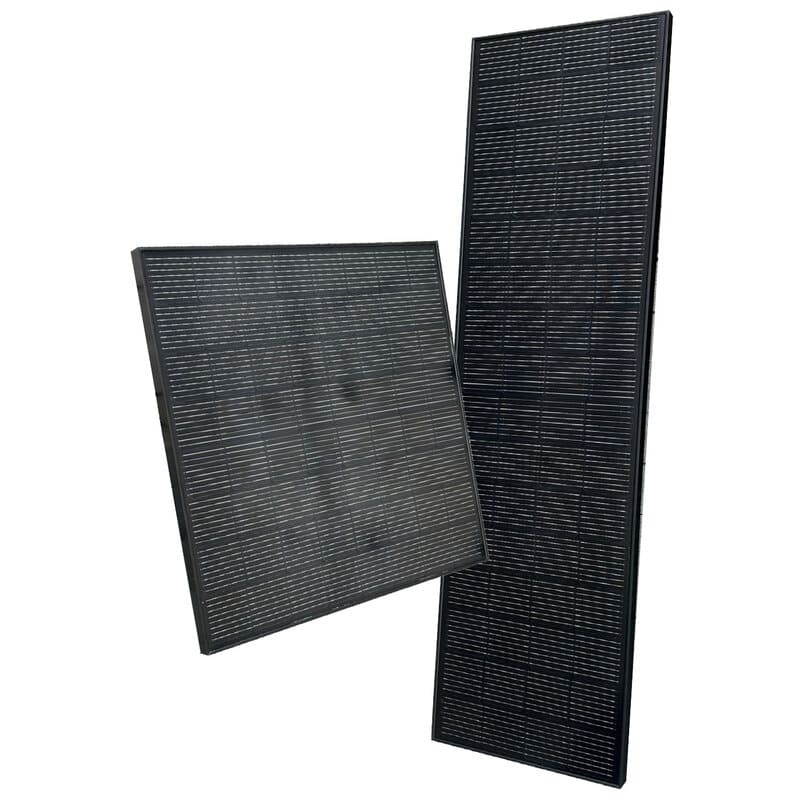
ULTRAblack tiger solar modules – 24.8% cell efficiency for maximum solar yield on the smallest area
Efficiency and Cell Aging
Solar cells don’t stay young forever either, and efficiency declines slightly over time. We are talking about a very long period here, though, for a motorhome life.
After about 25 years, the age-related drop in output is around 10%.
The different cell types don’t differ much in this respect. Only in the first few days, during initial degradation. Here the monocrystalline ones lose out by comparison. However, the initial degradation is already factored into the datasheet.
So what should you buy – mono- or polycrystalline?
Polycrystalline cells aren’t absolute nonsense. They are cheaper, but have a lower efficiency from the start due to contact resistances. On top of that comes a different spectral sensitivity – the usable light spectrum, as discussed above, is not quite as broad with polycrystalline cells. Very modern techniques are now being used to counteract this, to make better use of material from non-single-crystal blocks too, but if you want to buy new solar panels right now, you are definitely best off with monocrystalline, high-quality cells.
Is This Efficiency Really THAT Important?
How much attention you need to pay to efficiency when buying solar modules depends on the area available. For modules used on house roofs, a lower efficiency is therefore often found. Whether the complete system gets built at all is usually decided by the size of the initial investment. If you don’t reach the energy yield you hoped for, two more panels can still find room on a house roof without completely blowing the budget.
On a camper or motorhome, it looks different. Here we are dealing with a very limited area that has to be used optimally so that we can be self-sufficient off-grid.
A high efficiency makes sure you get MORE power into your batteries from the same solar panel area. For off-grid living, a look at the datasheet and the efficiency stated there definitely makes sense if you can’t simply mount one more module to reach the desired amount of energy – e.g. by giving up the roof hatch or the roof deck.

If you want to generate as much power as possible on your camper roof, support the high efficiency of the solar panel with optimal alignment to the sun by making the panel tiltable – from practical experience, though, you can say: you usually never tilt it up anyway. On top of that, the vehicle itself can’t be optimally aligned to the side of the panel that is tilted up. Constant re-parking would be the result.
When the Power Isn’t Enough Despite High Efficiency
If, after buying solar modules with the best efficiency, your power demand is still not fully covered but the space on the camper roof is full, a flexible foldable solar bag as an additional module is a recommendable solution.
Was this info helpful? Pass it on!
These topics might also interest you