

When it comes to the water supply in a camper, one question often comes up first: should I install a submersible pump or a pressure water pump?
As always: both systems have their pros and cons. Which one suits you better depends on your vehicle type and individual needs. Here is a comparison to make the decision easier.
Submersible Pump vs. Pressure Water Pump – Video
Our technik-tigers Nico and Lars explain the differences between the two pump systems in the video. If you prefer reading, below the video you will find everything they discuss as text, including links to the products mentioned.
Submersible Pump – Simple, but Good
Submersible pumps come in all kinds of shapes and with different power. In principle, though, they all do the same thing: they have a small impeller and – as the name says – are submerged, i.e. hung directly in the tank.
Switch Required
Every submersible pump needs a switch to turn it on. They do not switch on and off automatically the way pressure pumps do.
If you want to use a submersible pump with a normal faucet (i.e. without the typical camping faucet with an integrated micro switch), you need either an extra pressure switch or a flow switch.
Pressure vs. Water Filtration
In our range we have, for example, a Reich submersible pump with 2.1 bar – for a pump of this type that is quite strong. For normal water circulation in the camper that is completely sufficient.
But: filtering water for drinking water is often difficult with submersible pumps, because that usually requires more water pressure – see also our article Water Filters in a Motorhome – It Doesn’t Work Without Pressure.
So with a submersible pump, mechanical water filtration is rather difficult to implement.
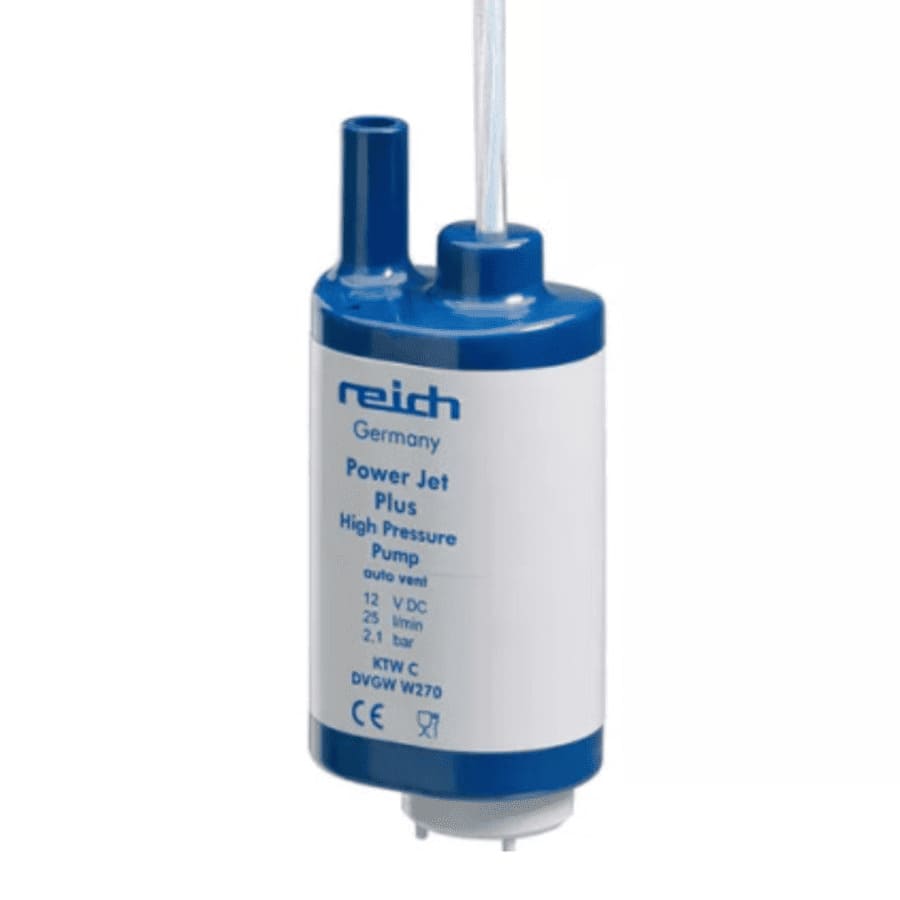
Submersible pump Power Jet plus with a flow rate of 25 l/min at 2.1 bar – a good and popular choice, as long as you do not want to use water filters.
Avoid Dry Running
A submersible pump relies on the water to cool it. If the tank is empty and the pump is not switched off, this quickly leads to overheating and irreparable damage.
Installation
Submersible pumps are simple to install: hang it in the tank, connect power, add a switch and a fuse, done.
However, do not let the pump sit directly on the tank floor, otherwise it may draw in accumulated dirt. Some pumps have a small filter, but by no means all of them.
Advantage of a Non-Pressurized System
Submersible pumps are great if you want to build a simple system and if a boiler or other pressure-sensitive parts are involved. So if you have no filter system, you can very well use a submersible pump, because it runs unpressurized.
Unpressurized means: pump on, water flows! Pump off, water flows back into the tank and does not stay in the line for quick availability. A water boiler can be heated this way without any problematic expansion. At most it may gurgle a bit in the tank.
But note: the system is only unpressurized if there is no check valve anywhere! If you have, for example, a boiler with a check valve and a pump with 2.1 bar, there will be too much pressure in the boiler and a pressure reducer must be used.
Pressure Water Pump – The “Big Brother”
The big brother of the submersible pump is the pressure water pump. It comes in numerous variants.
Two that we stock in our shop are the tigerexped pump with 4.2 bar and the Smart pump from Lilie.
The biggest difference to using a submersible pump: the entire water system is permanently under pressure! The pump builds up a pressure (e.g. 4.2 bar) that prevails throughout the system. That is why you usually need a pressure reducer, e.g. to reduce the inlet pressure for the boiler (usually to 1.5 bar).
Advantage of Higher Pressure
Our pump generates 4.2 bar, for example. If you want to integrate a drinking water filter into the system, that is ideal, because many filters need an inlet pressure of at least 3 bar.
For building your pressure water system this means: put the pump directly in front of the filter, and the pressure reducer then goes behind the filter to protect the other parts. In other words: we push into the filter with plenty of pressure and reduce the pressure again afterwards.

Water filters with pores so fine that they even retain the smallest germs (like the filters from ALB Filter shown here) naturally cause considerable back pressure, and a good pump is essential. In return, you can drink the water straight from your motorhome tank without worry and do not have to carry a huge amount of bottled drinking water.
Important:
The drinking water filter has nothing to do with the sediment filters that are used together with the pressure water pump (usually included in the delivery). The sediment filters are only there to protect the pump from coarse dirt. They always go in front of the pump, i.e. between tank and pump. When installing, also make sure the glass points downward. It can then simply be unscrewed and the dirt removed. But: switch off the pump and release the pressure first, otherwise you will make a huge mess.
Install a Switch for the Pressure Water Pump Too
A pressure water pump works fully automatically. It notices when the faucet is opened and the pressure in the system drops. It then starts up automatically to restore or maintain the pressure. It keeps running until you close the faucet again and the pump notices that the pressure stays up and no longer drops.
That means: if the pump is powered and a leak occurs somewhere, it happily keeps pumping until you can swim in your vehicle. At least until the water tank is empty. The only good thing: pressure water pumps can tolerate dry running to a certain extent better than a submersible pump.
To avoid the risk of such water damage: install a switch with which you can turn the pump off, and use it whenever you leave the vehicle or have the living area out of your control.
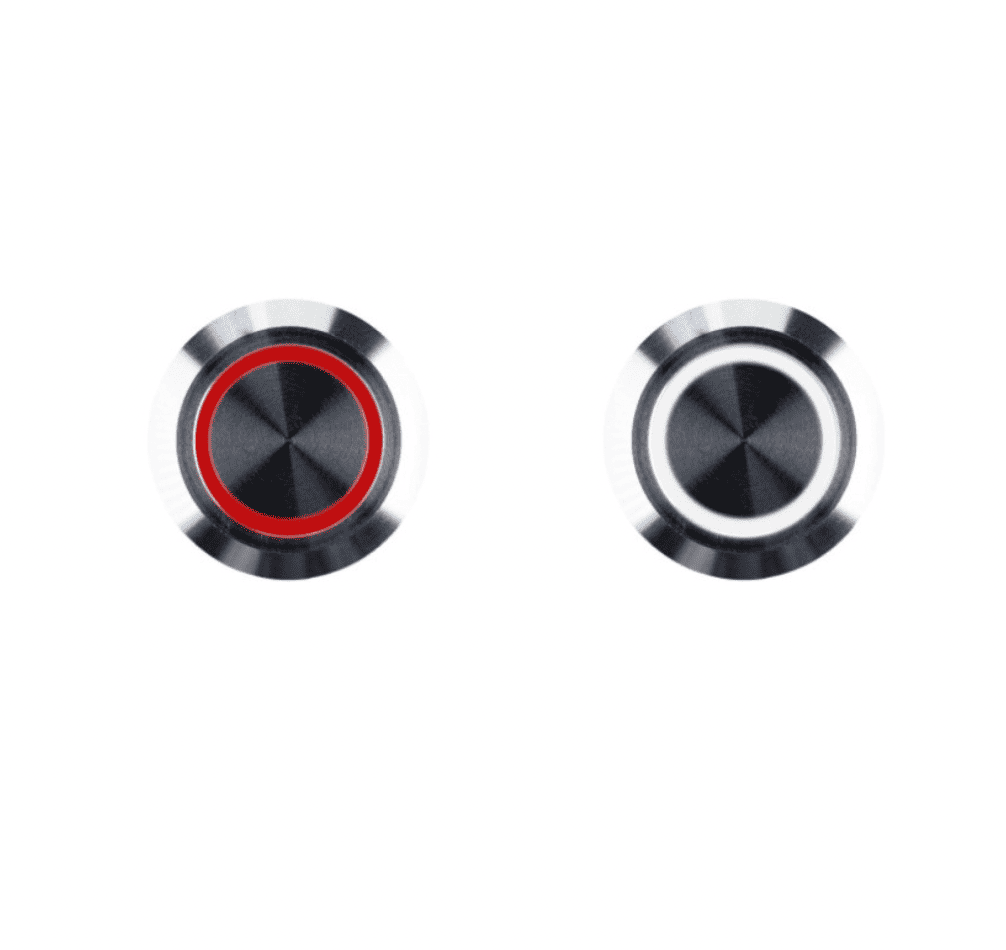
Such stainless steel switches with LED ring illumination, for example, show you at a glance whether the pump is still on when you leave the vehicle.
Power Consumption
Pressure systems definitely need more power than submersible pumps. If you shower the dog for an hour with pressure water, you will notice it in the power consumption at the end.
Accumulator Tank
The accumulator tank makes sure the pump does not switch on and off so often and that you always have an even water flow.
Inside it there is a balloon. It is pumped up until the system pressure is reached (e.g. 4.2 bar), then the pump switches off. When you open the tap, the balloon first pushes the water into the system before the pump kicks in.
Why all this? If you open the tap only a little, the pressure switch reacts and the pump starts. But it would build up pressure faster than water can flow out through the slightly opened faucet, and so it switches off again immediately. Since a small amount of water keeps flowing out, it switches on again right afterwards – this is called “pulsing”. It causes water hammer and the water sputters. The accumulator tank prevents that.
In our system of accumulator tank and pressure water pump, the pressures are preset to match each other. If you use the accumulator tank with a different pump, you can also change the tank pressure with the bicycle valve at the top.

tigerexped pressure water pump and accumulator tank, together with sediment filter and fittings as a practical bundle with a price advantage.
Without an Accumulator Tank – Lilie Smart
There is a special feature with the Lilie Smart pump. It has special electronics that slowly switch the water on and off.
With this special pump, no extra expansion tank is therefore necessary.
Supplied Accessories
When you buy a pressure water pump, fittings are usually included. Pay attention to the size, because they have to fit your system.
The Lilie pump, for example, comes with 12 mm fittings. With our tigerexped pump they are 10 mm connections, because we designed most parts in the shop for a common 10 mm system. Adapters to other systems are also available.
Important: do not use thread seal tape when screwing in the fittings. The plastic parts will otherwise break, since they seal via a cone. So simply screw them on, done!
Our Conclusion
In the end, your system decides which pump is the right one.
Submersible pumps are great for
- small vehicles, if you
- do not want to filter water and
- have only one tank.
Usually one pump is enough for two draw-off points. But pay attention to the flow rate – if you only carry 20 liters of water and the pump delivers 18 l/min, the tank is empty quickly.
A pressure water system is better
- for large systems,
- if you want to connect several tanks, or
- want to filter water.
For the electrical installation, with every system: always install a switch and a fuse!
On the topic of water in the camper you will find, among others, these further articles here:


Did this info on the differences between submersible and pressure water pumps help? Then feel free to share it with like-minded people who will appreciate it too!