For motorhome owners who depend on different water sources, water filters play a key role in hygiene and health. Among the various ways of making water safe to drink, we recommend mechanical filtration.
Hollow fiber membrane filters and activated carbon filters reliably retain both solid particles and substances dissolved in the water. Filtration is safe, easy to install and use, and needs no additional resources (no power consumption, no brine wastewater or the like).
One thing is essential for mechanical filtration to work as intended – pressure.
When filtering, the water has to pass through extremely fine pores. These naturally impede the flow, so it cannot run the way it does when you simply pour it out of a bucket. Logical.
Below, we will take a closer look at how much pressure is needed to get safe drinking water in your motorhome with water filters – without ending up with just a trickle (or nothing at all) coming out of your faucet.
Better Filtration = More Pressure Needed
With mechanical water filtration, the rule is: the better the filtration performance in terms of filter fineness, the more the flow through the filter is restricted.
You can picture it just like an ordinary sieve:
Say we have a sandbox with sand and pebbles and stones of different sizes in it. If we use coarse chicken wire as our sieve (the kind with hexagonal mesh you can get at a hardware store), we can shovel a large amount of sand through it very quickly – but only the really big stones stay behind in our filter, and everything else simply falls through.
If you use a fine-mesh kitchen sieve instead, you have your work cut out getting all that sand through – but afterwards it is completely free of stones.
Applied to our water filtration, we can say: aiming for the second result is desirable, because it is the small stones in particular that prick you afterwards – or, in other words, can harm your health. In our case, these would include disease-causing bacteria.
The big pebbles, which are rather harmless to your health, cause a different problem: as you can easily imagine, they clog the fine kitchen sieve pretty quickly. So it is best to pick them out beforehand. We do the same with water filtration, using a pre-filter. It makes sure the fine (and much more expensive) cartridges last longer, because the big pebbles never make it that far.
So with the pre-filter, another unit puts (at least slightly) more resistance in the water’s way.
Notes on Fill Filtration
Good filtration therefore needs sufficient pressure and more time than simply letting water run through unhindered.
Keep in mind: this does not only apply to drawing water from your fresh water tank. If you want to fill your motorhome with filtered water (fill filtration), exactly the same conditions apply. So if the line you want to fill your tanks from does not provide the required pressure itself (maybe you even want to fill your tanks from a river or lake, entirely without a fixed pressurized supply), you have to generate the pressure yourself with a pump.
If you are planning fill filtration, you should also be aware that the time you need to fill your motorhome with fresh water will increase because of the filtration. At filling stations that charge by the minute rather than by the liter, this can be more expensive.
On top of that, resentment can build up if a long queue is waiting behind you for the only water tap for miles around while you take far too long to fill your tanks because the pressure is far too low.
How Much Pressure Is Needed – Example Alb Filter
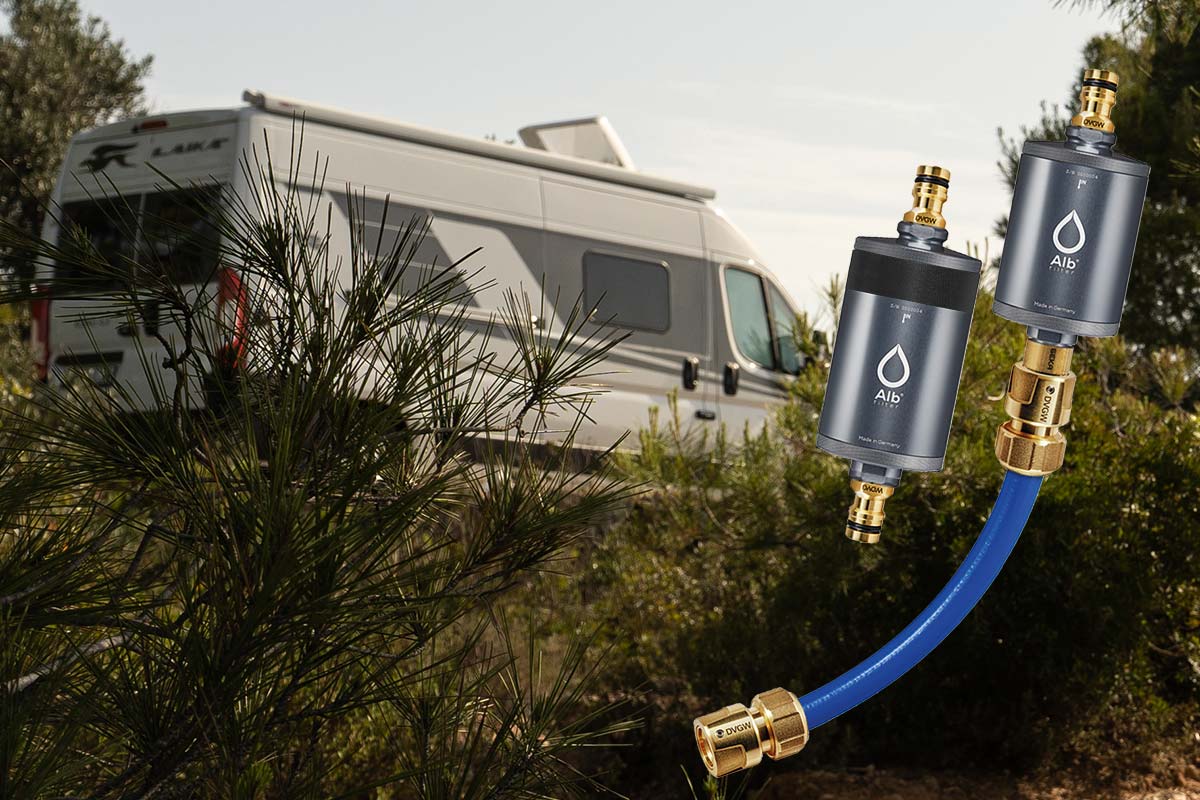
You will find Alb water filters in our range because they are known for very effective filtration and their small space requirement. That makes them a good choice for obtaining safe drinking water even in campers with little installation space.
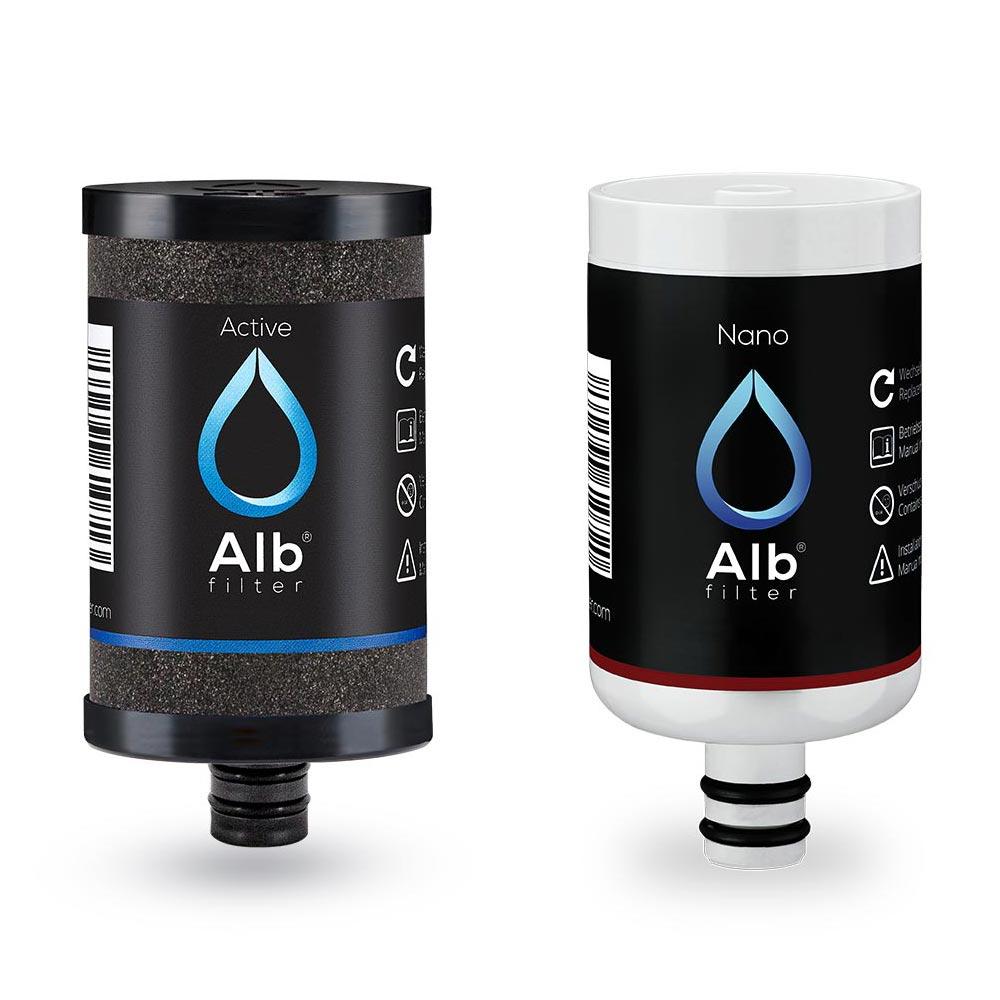
The Nano filter cartridges (hollow fiber membrane as a germ barrier with a filter fineness of 0.1µm) and Active (sintered activated carbon) can be used individually or in combination to enable tailor-made fill and/or draw-off filtration.
If you have questions and are not sure which cartridge or system is right for your needs, this article is for you:
Pressure Needed for Alb Filter Nano and Active Cartridges
Back to our sieve comparison: Alb Filter works with very fine “sieves”
In the case of the Nano germ filter, a 0.1µm hollow fiber membrane. That is fine enough to reliably retain even the smallest types of bacteria.
For activated carbon, Alb Filter relies on sintered blocks. Sintering increases the effectiveness of the activated carbon under great heat and high pressure.
With granulated activated carbon, a lot of water can simply run unhindered between the little beads; with a sintered block, it has to pass through very fine pores. This results in additional mechanical filtration, but the catalytic and adsorptive properties are also improved, because the water spends more time in closer contact with the surface of the activated carbon. Of course, this also takes more pressure and slows the flow.
Using Single Cartridges
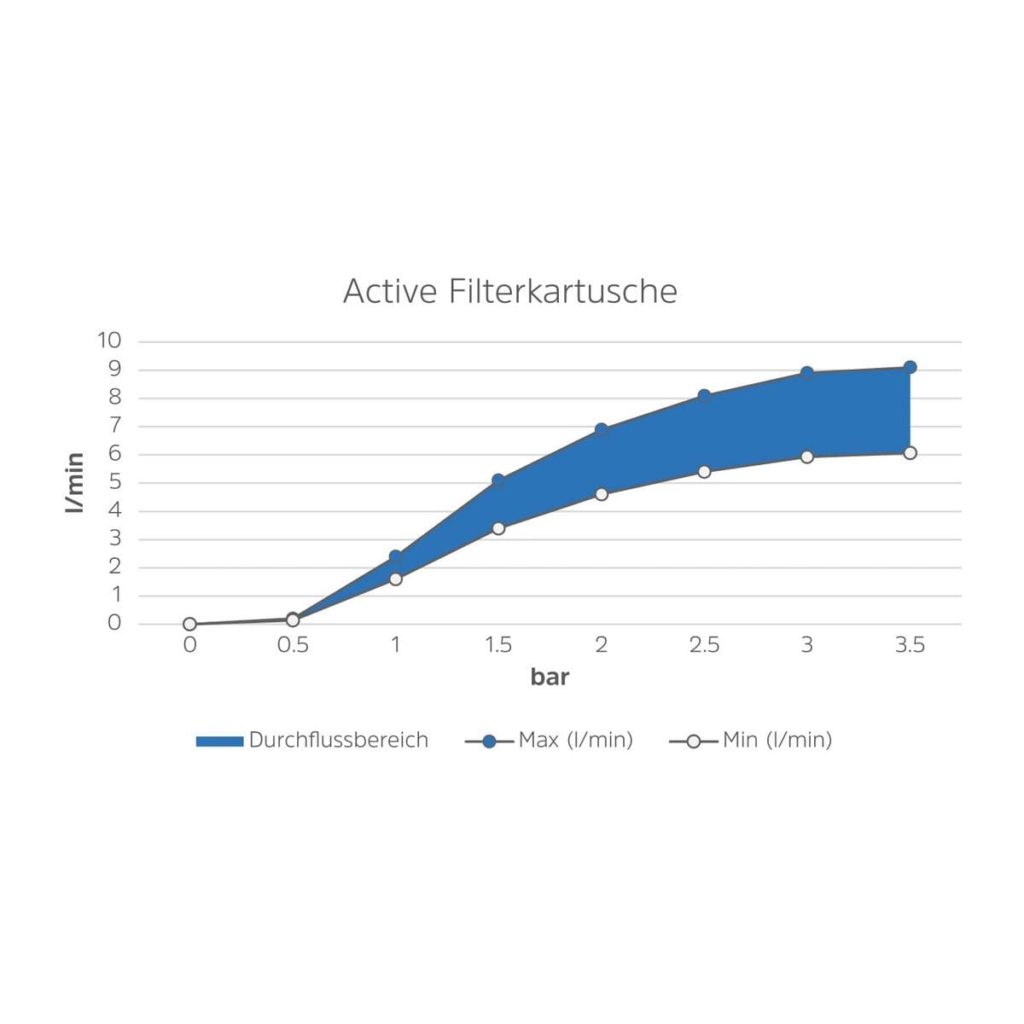
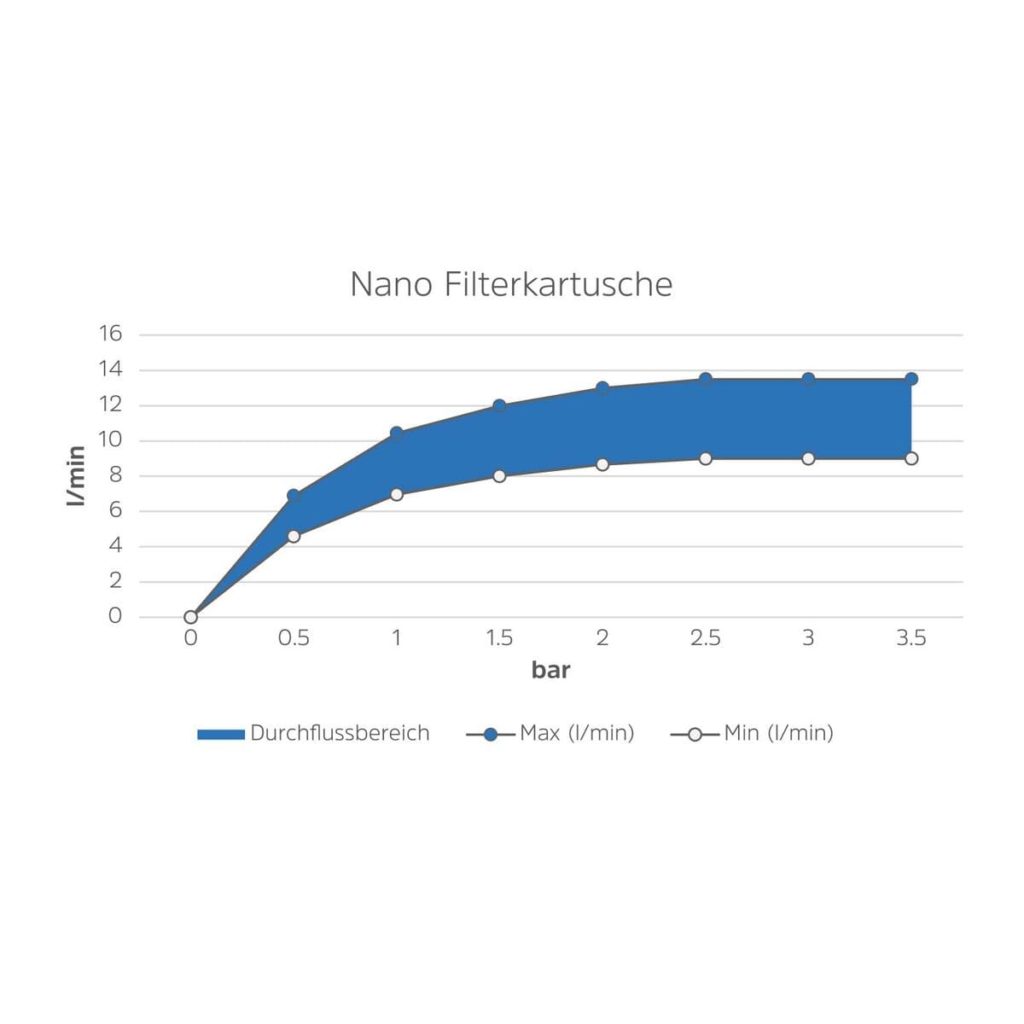
The following flow charts show how much pressure is needed to still have sufficient pressure or flow at the faucet after filtering.
We recommend that the pressure applied to the filters should be at least two bar when using one Nano or Active cartridge.
Also keep in mind that the flow decreases as the filter ages due to progressive clogging. How quickly that happens naturally depends on how dirty the water is that gets forced through. Many pebbles clog the sieve faster than a few. To still achieve sufficient flow at the faucet, the pressure logically has to be even higher than with a new filter. Sometimes the flow works quite okay until the filters have seen a few liters of water, and then after a fairly short time they are “clogged”. That is (usually, depending on water quality) not the case. In reality, your pump is too weak.
Two bar should therefore be regarded as the lower limit for a single cartridge, so that the filter still works as intended even after the first membrane tubes have clogged.
Using Fusion Filters
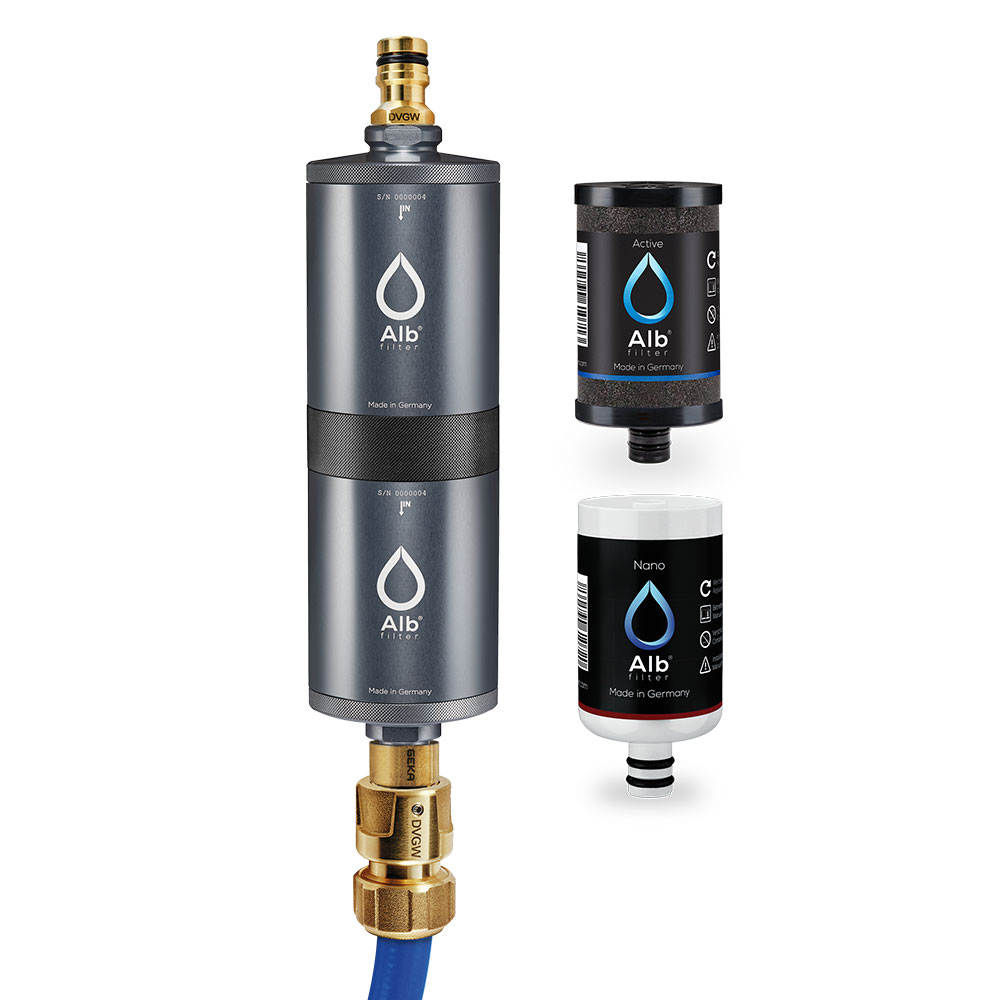
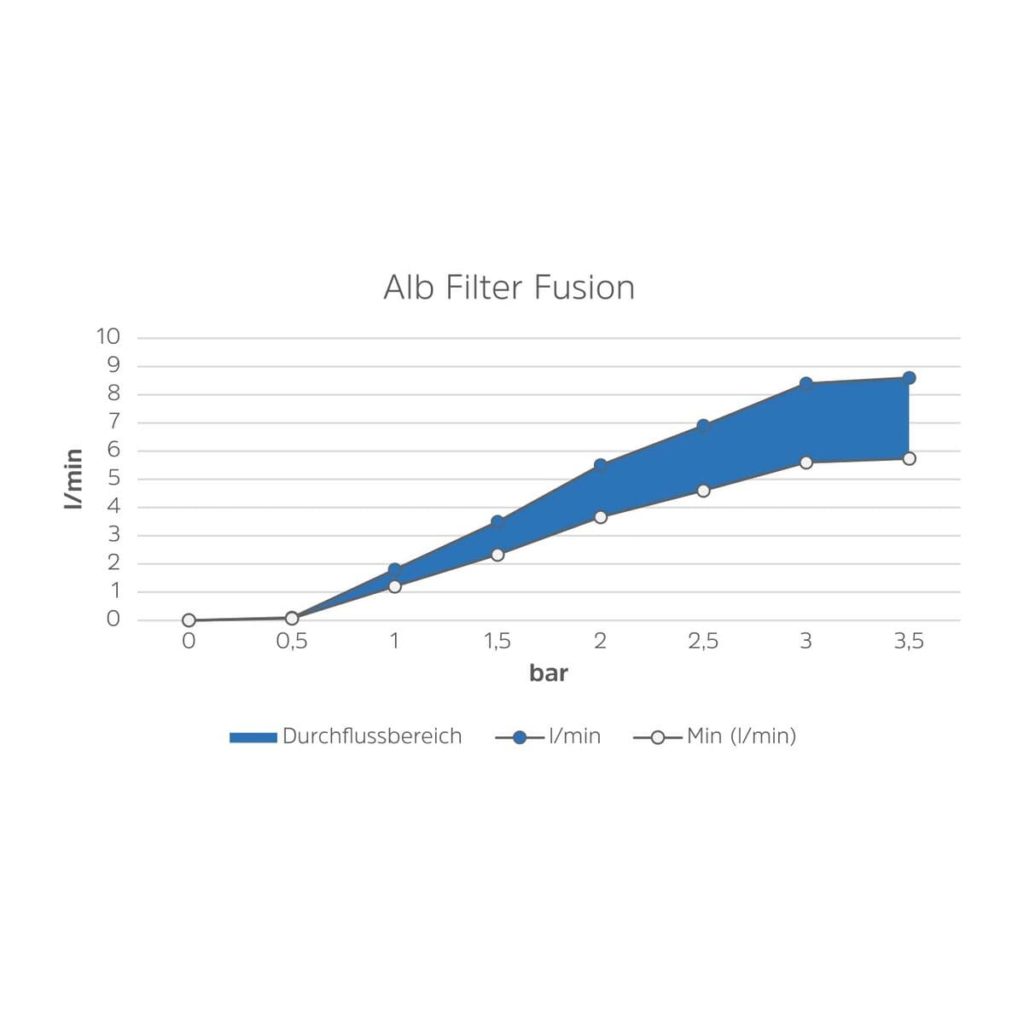
The housings of Alb Filter single cartridges can easily be joined with a connecting ring, so both cartridges can be used together in one compact combined housing. Combining the two elements guarantees an optimal result for the safe enjoyment of the filtered water, but it also restricts the flow to a not inconsiderable degree.
So that sufficient pressure and flow still reach the faucet, you should apply at least 3.2bar pressure to the water system at this point.
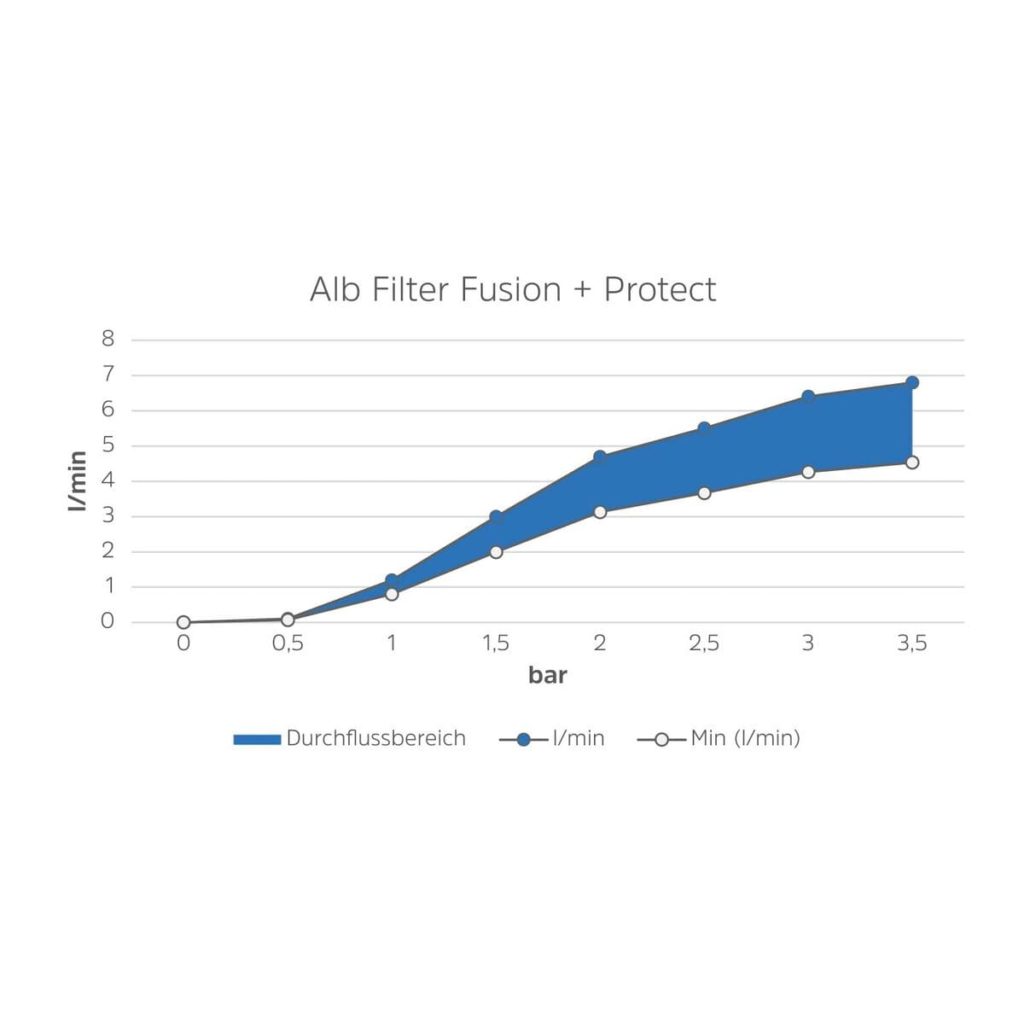
CAUTION: Some components that may be installed in your water system are not designed for such pressures. Connectors, hose clamps etc. must also be of high quality so that no leaks occur.
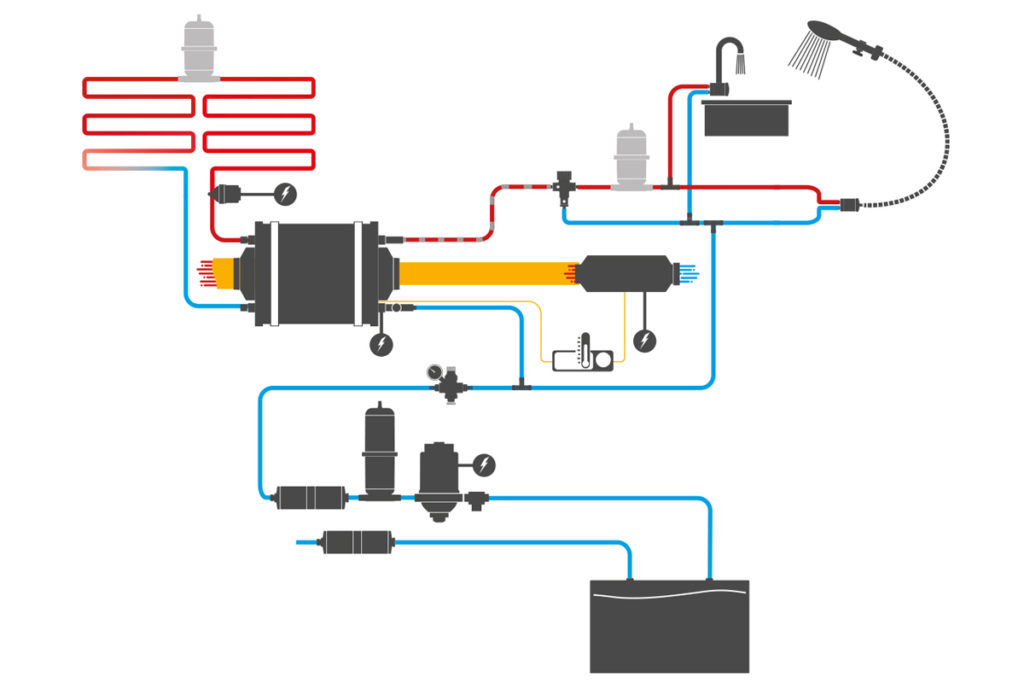
Upstream of pressure-sensitive components such as a hot water boiler, a pressure reducer must be installed that limits the water pressure at the boiler to max. 1.5bar.
Recommended reading: Pressurized Water System for Campers – Components, Design, Installation
Separating the Filter Components for Less Pressure
If your pump does not deliver enough pressure for both filter stages at the faucet, you can consider splitting up the filtration.
The Pro Camper Kit is designed for exactly that. When filling the fresh water tank, it pre-filters with activated carbon as a single cartridge. Unlike bacteria, the substances bound by this cartridge do not form anew in your tank, so they are already out of the race.
At the faucet, the Nano hollow fiber membrane cartridge then comes into play, retaining all bacteria that were filled in with the water or have settled in your tank and hose system.
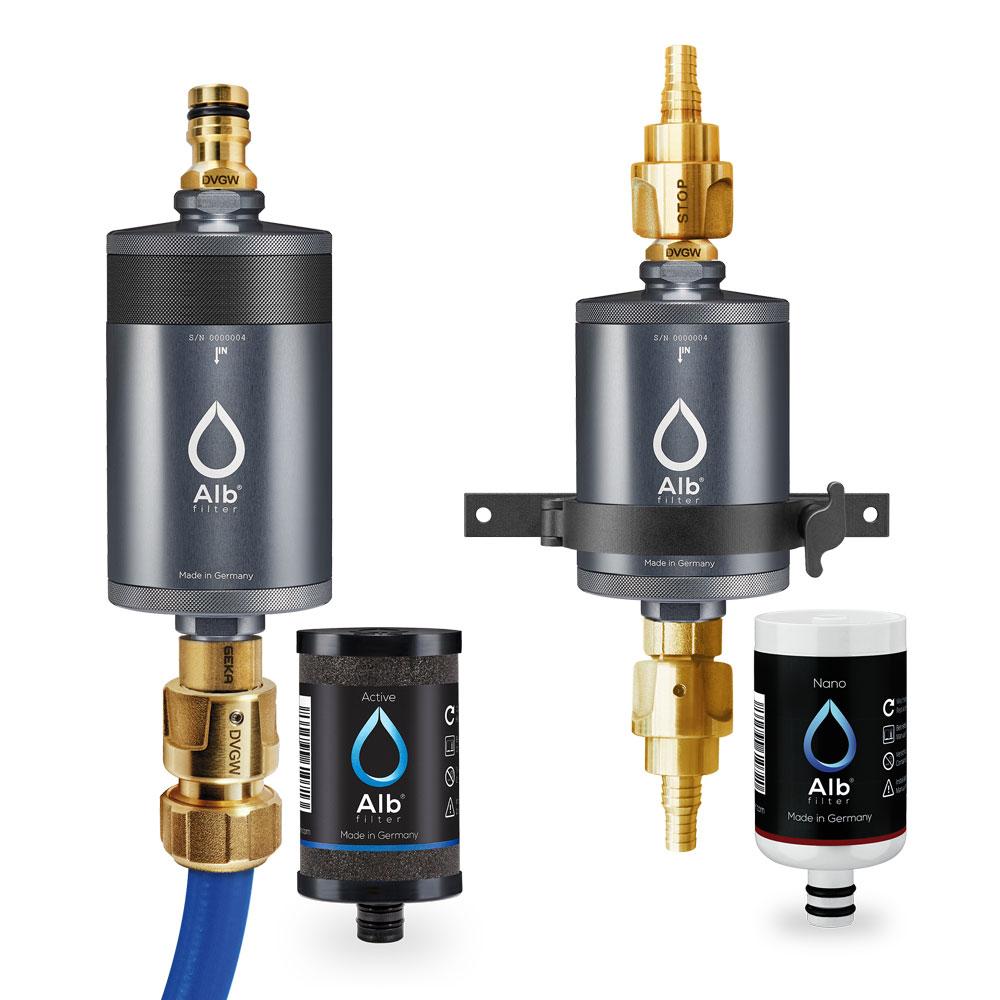
This way, two bar of pressure is enough at both points.
Important: Mind the Order
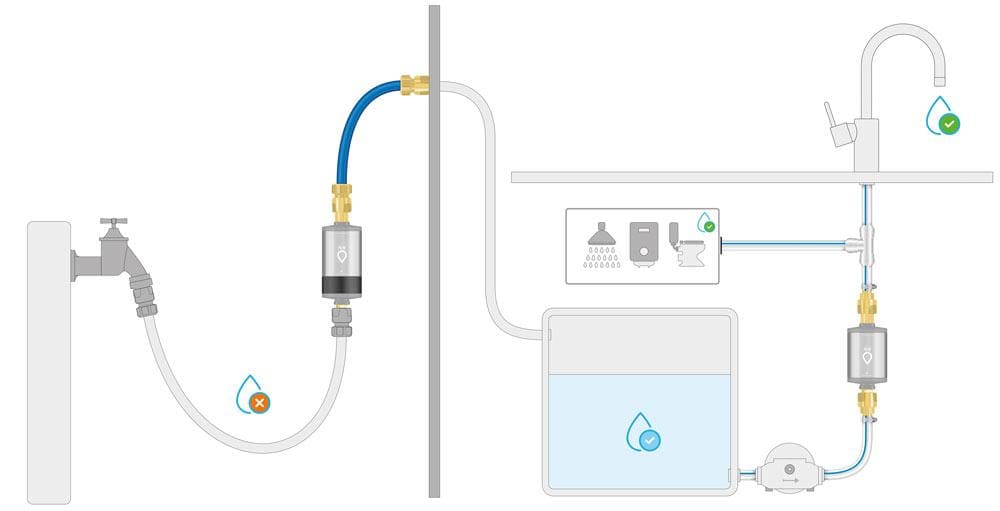
When using a hollow fiber membrane and an activated carbon filter, whether connected together as a Fusion in one housing or separately for filling and drawing off your water: in the direction of flow, use the activated carbon first and then the germ barrier.
The main reason: activated carbon can become contaminated with germs, especially with a too long period of use and summer temperatures. The hollow fiber membrane serves as the “last line of defense” and catches the bacteria in front of your water glass even in that possible case. To catch all germs that may have settled anywhere in the water and hose system, the germ barrier should be installed as close as possible to the draw-off point.
Keep in mind: if three more meters of hose follow after this filter, the bacteria that are in there can no longer be stopped. Colonization can also take place there, even if that section of line only comes into contact with filtered water (keyword: recontamination. A water system in a motorhome was not completely sterile when installed and never will be).
Use a Suitable Pump
We have now discussed several reasons for choosing a pump with enough pressure for the fresh water system in your camper.
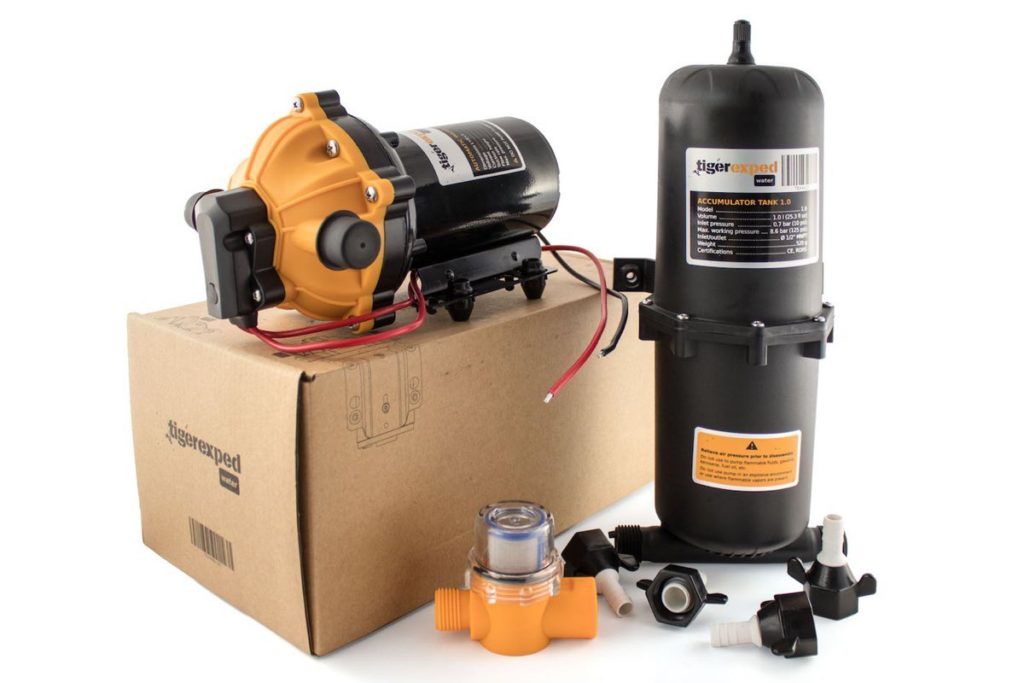
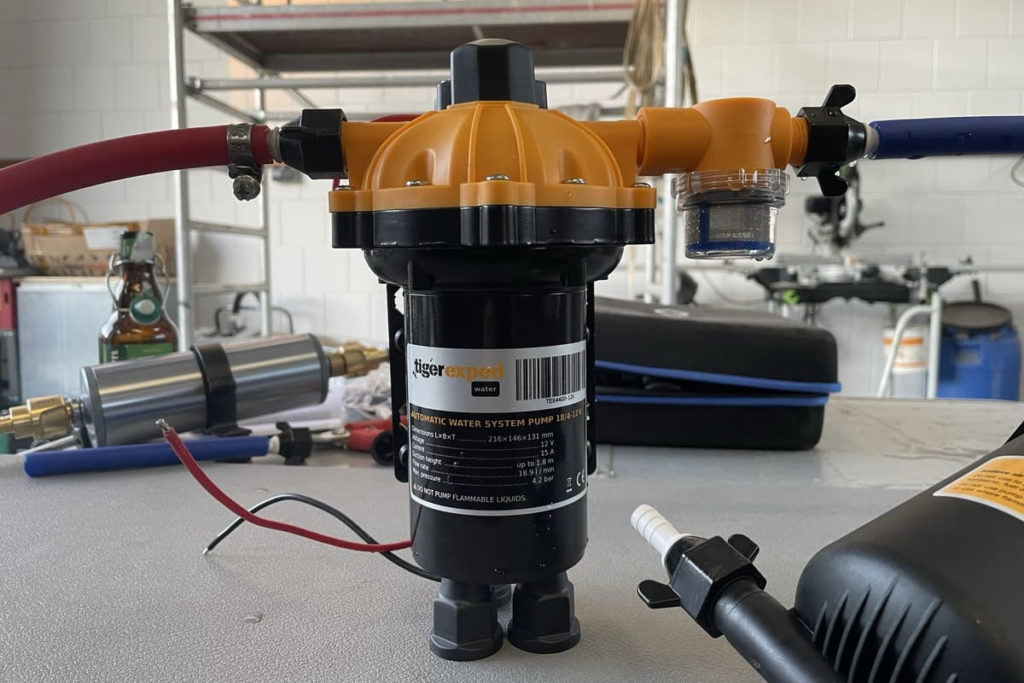
For these reasons, we recommend using a pressure water pump with sufficient power. This type of pump provides a constant and usually higher pressure than submersible pumps would. Perfectly suited for this is, for example, our water pressure system from tigerexped pressure water pump & accumulator tank.
The drawback of the operating noise of pressure water pumps compared to submersible pumps can be minimized by suitable measures during installation.
We have put together more information on this topic for you here:
Still Necessary: Regular Cleaning
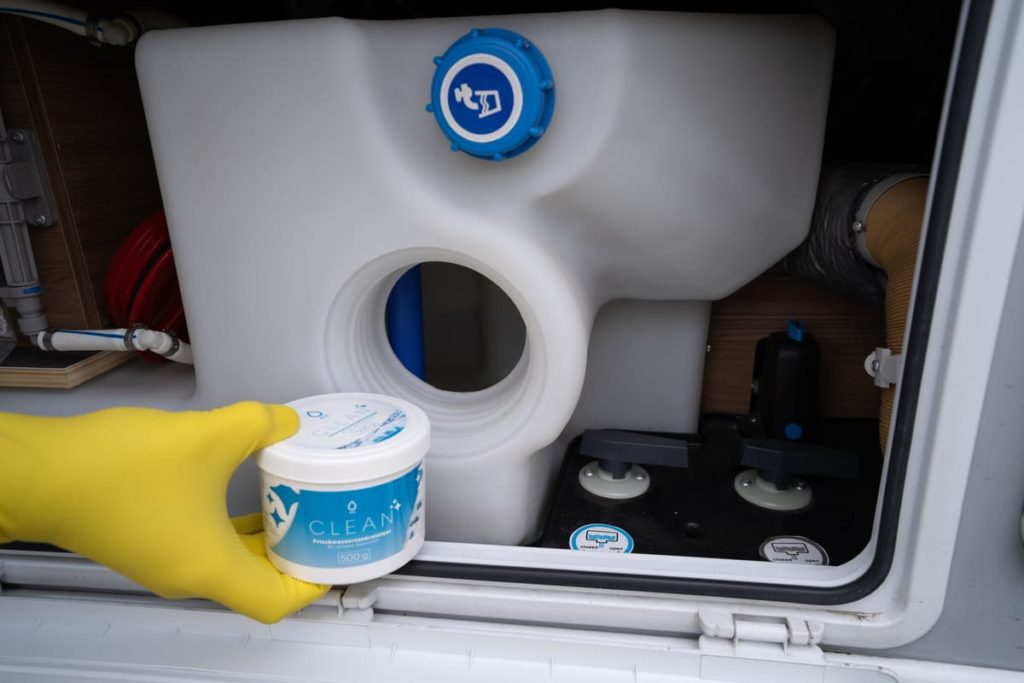
Even though bacteria are reliably filtered out by the germ barrier, it is strongly advisable to keep the water system as a whole at a hygienically safe level.
Cleaning should be done at least once per season – this also extends the life of the filters, because less contaminated water means they clog less quickly.
Find out here how to clean your fresh water system properly:
Conclusion on Pressure in Water Filtration
As so often, the design of the overall system determines whether the individual components work satisfactorily. With mechanical water filtration, it is in the nature of things that sufficient pressure has to be provided – especially when the first retained dirt in the filter is already causing even higher back pressure.
Unfortunately, the finer the filtration, the bigger the problem.
In our example of Alb Filter, a pressure of 2 bar for the single cartridge and 3.2 bar for the double housing should therefore not be undercut.
When building the water system, you therefore need to choose a suitable pump, and make sure the rest of the components withstand this pressure or are protected from it by suitable measures.
Please also do not forget regular cleaning of the entire system, which also helps ensure good flow through the filters over the long term.
Did this article on pressure in water filtration for motorhomes help you? Then feel free to share it with like-minded people who would also find this information interesting!
These articles might also be interesting for you: