Plug it in and done? That’s one easy way to go about charging via USB in a motorhome, but you may then have to put up with longer charging times or other drawbacks of suboptimal USB charging options.
This article is for you if you’d rather get the maximum performance out of your mobile power system. Here we dive into the technical aspects of USB charging. You’ll learn which requirements have to be met for optimal charging and how you can even satisfy a power-hungry laptop on the 12V onboard system via USB.
Ready? Then power ON!
USB Charging in a Motorhome: The Basics
The 12V onboard system in a motorhome provides a reliable power supply for a wide range of devices. Charging via USB is a convenient and simple way to charge devices without an inverter or shore power.
That’s why USB ports are now standard equipment in most modern motorhomes. Nevertheless, there are some differences and technical basics to keep in mind so that everything works the way you’d expect.
How a USB Charger Works in a 12V Motorhome System
A USB charger connected to the 12V system of a motorhome works by converting the DC voltage stored in the vehicle battery into a form suitable for electronic devices.
For this it uses a voltage converter that transforms the input voltage into the 5V DC that USB devices (mostly) need.
The stable 5V DC produced in the charger is passed on to the charger’s USB ports to charge connected devices safely and efficiently.
Which Devices Can I Charge via USB in a Motorhome?
USB ports normally provide an output voltage of 5 volts at up to 2.4 amps (12 watts). This is enough to charge many common devices in a motorhome, including smartphones, tablets, cameras, portable speakers or batteries, for example for a drone, and so on.
Which Devices Can’t I Charge, or Only to a Limited Extent?
Some modern devices such as smartphones and tablets have fast-charging features with higher power requirements. These devices are usually compatible with fast-charging standards such as Quick Charge or Power Delivery. Powerful laptops are also a special challenge and can only be charged in a motorhome via an inverter and power supply or a special adapter.
To charge laptops and devices with fast-charging protocols (quickly) via USB in a motorhome, you need a charger that supports these standards. As mentioned above, USB chargers convert 12V to 5V – in this case, however, voltages well above 12V are needed.
To regulate the 12V up rather than down, you need a USB charger with buck-boost technology. We will come back to this in more detail below.
Which USB Connectors Are There, Anyway?
There are various types of USB ports, or connector types, that have been developed over time to meet the needs of different devices and technologies. For charging via USB in a motorhome, the following are the most relevant:
USB-A
This is the classic USB port that most people know. It is rectangular and is often used as a host port to connect devices such as computers, laptops or USB hubs with other devices, transferring data and electrical power.
The USB-A port usually delivers fairly limited power. At 5V, the current in the 12V system is 0.5 amps, which means we get 2.5 watts of power.
USB-C
USB-C is a modern, universal connector found in many current devices. It has a symmetrical shape, which means there is no “right” or “wrong” way around and it can be plugged in either way.
USB-C ports support high data transfer rates and fast charging and are versatile. They are widespread in laptops, smartphones, tablets, monitors and other modern electronic devices.
Unlike USB-A, USB-C ports can deliver up to 100 watts.
Micro USB and Others
It is smaller and flatter than USB-A and used to be common on mobile phones and tablets. However, it never became as widespread, because it was quickly replaced by USB-C. Mini USB is now also less common.
Besides these USB ports, which are the most important for us, there are a few more such as USB-B, USB 3.x or USB On-The-Go. They only help us to a limited extent when it comes to “charging via USB”, since they are mainly ports for data transfer.

USB Charging Cables – More Than a Simple Conductor
The role of the cable is often underestimated – besides the device, which may request fast charging, and the corresponding charging socket that could deliver it, the cable must also support it.
Various factors can lead to considerable differences in performance and in the compatibility of USB cables with certain devices. It can go so far that a particular cable charges one device super fast while not working at all with another. These factors include manufacturer-specific differences in coding, but also the quality of the cables and the USB standards they support. The following factors often cause problems:
Manufacturer-Specific Standards
Different manufacturers implement their own standards and protocols for charging and data transfer over USB cables. Apple, for example, uses the Lightning connector and the MFi program (Made for iPhone/iPad), while Android devices support USB-C and various fast-charging standards such as Quick Charge or Power Delivery.
This leads to incompatibilities between cables and devices from different manufacturers.
Fast Charging
If you want to use fast charging, you have to make sure that all three components, that is, the device, the charger AND the cable, support this function.
A fast-charging cable can work more slowly with a conventional charger, and vice versa.
Quality
Cheap, low-quality USB cables can be more prone to damage and performance problems. It’s better to use high-quality cables to ensure a reliable connection and a longer service life.
Using USB Adapters and Converters
Sometimes it is necessary to use USB adapters or converters to connect different USB connector types. This can improve compatibility between devices and cables, but it also means choosing suitable adapters.
There Is No Such Thing as THE USB Cable
Because of the many differences and codings among manufacturers, there really is no “THE USB cable”. It is crucial to understand that USB cables are not universally interchangeable, and what matters is always to use exactly the cable that connects a particular device optimally with a particular charger.
Because USB cables serve several purposes (transferring (charging) energy and transferring data), the thickness of the cable also tells you nothing about whether it can, for example, charge quickly or not.
Recommendation:
Because of the different standards and codings mentioned above: it is best to always use the cable / accessories recommended or supplied by the manufacturer. Only then can optimal performance be guaranteed.
USB Chargers for Motorhomes
Various types of USB chargers can be used in the 12V system of a motorhome. Common types of USB chargers include:
Cigarette Lighter Adapters
These are small devices that plug into the cigarette lighter socket or other 12V sockets in the motorhome. They usually have USB output ports to which USB cables are connected to charge devices.
Cigarette lighter adapters are easy to install and often offer several USB ports. An existing cigarette lighter, for example in the driver’s area, can thus be used to charge devices easily and without new wiring or installation.
12V USB Sockets
USB sockets make it possible to charge devices directly via USB cables without needing additional adapters.
This type of charging socket, such as our USB sockets from the tigerexped power parts series, can be integrated into the vehicle fit-out and offers a clean, professional look.
Special Case – USB Socket with Buck-Boost (Charging / Running a Laptop via USB on 12V)
As described above, charging powerful laptops, tablets, or charging with protocols such as PD3.0 or Quick Charge is a problem in a 12V system.
Such devices often require more electrical power, in terms of both voltage and current, than a standard 12V onboard system can normally deliver. This is where inverters and power supplies or bulky adapters usually come in, which can make the electrical installation unnecessarily complex and expensive.
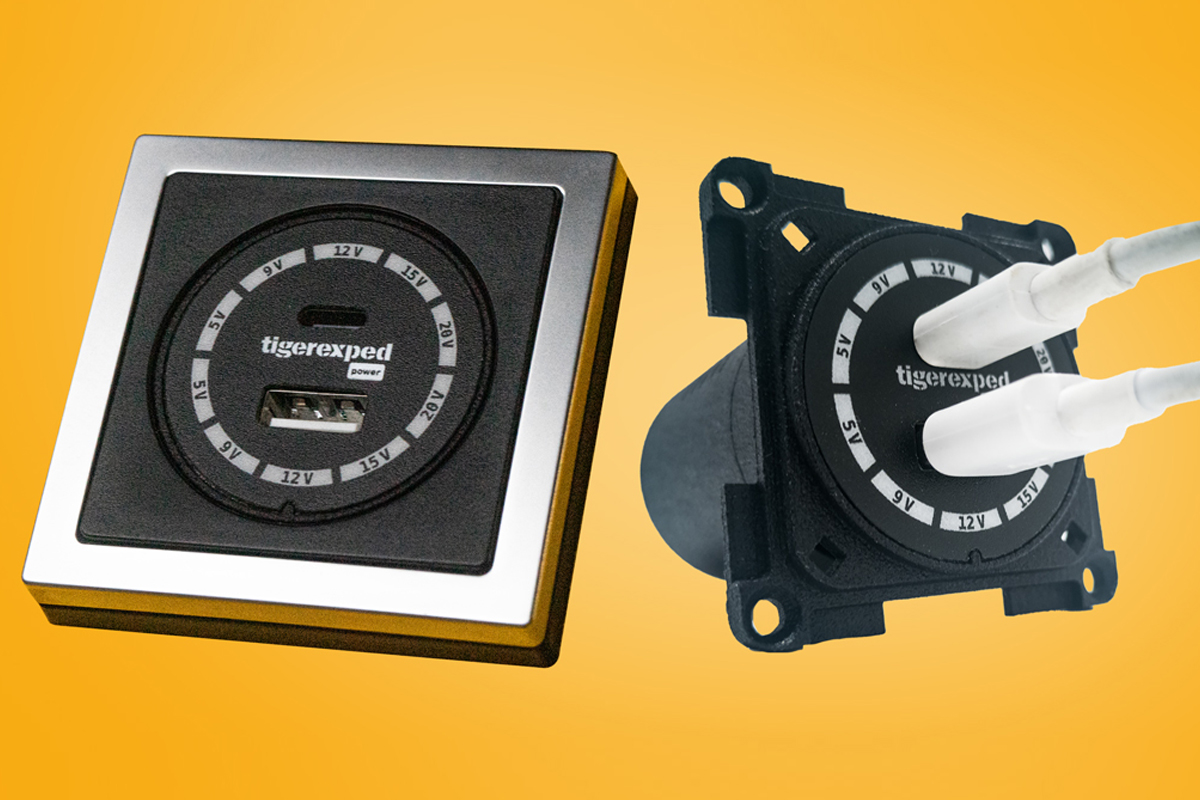
Our USB-C socket with buck-boost technology solves this problem without the detour of converting to AC. Equipped with intelligent charging technology, it adjusts the charging power to the device in question to charge it optimally. When the device and cable request it, it boosts the 12V input voltage to up to 20V / 5A (100W max.) at the USB-C output. This finally makes the fast-charging protocols usable without problems in the 12V system, too.
Avoiding an inverter also saves valuable power reserves, because an inverter consumes energy not only in standby but also a certain percentage of the power drawn to convert it into the required AC. Some van builders may even be able to do without the inverter entirely.
Calculation Example: Charging with an Inverter vs. Buck-Boost USB-C
The standby consumption of the USB socket is negligibly small, namely 3.12Wh per 24h. It can therefore be ready for use at all times.
A phone battery holds roughly 10-15Wh. If you charge your phone with the USB socket, that is about 15-20Wh including the socket’s standby for 24h. But if you use an inverter and don’t dutifully switch it on only for charging and off again right afterward, then after 2h of charging there are 22h of idling at 10-20W standby – so 220-440Wh wasted for 15Wh in the battery.
If you are very disciplined and only switch the inverter on when you are really charging, you end up with 15Wh that fit in the battery + about 5-10% for converting the power + the standby that probably still accrues over 2h, so another 20-40Wh – which makes 15Wh vs. about 55Wh. That doesn’t hurt quite as much – but let’s be honest: who is that disciplined?
What Does This Difference Mean for You in Practice?
A 12V 100Ah LiFePo4 battery holds 1280Wh of energy. With 100Wp of solar on the roof, you get about 430Wh of charge per day in June in Germany – in September still 250Wh. That means that in June you already need 50-100W of solar just for the 24h standby operation of the inverter. In September you already need 100-200W for it – and haven’t charged a single device yet!
With a 30A DC-DC charger (battery-to-battery), you have to drive 1-2h per day to recharge that!

Want to learn more about solar, charging via DC-DC charger (battery-to-battery) and power concepts for off-grid travel in general? Then these articles are sure to interest you:
So clear advantages when charging via USB.
Our USB buck-boost charger convertiger 100 also fits into the Inprojal 20.000 installation system popular with many manufacturers and thus blends seamlessly into the look of the vehicle fit-out. The system also offers the advantage of a spacer frame that can reduce the installation depth in the wall.

Charge laptops etc. with up to 20V / 5A (100W max.) at 12V onboard voltage!
Devices with USB Outputs (e.g. Solar Charge Controllers)
There are devices such as solar charge controllers with built-in USB outputs. Whether the mounting location is also a suitable place where you want to charge your devices is another question, though.
Since charging via USB directly from the sun is generally a good idea (solar cells produce direct current), our big tiger 160 solar bag also offers integrated USB-A ports, right in the handle of the bag. This way you can even charge devices directly from the sun and entirely without the detour via the vehicle.
GaN Chargers with USB Ports
GaN chargers use gallium nitride (GaN) as the semiconductor material, which helps improve efficiency and performance compared to conventional silicon-based chargers. However, they are used mainly on the AC side (at 230V), so you first need an inverter in the vehicle or have to connect the vehicle to shore power with a corresponding “pass-through”. With an internal converter, the GaN chargers then produce again the direct current that the leisure batteries had actually already produced.
Their advantage is that, thanks to gallium nitride, they can convert to the required form of energy especially efficiently and with little loss. They are also particularly small and can charge devices with high power requirements, such as laptops, gaming laptops and other high-end electronics where fast and efficient charging matters.
Conclusion and Key Takeaways on USB Charging in a Motorhome
Choosing the right USB charging equipment and paying attention to compatibility requirements are crucial to maximizing performance and efficiency when charging devices in a motorhome.
Most devices such as smartphones and tablets can be charged via USB ports in a motorhome, because USB chargers convert the vehicle battery’s DC voltage into a suitable 5V DC.
Powerful laptops or devices with fast-charging features, however, require special USB chargers that can both deliver more power and communicate accordingly with the requesting devices and cables.
Most important in any case is the use of compatibly coded components. For optimal charging, charger, cable and device have to “speak the same language”.
Did this article answer your questions? Share it with friends or other camper enthusiasts who are facing the same problems!
You might also be interested in these topics: